Department of Laboratory Medicine, Yale School of Medicine, 330 Cedar Street, New Haven, CT, 06520, USA.
Departments of Laboratory Medicine and Pathology, Yale School of Medicine, New Haven, CT, USA.
J Thromb Thrombolysis. 2022 May;53(4):945-949. doi: 10.1007/s11239-021-02591-4. Epub 2021 Oct 25.
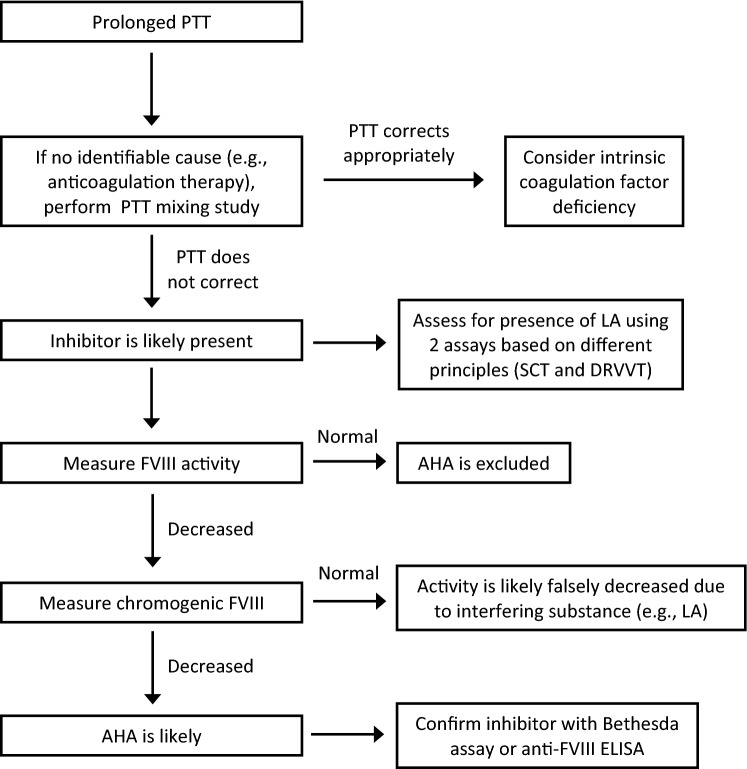
Acquired hemophilia A, caused by autoantibodies that bind to and neutralize the activity of coagulation factor VIII (FVIII), almost universally presents as a severe bleeding diathesis. Lupus anticoagulants (LAs), autoantibodies directed against phospholipids or protein-phospholipid complexes, manifest clinically with an increased risk of thrombosis. While these autoantibodies are uncommon, the distinctive clinical presentation in conjunction with the typical laboratory findings often enable straightforward identification of the underlying autoantibody. However, the presence of a concomitant acquired FVIII inhibitor and LA is exceedingly rare with fewer than 20 documented cases. All prior patients presented with life-threatening hemorrhage, thrombosis, or both, prompting comprehensive hematologic evaluation and subsequent identification of the pathologic antibodies. We describe a novel case of a patient with no signs of hemorrhage or thrombosis who was incidentally found to have both a FVIII inhibitor and LA during evaluation of a prolonged partial thromboplastin time (PTT). This finding resulted in FVIII inhibitor-directed management, including immunosuppressive therapy. The unique presentation of an incidental FVIII inhibitor and LA in an asymptomatic patient without thrombotic or bleeding complications highlights the potential challenge in elucidating the etiology of a prolonged PTT, as LAs and FVIII inhibitors both prolong the PTT, and each entity can interfere with assays designed to detect the presence of the other autoantibody. This case underscores the importance of recognizing that patients with major underlying disturbances in their hematologic physiology, but in whom clinical symptoms have yet to manifest, may potentially be overlooked until such symptoms are evident.
获得性血友病 A 是由自身抗体结合并中和凝血因子 VIII (FVIII) 的活性引起的,几乎普遍表现为严重的出血倾向。狼疮抗凝物 (LA) 是针对磷脂或蛋白-磷脂复合物的自身抗体,临床上表现为血栓形成风险增加。虽然这些自身抗体并不常见,但独特的临床表现结合典型的实验室发现,通常能够直接识别潜在的自身抗体。然而,同时存在获得性 FVIII 抑制剂和 LA 的情况极为罕见,仅有不到 20 例有记录的病例。所有之前的患者都出现了危及生命的出血、血栓形成或两者兼有,促使进行全面的血液学评估,并随后确定病理性抗体。我们描述了一例新病例,患者既没有出血也没有血栓形成的迹象,但在评估延长的部分凝血活酶时间 (PTT) 时偶然发现同时存在 FVIII 抑制剂和 LA。这一发现导致了针对 FVIII 抑制剂的管理,包括免疫抑制治疗。在没有血栓形成或出血并发症的无症状患者中偶然发现的 FVIII 抑制剂和 LA 的独特表现,突出了阐明延长 PTT 病因的潜在挑战,因为 LA 和 FVIII 抑制剂都会延长 PTT,并且每种自身抗体都会干扰旨在检测另一种自身抗体的检测。这个病例强调了认识到那些主要的血液生理紊乱但尚未出现临床症状的患者的重要性,这些患者可能会被忽视,直到出现这些症状。