Czelusniak Olivia, Favreau Emily, Ives Stephen J
Health and Human Physiological Sciences Department, Skidmore College, Saratoga Springs, NY 12866, USA.
J Funct Morphol Kinesiol. 2021 Oct 19;6(4):85. doi: 10.3390/jfmk6040085.
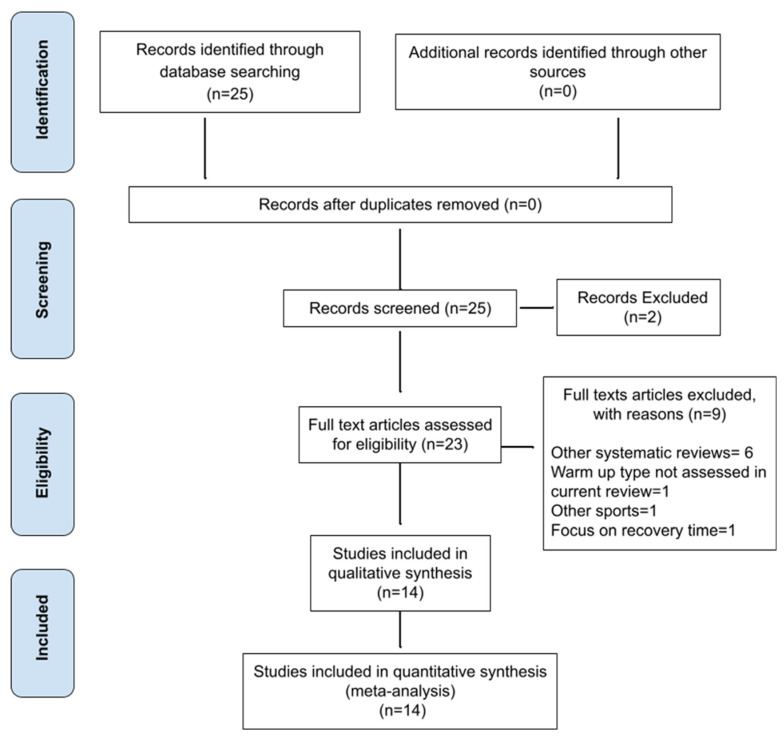
(1) Background: warm-ups precede physical exertion and has been shown to have positive and negative effects on performance. Positive effects include elevating body temperature, heart rate, and VO. Negative effects include increasing fatigue and blood lactate concentration. The most effective warm-up format is still unknown, particularly in competitive swimming. The purpose of this systematic review was to determine the most beneficial warm-up for maximal performance in sprint swimming events; (2) Methods: a structured search was carried out following the Preferred Reporting Items for Systematic review and Meta-Analyses (PRISMA) guidelines in the PubMed, SportDiscus, and Google Scholar databases until March 2021. Studies with double-blind and randomized designs in which different types of warm-up were compared to each other or an identical placebo condition (no warm-up) were considered. Fourteen published studies were included. The effects of warm-up on sprint swimming performance, rating of perceived exertion (RPE) and blood lactate concentration (La) were investigated. (3) Results: in half of the studies, swimmers performed significantly better after a regular warm-up; however, the effect of warm-up on performance was small. Warm-ups had a medium to large effect on RPE and a small to medium effect on La. (4) Conclusions: the findings of this review suggest that warm-ups do influence performance, although the magnitude is small. Future studies are needed in larger populations to clarify whether warm ups improve swim performance, to what extent, and the potential role of variables related to participant characteristics and swimming competitions.
(1) 背景:热身活动在体力消耗之前进行,已被证明对运动表现有积极和消极影响。积极影响包括提高体温、心率和摄氧量。消极影响包括增加疲劳感和血乳酸浓度。最有效的热身形式仍然未知,尤其是在竞技游泳中。本系统综述的目的是确定在短距离游泳项目中实现最佳表现的最有益热身方式;(2) 方法:按照系统综述和Meta分析的首选报告项目(PRISMA)指南,在PubMed、SportDiscus和谷歌学术数据库中进行结构化检索,直至2021年3月。纳入比较不同类型热身或与相同安慰剂条件(无热身)的双盲和随机设计研究。共纳入14项已发表研究。研究了热身对短距离游泳表现、主观用力程度评分(RPE)和血乳酸浓度(La)的影响。(3) 结果:在一半的研究中,游泳运动员在常规热身之后表现显著更好;然而,热身对表现的影响较小。热身对RPE有中等到较大的影响,对La有小到中等的影响。(4) 结论:本综述结果表明,热身确实会影响表现,尽管影响程度较小。未来需要在更大规模人群中开展研究,以阐明热身是否能提高游泳表现、提高的程度以及与参与者特征和游泳比赛相关变量的潜在作用。