Environmental Systems Analysis Group, Wageningen University & Research, Wageningen, the Netherlands.
Nutrient Management Institute, Wageningen, the Netherlands.
Glob Chang Biol. 2022 Feb;28(3):899-917. doi: 10.1111/gcb.15960. Epub 2021 Nov 20.
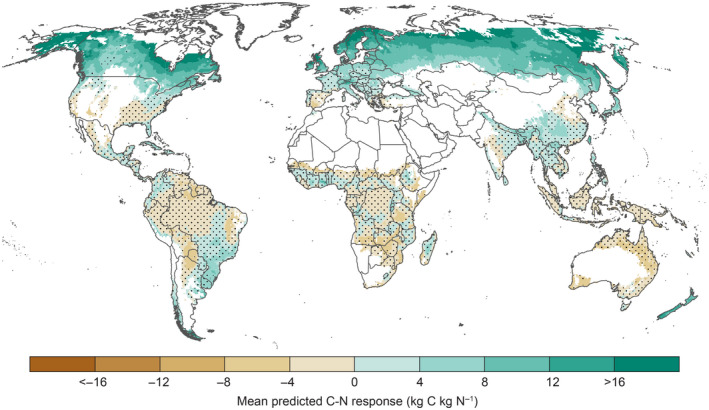
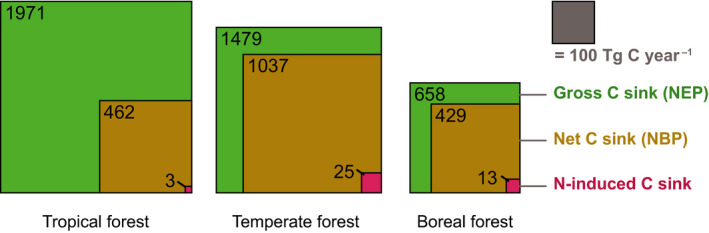
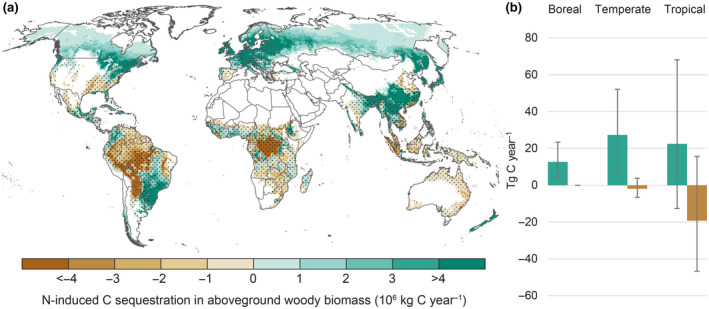
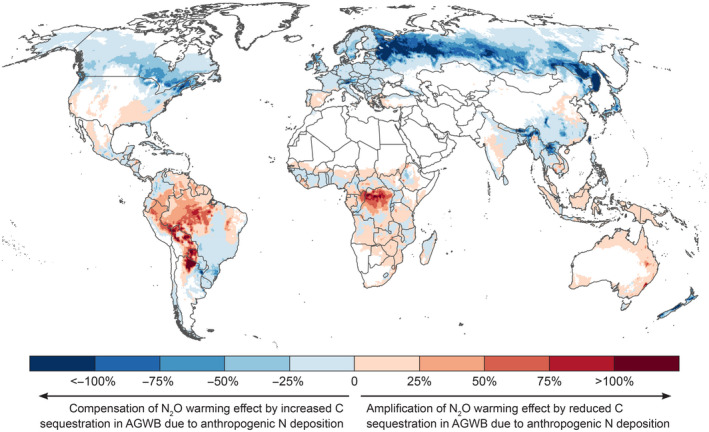
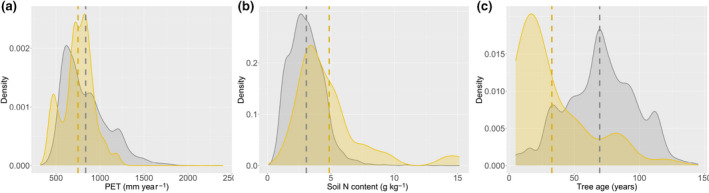
Human activities have drastically increased nitrogen (N) deposition onto forests globally. This may have alleviated N limitation and thus stimulated productivity and carbon (C) sequestration in aboveground woody biomass (AGWB), a stable C pool with long turnover times. This 'carbon bonus' of human N use partly offsets the climate impact of human-induced N O emissions, but its magnitude and spatial variation are uncertain. Here we used a meta-regression approach to identify sources of heterogeneity in tree biomass C-N response (additional C stored per unit of N) based on data from fertilization experiments in global forests. We identified important drivers of spatial variation in forest biomass C-N response related to climate (potential evapotranspiration), soil fertility (N content) and tree characteristics (stand age), and used these relationships to quantify global spatial variation in N-induced forest biomass C sequestration. Results show that N deposition enhances biomass C sequestration in only one-third of global forests, mainly in the boreal region, while N reduces C sequestration in 5% of forests, mainly in the tropics. In the remaining 59% of global forests, N addition has no impact on biomass C sequestration. Average C-N responses were 11 (4-21) kg C per kg N for boreal forests, 4 (0-8) kg C per kg N for temperate forests and 0 (-4 to 5) kg C per kg N for tropical forests. Our global estimate of the N-induced forest biomass C sink of 41 (-53 to 159) Tg C yr is substantially lower than previous estimates, mainly due to the absence of any response in most tropical forests (accounting for 58% of the global forest area). Overall, the N-induced C sink in AGWB only offsets ~5% of the climate impact of N O emissions (in terms of 100-year global warming potential), and contributes ~1% to the gross forest C sink.
人类活动极大地增加了全球森林的氮(N)沉积。这可能缓解了 N 的限制,从而刺激了地上木质生物量(AGWB)的生产力和碳(C)固存,AGWB 是一个具有长周转时间的稳定 C 库。人类对 N 的利用产生的这种“碳红利”部分抵消了人为 N O 排放对气候的影响,但它的幅度和空间变化尚不确定。在这里,我们使用元回归方法,根据全球森林施肥实验的数据,确定树木生物量 C-N 响应(每单位 N 存储的额外 C)的异质性来源。我们确定了与气候(潜在蒸散量)、土壤肥力(N 含量)和树木特征(林分年龄)相关的森林生物量 C-N 响应空间变化的重要驱动因素,并利用这些关系量化了全球范围内 N 诱导的森林生物量 C 固存的空间变化。结果表明,N 沉积仅在全球三分之一的森林中增强了生物量 C 的固存,主要在北方地区,而在全球 5%的森林中,N 减少了 C 的固存,主要在热带地区。在其余 59%的全球森林中,N 添加对生物量 C 固存没有影响。北方森林的平均 C-N 响应为每千克 N 增加 11(4-21)千克 C,温带森林为每千克 N 增加 4(0-8)千克 C,热带森林为每千克 N 增加 0(-4 至 5)千克 C。我们对全球森林生物量 C 汇的 N 诱导估计为 41(-53 至 159)Tg C yr,明显低于以前的估计,主要是因为大多数热带森林(占全球森林面积的 58%)没有任何响应。总体而言,AGWB 中 N 诱导的 C 汇仅抵消了 N O 排放气候影响的 5%(以 100 年全球变暖潜能值计),并为森林总 C 汇贡献了 1%左右。