McArdle Laboratory for Cancer Research, University of Wisconsin School of Medicine and Public Health, Madison, WI.
Division of Hematology, Department of Internal Medicine, Mayo Clinic, Rochester, MN.
Blood. 2022 Feb 17;139(7):1066-1079. doi: 10.1182/blood.2021012519.
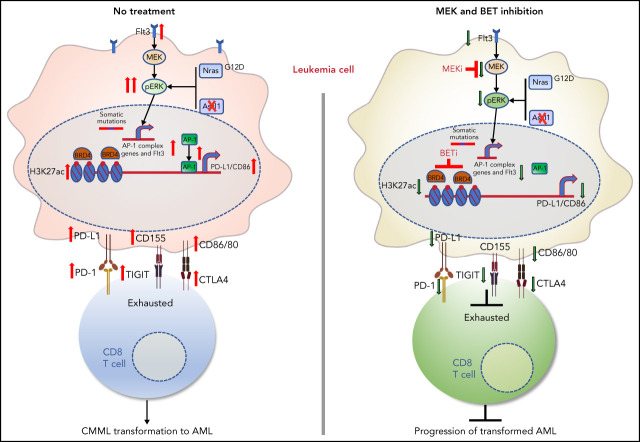
Mutations in chromatin regulator ASXL1 are frequently identified in myeloid malignancies, in particular ∼40% of patients with chronic myelomonocytic leukemia (CMML). ASXL1 mutations are associated with poor prognosis in CMML and significantly co-occur with NRAS mutations. Here, we show that concurrent ASXL1 and NRAS mutations defined a population of CMML patients who had shorter leukemia-free survival than those with ASXL1 mutation only. Corroborating this human data, Asxl1-/- accelerated CMML progression and promoted CMML transformation to acute myeloid leukemia (AML) in NrasG12D/+ mice. NrasG12D/+;Asxl1-/- (NA) leukemia cells displayed hyperactivation of MEK/ERK signaling, increased global levels of H3K27ac, upregulation of Flt3. Moreover, we find that NA-AML cells overexpressed all the major inhibitory immune checkpoint ligands: programmed death-ligand 1 (PD-L1)/PD-L2, CD155, and CD80/CD86. Among them, overexpression of PD-L1 and CD86 correlated with upregulation of AP-1 transcription factors (TFs) in NA-AML cells. An AP-1 inhibitor or short hairpin RNAs against AP-1 TF Jun decreased PD-L1 and CD86 expression in NA-AML cells. Once NA-AML cells were transplanted into syngeneic recipients, NA-derived T cells were not detectable. Host-derived wild-type T cells overexpressed programmed cell death protein 1 (PD-1) and T-cell immunoreceptor with immunoglobulin and ITIM domains (TIGIT) receptors, leading to a predominant exhausted T-cell phenotype. Combined inhibition of MEK and BET resulted in downregulation of Flt3 and AP-1 expression, partial restoration of the immune microenvironment, enhancement of CD8 T-cell cytotoxicity, and prolonged survival in NA-AML mice. Our study suggests that combined targeted therapy and immunotherapy may be beneficial for treating secondary AML with concurrent ASXL1 and NRAS mutations.
染色质调节因子 ASXL1 的突变在髓系恶性肿瘤中经常被发现,特别是在约 40%的慢性粒单核细胞白血病(CMML)患者中。ASXL1 突变与 CMML 的不良预后相关,并与 NRAS 突变显著相关。在这里,我们表明,ASXL1 和 NRAS 同时突变定义了一个 CMML 患者群体,与仅存在 ASXL1 突变的患者相比,这些患者的无白血病生存期更短。与这些人类数据一致,Asxl1-/-加速了 CMML 的进展,并促进了 NrasG12D/+ 小鼠中的 CMML 向急性髓系白血病(AML)的转化。NrasG12D/+;Asxl1-/-(NA)白血病细胞表现出 MEK/ERK 信号的过度激活、H3K27ac 水平的整体升高、Flt3 的上调。此外,我们发现 NA-AML 细胞过度表达了所有主要的抑制性免疫检查点配体:程序性死亡配体 1(PD-L1)/PD-L2、CD155 和 CD80/CD86。其中,PD-L1 和 CD86 的过度表达与 NA-AML 细胞中 AP-1 转录因子(TFs)的上调相关。AP-1 抑制剂或针对 AP-1 TF Jun 的短发夹 RNA 降低了 NA-AML 细胞中 PD-L1 和 CD86 的表达。一旦 NA-AML 细胞被移植到同基因受体中,就无法检测到源自 NA 的 T 细胞。源自宿主的野生型 T 细胞过度表达程序性细胞死亡蛋白 1(PD-1)和 T 细胞免疫受体含免疫球蛋白和 ITIM 结构域(TIGIT)受体,导致耗尽的 T 细胞表型占主导地位。MEK 和 BET 的联合抑制导致 Flt3 和 AP-1 表达的下调,部分恢复免疫微环境,增强 CD8 T 细胞的细胞毒性,并延长 NA-AML 小鼠的存活时间。我们的研究表明,联合靶向治疗和免疫疗法可能对治疗伴有 ASXL1 和 NRAS 突变的继发性 AML 有益。