Pranggono Emmy Hermiyanti, Tiara Marita Restie, Pamungkas Tohari Catur, Syafriati Esti, Mutyara Kuswandewi, Wisaksana Rudi
Department of Internal Medicine, Hasan Sadikin General Hospital/Universitas Padjadjaran, Jl. Pasteur No. 38 Bandung, West Java, Indonesia.
Faculty of Medicine, Universitas Padjadjaran, Jl. Eyckman No. 38 Bandung, West Java, Indonesia.
Brain Behav Immun Health. 2021 Oct 5;18:100362. doi: 10.1016/j.bbih.2021.100362. eCollection 2021 Dec.
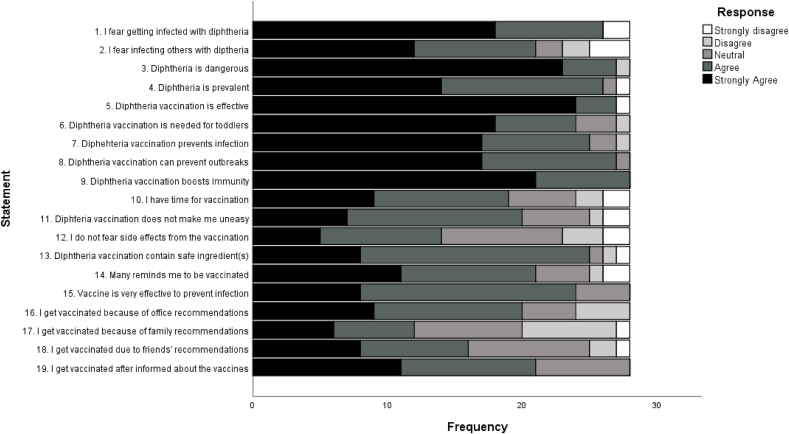
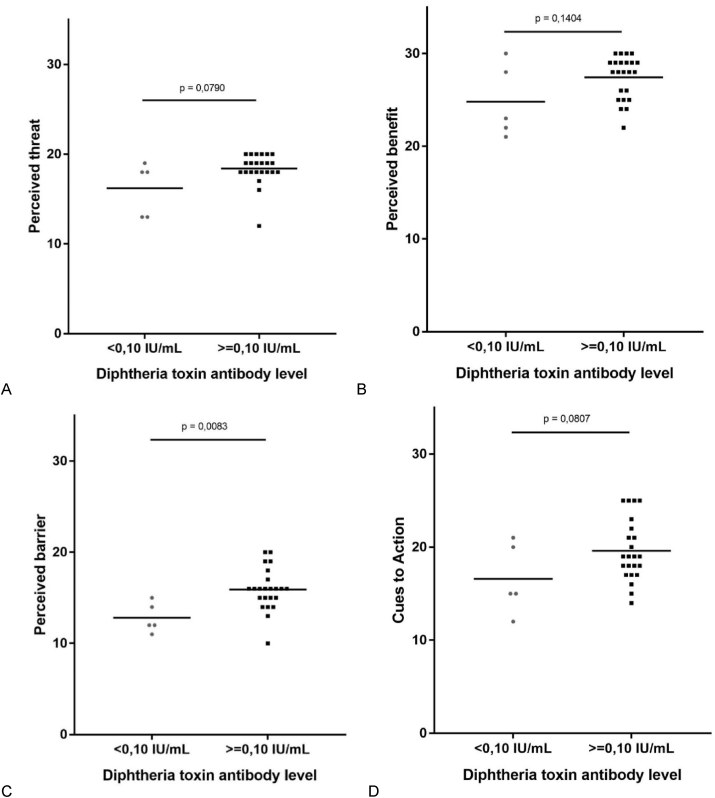
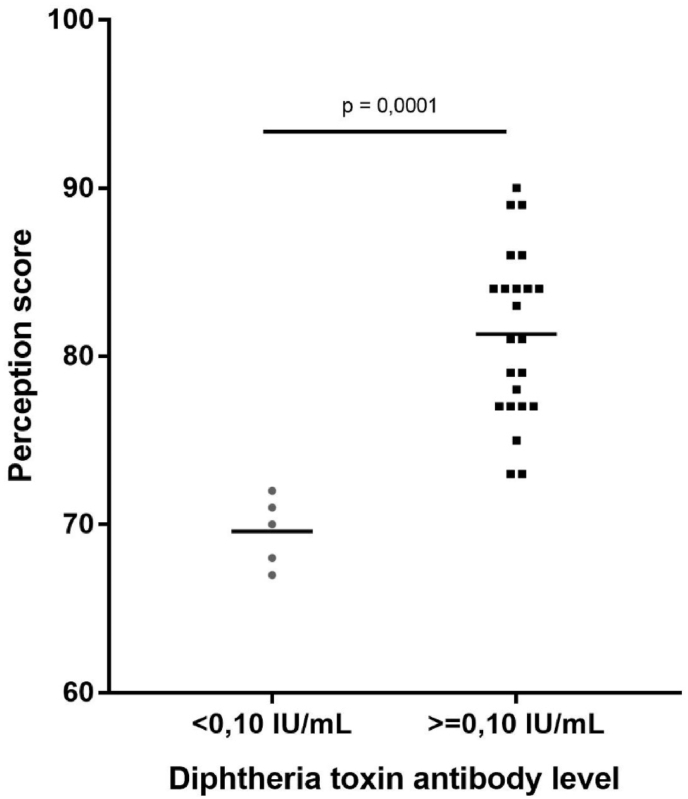
Negative perception towards vaccination is one of the reasons for low coverage of diphtheria immunization in Indonesia. Perception, which is difficult to change, is related to stress level, possibly influences outcome of diseases, and also vaccination. This study aims to identify the correlation between perception of diphtheria vaccination and antibody response after vaccination. This study used secondary data from two unpublished studies on 30 medical interns in Hasan Sadikin Hospital, Bandung, West Java, after diphtheria outbreak, from June to July 2019. Antibody level after diphtheria emergency vaccination was measured using ELISA and perception towards vaccination was measured using a questionnaire. Perception towards vaccination was expressed as perception score and was divided into 4 components: perceived threat, benefit, barrier, and cues to action. Higher perception score indicated more positive perception towards vaccination. Diphtheria antibody level was grouped into reliable protection (≥0,10 IU/mL) or unreliable protection (<0,10 IU/mL). Statistical correlation analysis was done with GraphPad Prism version 7.0. Most of our subjects were female. Median age was 22 (20-24) years old. Median time elapsed between vaccination date and measurement of antibody level was 18 (6-18) months. Median antibody level was 0,28 (0,09-3,47) IU/mL. Twenty-three subjects (82,1%) had reliable protection. Subjects with reliable protection had more positive perception compared to unreliable protection (perception score 80,6 ± 5,4 vs 69,0 ± 1,8, = 0,0001). Subjects with reliable protection had less perceived barrier for vaccination (15,6 ± 2,1 vs 13,0 ± 1,8, = 0,0083). Perception score showed strong, positive correlation to reliable protection against diphtheria (R = 0,705, p < 0,001). Perceived barrier and threat showed positive correlation to reliable protection (R = 0,489, p = 0,008 and R = 0,402, p = 0,034). In conclusion, perception towards diphtheria vaccination is strongly correlated to protective antibody. Improving perception of vaccination are needed to overcome vaccine hesitancy.
对疫苗接种的负面认知是印度尼西亚白喉免疫接种覆盖率低的原因之一。难以改变的认知与压力水平有关,可能影响疾病的转归,也与疫苗接种有关。本研究旨在确定对白喉疫苗接种的认知与接种后抗体反应之间的相关性。本研究使用了来自两项未发表研究的二手数据,这两项研究针对西爪哇省万隆哈桑·萨迪金医院的30名医学实习生,研究时间为2019年6月至7月白喉疫情爆发后。使用酶联免疫吸附测定法(ELISA)测量白喉紧急疫苗接种后的抗体水平,并使用问卷测量对疫苗接种的认知。对疫苗接种的认知用认知得分表示,分为4个组成部分:感知威胁、益处、障碍和行动线索。较高的认知得分表明对疫苗接种的认知更积极。白喉抗体水平分为可靠保护(≥0.10 IU/mL)或不可靠保护(<0.10 IU/mL)。使用GraphPad Prism 7.0版本进行统计相关性分析。我们的大多数受试者为女性。中位年龄为22(20 - 24)岁。接种日期与抗体水平测量之间的中位时间间隔为18(6 - 18)个月。中位抗体水平为0.28(0.09 - 3.47)IU/mL。23名受试者(82.1%)具有可靠保护。与无可靠保护的受试者相比,有可靠保护的受试者认知更积极(认知得分80.6 ± 5.4 vs 69.0 ± 1.8,P = 0.0001)。有可靠保护的受试者对疫苗接种的感知障碍较少(15.6 ± 2.1 vs 13.0 ± 1.8,P = 0.0083)。认知得分与对白喉的可靠保护呈强正相关(R = 0.705,P < 0.001)。感知障碍和威胁与可靠保护呈正相关(R = 0.489,P = 0.008和R = 0.402,P = 0.034)。总之,对白喉疫苗接种的认知与保护性抗体密切相关。需要提高对疫苗接种的认知以克服疫苗犹豫。