
体育博彩机会对人力资本形成的负面影响:来自西班牙的证据。
The negative consequences of sports betting opportunities on human capital formation: Evidence from Spain.
机构信息
Department of Social and Political Sciences, European University Institute, Fiesole, Italy.
出版信息
PLoS One. 2021 Oct 27;16(10):e0258857. doi: 10.1371/journal.pone.0258857. eCollection 2021.
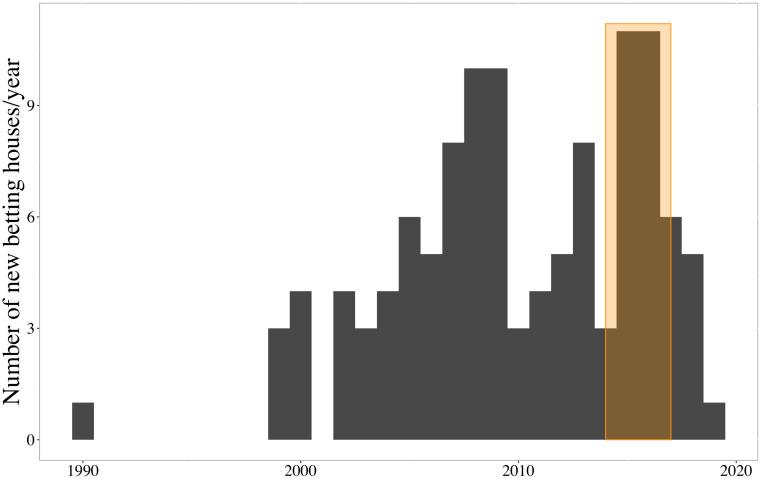
The proliferation of on-site betting shops has received enormous public attention, becoming one of the most alarming health policy issues in contemporary cities. However, there is little evidence on whether its growing presence nearby vulnerable populations produce social harm beyond its known adverse individual effects. This study provides new evidence on the negative societal effects of betting houses. Our research design takes advantage of a new wave of openings in Madrid (Spain), which created a sudden increase in the supply of on-site gambling. Using a differences-in-differences design, we find that new betting houses decline nearby high schools' educational performance, especially in public schools in less advantaged areas. This effect is neither trivial nor diminishing with time. This evidence suggests that betting houses increase inequality of educational opportunities. The ubiquity of betting houses around vulnerable populations in multiple regions drives us to think that these findings have relevant policy implications for many countries currently designing policies tackling the increase of problem gambling.
现场投注店的泛滥引起了公众的极大关注,成为当代城市中最令人担忧的健康政策问题之一。然而,几乎没有证据表明,其在弱势人群附近的存在除了已知的对个人的不良影响之外,是否会产生社会危害。本研究提供了关于投注屋的负面社会影响的新证据。我们的研究设计利用了马德里(西班牙)新开的一轮投注店这一机会,这突然增加了现场赌博的供应。通过使用双重差分设计,我们发现新的投注店降低了附近高中的教育绩效,尤其是在条件较差地区的公立学校。这种影响既不小,也不会随着时间的推移而减弱。这一证据表明,投注店增加了教育机会的不平等。在多个地区,投注店普遍存在于弱势人群附近,这让我们认为,对于目前正在制定政策以应对赌瘾增加的许多国家来说,这些发现具有相关的政策意义。



 Zotero 插件