Faculty of Social Sciences, Tampere University, 33014 Tampere, Finland.
Department of Social Sciences and Philosophy, University of Jyväskylä, 40014 Jyväskylä, Finland.
Int J Environ Res Public Health. 2021 Mar 20;18(6):3220. doi: 10.3390/ijerph18063220.
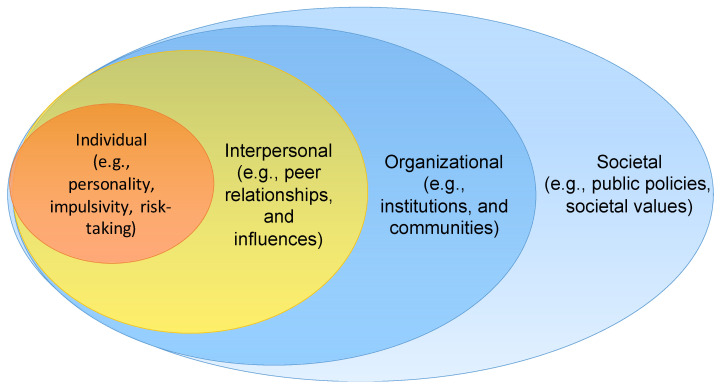
Problem gambling among young people is an emerging trend globally. The online environment in particular offers various possibilities for gambling engagement. This is the first cross-national survey study using the social ecological model to analyze problem gambling, especially in the online context. The study aimed to analyze how different social ecological spheres explain problem gambling. Participants were young people aged 15-25 in the United States ( = 1212), South Korea ( = 1192), Spain ( = 1212), and Finland ( = 1200). The South Oaks Gambling Screen (SOGS) instrument measured problem gambling. The regression models analyzed problem gambling with measures of intrapersonal, interpersonal, organizational, and societal spheres. Spanish participants had the highest SOGS score for problem gambling. In all countries, the variations in problem gambling were best explained by the organizational sphere measures (26%) when compared to the intrapersonal (11%), interpersonal (5%), and societal (3%) spheres. In the full model, the organizational sphere measures had strong associations with problem gambling. These included consumer debt, online gambling community participation, online casino participation, and exposure to online pop-up advertisements. Problem gambling was also associated with conformity to group norms in the interpersonal sphere, and male gender and impulsivity in the intrapersonal sphere. Cross-national results were similar in different countries. Within the final model, gambling community participation had the strongest association with problem gambling (β = 0.23, < 0.001). The online context plays a major role in problem gambling behavior. The social ecological model is a useful tool for tackling problem gambling and developing preventative measures.
青少年网络赌博问题在全球范围内日益严重。网络环境尤其为赌博活动提供了各种可能。这是第一项使用社会生态学模型分析网络赌博问题的跨国调查研究。本研究旨在分析不同的社会生态环境如何解释赌博问题。参与者为美国(n = 1212)、韩国(n = 1192)、西班牙(n = 1212)和芬兰(n = 1200)15-25 岁的年轻人。采用 SOGS 量表评估赌博问题。回归模型分析了个人、人际、组织和社会层面的赌博问题。西班牙参与者的 SOGS 总分最高,表明其存在赌博问题。在所有国家中,与个人层面(11%)、人际层面(5%)和社会层面(3%)相比,组织层面(26%)对赌博问题的变化解释最好。在全模型中,组织层面的测量与赌博问题有很强的关联。这些因素包括消费债务、参与网络赌博社区、参与网络赌场和接触弹出式在线广告。人际层面的群体规范一致性以及个人层面的男性性别和冲动性也与赌博问题相关。不同国家的跨国结果相似。在最终模型中,赌博社区参与与赌博问题的关联最强(β=0.23,<0.001)。网络环境在赌博问题行为中起着重要作用。社会生态学模型是解决赌博问题和制定预防措施的有用工具。