Department of Clinical Sciences, Faculty of Veterinary Medicine, Utrecht University, Utrecht, The Netherlands.
Dierenhospitaal Visdonk, Roosendaal, The Netherlands.
Equine Vet J. 2022 Sep;54(5):965-972. doi: 10.1111/evj.13526. Epub 2021 Nov 21.
Topical dexamethasone and prednisolone are currently the mainstay treatment for equine ophthalmic inflammatory diseases, such as equine recurrent uveitis. Comparative pharmacokinetic studies in horses are lacking and current guidelines are mainly based on empirical data and extrapolation from other species.
To investigate the penetration and local concentrations of topically applied dexamethasone and prednisolone in normal equine ocular fluids and serum.
Prospective randomised experimental pharmacokinetic study.
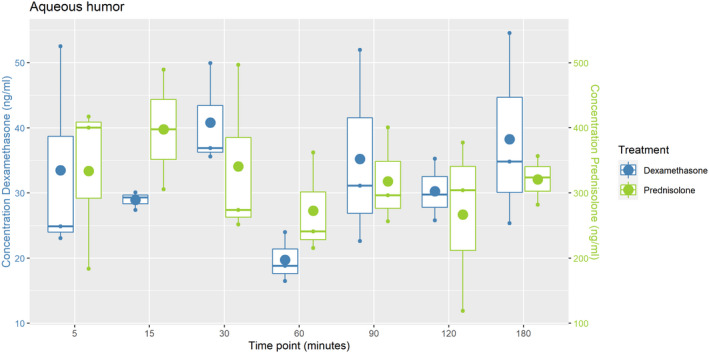
Twenty-one Shetland ponies without ophthalmic disease were treated bilaterally topically every 2 hours during 24 hours to obtain steady state drug concentrations. One eye was treated with 0.15 mg of dexamethasone disodium phosphate (0.1%), and the other eye was simultaneously treated with 1.5 mg of prednisolone acetate (1%). Serum samples were taken prior to the induction of general anaesthesia. Aqueous and vitreous humour samples were taken during euthanasia at time points after administration of the last dose (t = 5 min, t = 15 min, t = 30 min, t = 60 min, t = 90 min, t = 120 min, t = 180 min). Each pony was randomly assigned to one time point, and three ponies were sampled per time point. Dexamethasone and prednisolone concentrations were measured by liquid chromatography-mass spectrometry.
The mean dexamethasone concentration in aqueous humour was 32.4 ng/mL (standard deviation [SD] 10.9) and the mean prednisolone concentration was 321.6 ng/mL (SD 96.0). In the vitreous and in serum samples concentrations of both corticosteroids were below the limit of detection (LOD 2.5 ng/mL).
The study group was limited to subjects without evidence of current ophthalmic disease. A limited number of time points were measured.
Potentially effective dexamethasone and prednisolone concentrations were measured in the anterior chamber, but vitreal concentrations were negligible. Systemic uptake was low. Therefore, treatment with only topically administered corticosteroids is deemed insufficient in horses in cases of posterior uveitis. Further studies evaluating other routes of administration are warranted.
局部应用地塞米松和泼尼松龙目前是治疗马眼部炎症性疾病(如马复发性葡萄膜炎)的主要方法。马的比较药代动力学研究缺乏,目前的指南主要基于经验数据和其他物种的推断。
研究局部应用地塞米松和泼尼松龙在正常马眼液和血清中的渗透和局部浓度。
前瞻性随机实验药代动力学研究。
21 匹无眼部疾病的设得兰矮种马每 2 小时双侧局部用药 24 小时以获得稳定的药物浓度。一只眼用 0.15mg 磷酸二钠地塞米松(0.1%)治疗,另一只眼同时用 1.5mg 醋酸泼尼松龙(1%)治疗。在全身麻醉诱导前采集血清样本。在最后一次给药后不同时间点(t=5min、t=15min、t=30min、t=60min、t=90min、t=120min、t=180min)安乐死时采集房水和玻璃体液样本。每匹马随机分配到一个时间点,每个时间点采集 3 匹马。通过液相色谱-质谱法测量地塞米松和泼尼松龙的浓度。
房水中地塞米松的平均浓度为 32.4ng/mL(标准差[SD]10.9),平均泼尼松龙浓度为 321.6ng/mL(SD96.0)。在玻璃体液和血清样本中,两种皮质激素的浓度均低于检测限(LOD2.5ng/mL)。
研究组仅限于没有当前眼部疾病证据的受试者。测量的时间点有限。
在前房内测量到潜在有效的地塞米松和泼尼松龙浓度,但玻璃体内浓度可忽略不计。全身吸收量低。因此,在马的后葡萄膜炎病例中,仅局部应用皮质激素治疗被认为是不够的。需要进一步研究评估其他给药途径。