Department of Orthopedics, Orthopedic Research Institute, West China Hospital, Sichuan University, Sichuan, Chengdu, China.
Department of Orthopaedic Surgery, West China Hospital, Sichuan University, No 37 Guo Xue Xiang, Chengdu, Sichuan, 610041, P. R. China.
BMC Musculoskelet Disord. 2021 Oct 27;22(1):904. doi: 10.1186/s12891-021-04596-9.
There is still a lack of clinical data in arthroscopic treatment for treating multiple ligament injuries. This study aims to evaluate the clinical outcomes of patients with multiple ligament injuries undergoing treatment based on the classification stage and type of injury.
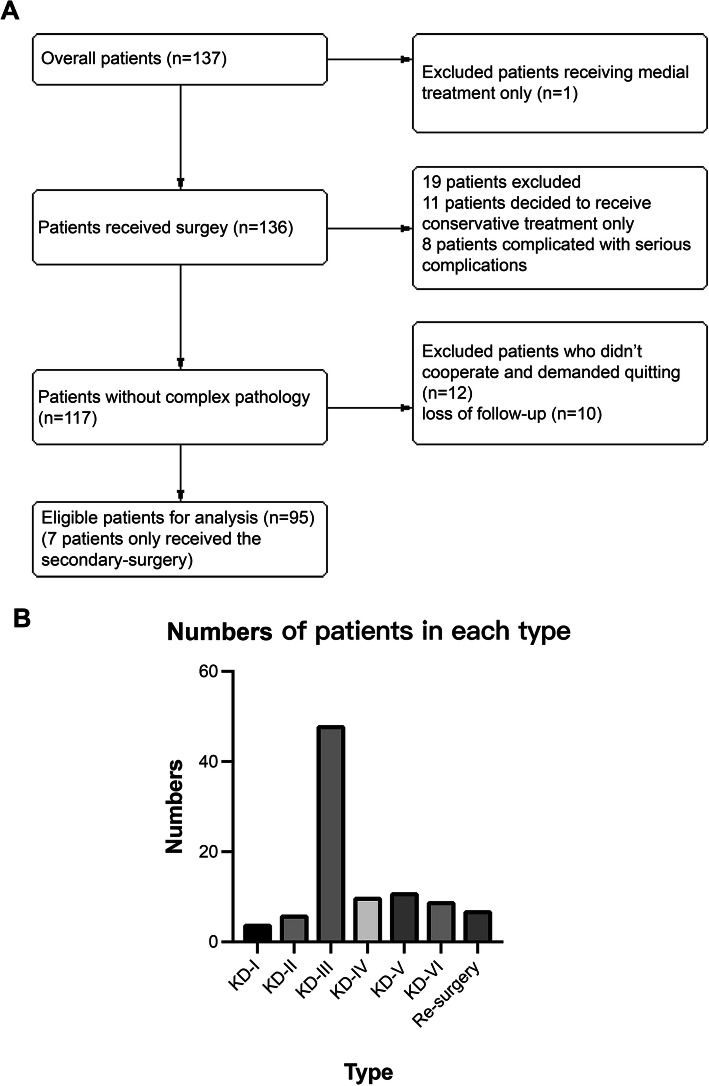
A prospective, clinical trial on multiple ligament injuries was planned, which included 95 patients (58 men and 37 women; age: 42.8 ± 11.9 [range, 18-63] years) from October 2017 to June 2018. Injuries were classified into three stages (emergency stage < 24 h; acute stage: 24 h to 3 weeks, and chronic stage: > 3 weeks) and six types (KD I-VI) based on injuries time and structures, which indicated appropriate treatments. The clinical outcomes were evaluated at 2, 4, 6, 8, and 12 weeks and at 6, 9, 12 months and 24 months after surgery. The final choices in efficacy index included International Knee Documentation Committee (IKDC) score, Lysholm score, visual analog scale (VAS) score, and range of motion.
During the follow-up, all patients exhibited statistically significant functional improvement in the injured limb compared with their preoperative situation. The mean postoperative scores of acute stage patients at 2-year follow-up were IKDC subjective score, 77.54 ± 11.53; Lysholm score, 85.96 ± 9.39; Tegner score, 4.13 ± 1.08; and VAS score, 1.21 ± 0.76. The mean postoperative scores of chronic stage patents at 2-year follow-up were IKDC subjective score, 74.61 ± 12.38; Lysholm score, 81.71 ± 10.80; Tegner score, 3.96 ± 1.14; and VAS score, 1.71 ± 0.60. The IKDC subjective score, Lysholm score, and Tegner score were significantly improved (P < 0.01) and the VAS score was significantly decreased (P < 0.01) at 2-year follow-up. Regarding the multiple ligament injuries classification, patients with more structural damage in stages V and VI showed less progress in functional recovery than those in stages I-IV.
This new classification with three stages and six types helps to identify the severity of injury and plan the management effectively. The outcomes were encouraging and the subjective functional results showed significant improvement at 2-year follow-up.
Prospective clinical trial.
II.
关节镜治疗多发韧带损伤的临床资料仍较为缺乏。本研究旨在根据损伤分期和类型评估多发韧带损伤患者的临床疗效。
本前瞻性临床试验纳入 2017 年 10 月至 2018 年 6 月的 95 例多发韧带损伤患者(男 58 例,女 37 例;年龄 42.8±11.9[1863]岁),根据损伤时间和结构分为 3 期(紧急期<24 h;急性期:24 h3 周;慢性期:>3 周)和 6 型(KD I-VI),并选择合适的治疗方法。术后 2、4、6、8 和 12 周及 6、9、12 个月和 24 个月时评估临床疗效。疗效指标最终选择国际膝关节文献委员会(IKDC)评分、Lysholm 评分、视觉模拟评分(VAS)和关节活动度。
随访期间,所有患者患侧肢体的功能均较术前有明显改善,其中急性损伤患者术后 2 年的 IKDC 主观评分、Lysholm 评分、Tegner 评分和 VAS 评分分别为 77.54±11.53、85.96±9.39、4.13±1.08 和 1.21±0.76;慢性损伤患者术后 2 年的 IKDC 主观评分、Lysholm 评分、Tegner 评分和 VAS 评分分别为 74.61±12.38、81.71±10.80、3.96±1.14 和 1.71±0.60。术后 2 年时,IKDC 主观评分、Lysholm 评分和 Tegner 评分明显改善(P<0.01),VAS 评分明显降低(P<0.01)。按多发韧带损伤分类,V 型和 VI 型多结构损伤患者的功能恢复较 I-IV 型差。
该新的三阶段六类型分类有助于识别损伤严重程度,并能有效制定治疗方案。术后 2 年时的主观功能结果令人鼓舞,显示出显著改善。
前瞻性临床试验。
II 级。