Han Jun, Zhang Jing, Zhang Chengliang
Tongji Hospital, Tongji Medical College, Huazhong University of Science and Technology, Wuhan, China.
Department of Pharmacy, Affiliated Hospital of Jianghan University, Wuhan, China.
Front Oncol. 2021 Oct 11;11:754891. doi: 10.3389/fonc.2021.754891. eCollection 2021.
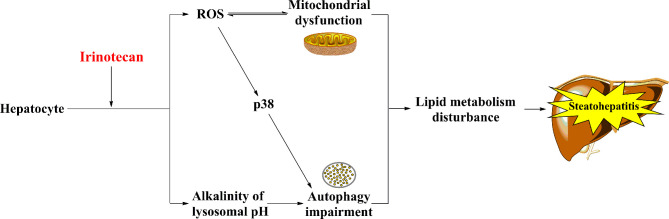
The hepatotoxicity of irinotecan is drawing wide concern nowadays due to the widespread use of this chemotherapeutic against various solid tumors, particularly metastatic colorectal cancer. Irinotecan-induced hepatotoxicity mainly manifests as transaminase increase and steatosis with or without transaminase increase, and is accompanied by vacuolization, and lobular inflammation. Irinotecan-induced steatohepatitis (IIS) increases the risk of morbidity and mortality in patients with colorectal cancer liver metastasis (CRCLM). The major risks and predisposing factors for IIS include high body mass index (BMI) or obesity, diabetes, and high-fat diet. Mitochondrial dysfunction and autophagy impairment may be involved in the pathogenesis of IIS. However, there is currently no effective preventive or therapeutic treatment for this condition. Thus, the precise mechanisms underlying the pathogenesis of IIS should be deciphered for the development of therapeutic drugs. This review summarizes the current knowledge and research progress on IIS.
由于伊立替康这种化疗药物广泛用于治疗各种实体瘤,尤其是转移性结直肠癌,其肝毒性目前正引起广泛关注。伊立替康诱导的肝毒性主要表现为转氨酶升高以及伴有或不伴有转氨酶升高的脂肪变性,并伴有空泡化和小叶炎症。伊立替康诱导的脂肪性肝炎(IIS)增加了结直肠癌肝转移(CRCLM)患者发病和死亡的风险。IIS的主要风险和易感因素包括高体重指数(BMI)或肥胖、糖尿病和高脂饮食。线粒体功能障碍和自噬受损可能参与IIS的发病机制。然而,目前对于这种情况尚无有效的预防或治疗方法。因此,为了开发治疗药物,应阐明IIS发病机制的精确机制。本综述总结了目前关于IIS的知识和研究进展。