Department of Nephrology, Chang Gung Memorial Hospital, Linkou, Taiwan.
Kidney Research Center, Department of Nephrology, Chang Gung Memorial Hospital, Linkou, Taiwan.
JAMA Netw Open. 2021 Oct 1;4(10):e2131749. doi: 10.1001/jamanetworkopen.2021.31749.
Adults receiving dialysis treatment have a higher likelihood of death when infected with SARS-CoV-2 than adults not receiving dialysis treatment. To date, the immune response of people receiving dialysis after SARS-CoV-2 vaccination has not been systematically discussed.
To assess immunogenicity rates in people with end-stage kidney disease (ESKD) receiving SARS-CoV-2 vaccines, explore postvaccination potential risk factors for nonresponse, and assess whether receiving dialysis is associated with different antibody response rates compared with the nondialysis population.
This systematic review and meta-analysis used articles from PubMed, Medline, and Embase published before July 30, 2021, as well as articles in the medRxiv preprint server.
Studies that evaluated the immunogenicity rate according to the postvaccine antibody response rate in patients with ESKD receiving dialysis were selected.
The meta-analysis was conducted according to the Preferred Reporting Items for Systematic Reviews and Meta-Analyses (PRISMA) guideline. A random-effects model was used. Two independent reviewers conducted the literature search and extracted the data.
The primary outcome was the pooled antibody postvaccine response rates in individuals with ESKD. The secondary outcomes were pooled response rates in individuals receiving and not receiving dialysis. Subgroup analysis and meta-regression were conducted to identify the sources of heterogeneity.
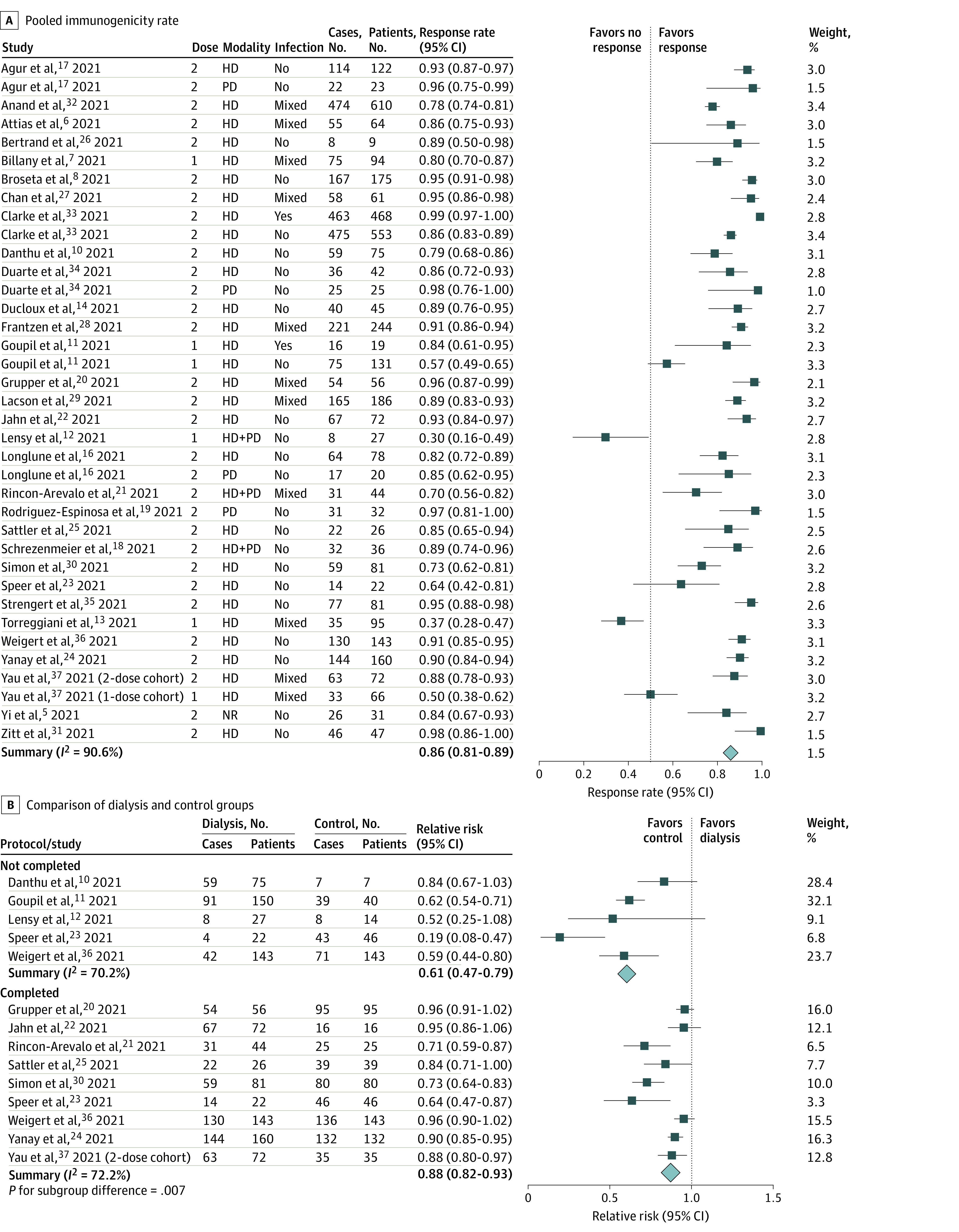
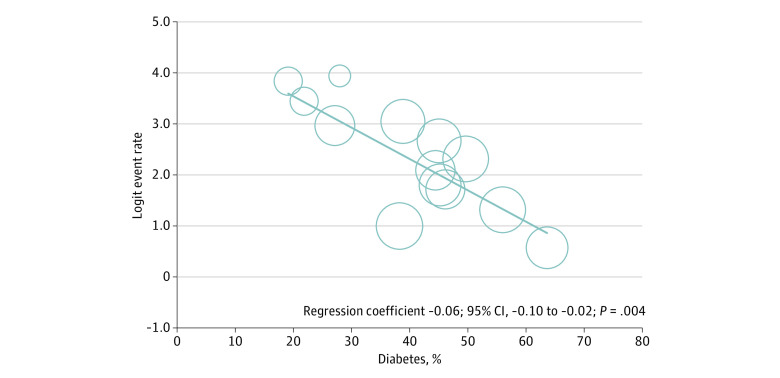
A total of 32 studies were included. The overall immunogenicity rate of the dialysis group was 86% (95% CI, 81%-89%). Meta-regression showed a significant difference was detected in the postvaccine response rate on the basis of prevalence of diabetes (regression coefficient, -0.06; 95% CI, -0.10 to -0.02; P = .004). Compared with nondialysis controls, patients in the dialysis group had a lower response rate after the first (relative risk [RR], 0.61; 95% CI, 0.47-0.79; I2 = 70.2%) and second (RR, 0.88; 95% CI, 0.82-0.93; I2 = 72.2%) doses, with statistically significantly increased RR between first and second doses (P = .007).
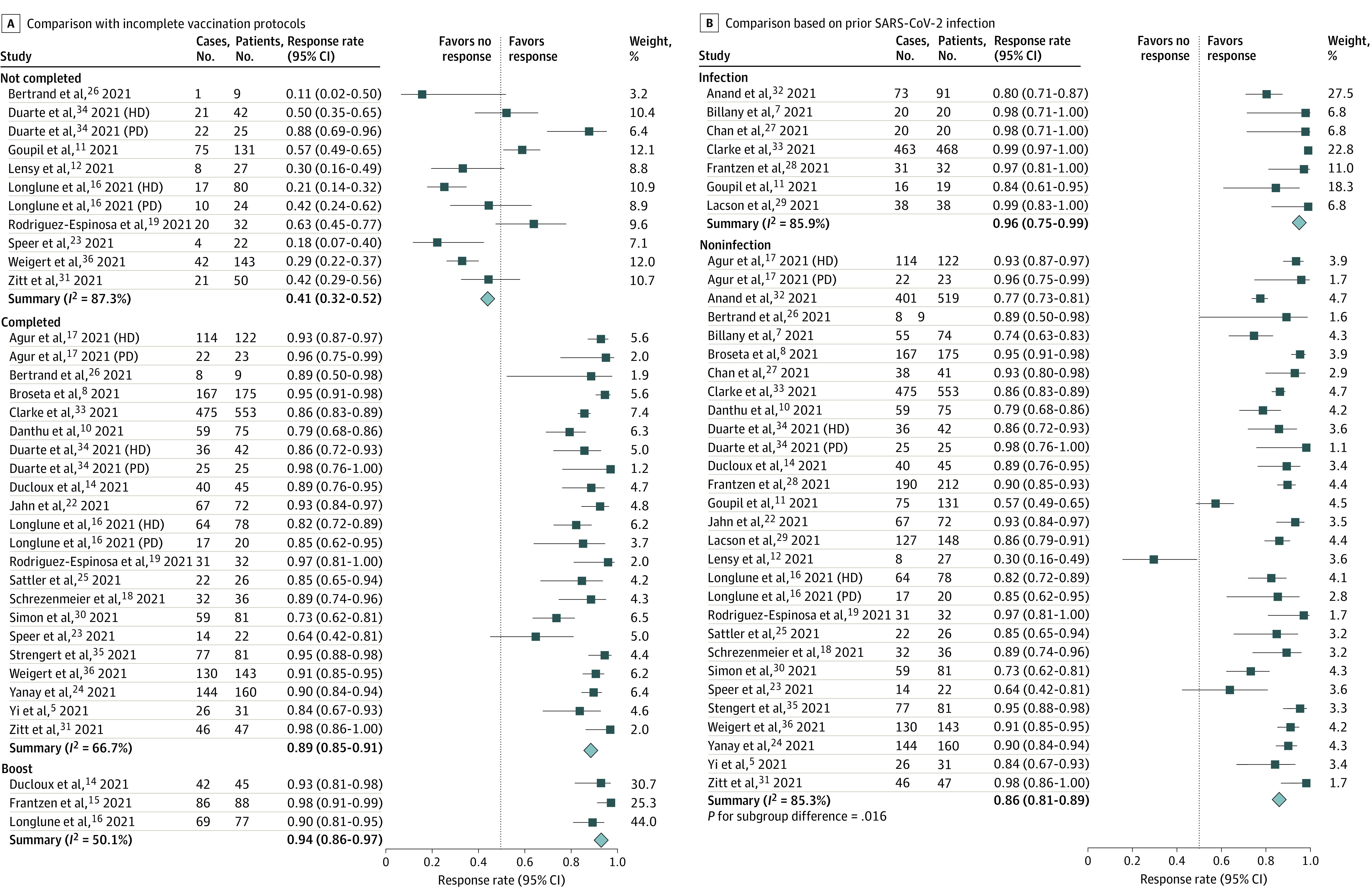
These findings suggest that the immunogenicity rate among patients receiving dialysis was 41% after the first dose and 89% after the second dose. Diabetes might be a risk factor for nonresponse in the dialysis population. Patients receiving dialysis had a poorer antibody response rate than did individuals not receiving dialysis, particularly after the first dose.
接受透析治疗的成年人感染 SARS-CoV-2 后死亡的可能性高于未接受透析治疗的成年人。迄今为止,人们对接受 SARS-CoV-2 疫苗接种后的透析患者的免疫反应尚未进行系统讨论。
评估终末期肾病 (ESKD) 患者接受 SARS-CoV-2 疫苗后的免疫原性率,探讨接种后非应答的潜在危险因素,并评估与非透析人群相比,接受透析治疗是否与不同的抗体反应率相关。
本系统评价和荟萃分析使用了 2021 年 7 月 30 日前发表在 PubMed、Medline 和 Embase 上的文章以及 medRxiv 预印本服务器上的文章。
选择了根据透析患者接种疫苗后的抗体反应率评估免疫原性率的研究。
根据系统评价和荟萃分析的首选报告项目 (PRISMA) 指南进行荟萃分析。使用随机效应模型。两名独立的审查员进行文献检索和数据提取。
主要结局是 ESKD 患者接种疫苗后的抗体总体反应率。次要结局是接受和不接受透析的个体的反应率。进行了亚组分析和荟萃回归以确定异质性的来源。
共纳入 32 项研究。透析组的总体免疫原性率为 86%(95%CI,81%-89%)。荟萃回归显示,基于糖尿病患病率,疫苗接种后的反应率存在显著差异(回归系数,-0.06;95%CI,-0.10 至-0.02;P = .004)。与非透析对照组相比,透析组患者在第一(相对风险 [RR],0.61;95%CI,0.47-0.79;I2 = 70.2%)和第二(RR,0.88;95%CI,0.82-0.93;I2 = 72.2%)剂量后反应率较低,第一和第二剂量之间的 RR 统计学显著增加(P = .007)。
这些发现表明,透析患者在第一剂后免疫原性率为 41%,第二剂后为 89%。糖尿病可能是透析人群无应答的一个危险因素。与未接受透析治疗的患者相比,接受透析治疗的患者抗体反应率较差,尤其是在第一剂后。