Cheng Chun-Wen, Huang Po-Yen, Wu Ting-Shu, Huang Chung-Guei, Tsao Kuo-Chien, Lin Chun-Sui, Chung Ting-Ying, Lai Chi-Chun, Yang Cheng-Ta, Chiu Cheng-Hsun
Division of Infectious Diseases, Department of Internal Medicine, Chang Gung Memorial Hospital at Linkou, Taoyuan, Taiwan; Infection Control Committee, Chang Gung Memorial Hospital at Linkou, Taoyuan, Taiwan.
Department of Laboratory Medicine, Chang Gung Memorial Hospital at Linkou, Taoyuan, Taiwan; Department of Medical Biotechnology and Laboratory Science, College of Medicine, Chang Gung University, Taoyuan, Taiwan; Research Center for Emerging Viral Infections, College of Medicine, Chang Gung University, Taoyuan, Taiwan.
Biomed J. 2021 Dec;44(6 Suppl 1):S8-S14. doi: 10.1016/j.bj.2021.10.009. Epub 2021 Oct 26.
Severe acute respiratory syndrome coronavirus-2 (SARS-CoV-2) that causes coronavirus disease 2019 (COVID-19) is highly contagious, with a potential to cause large nosocomial outbreaks in the hospital setting. We report the advance deployment of comprehensive, multi-level infection control measures in a 3,700-bed large hospital to prevent nosocomial outbreaks of COVID-19 during the pandemic.
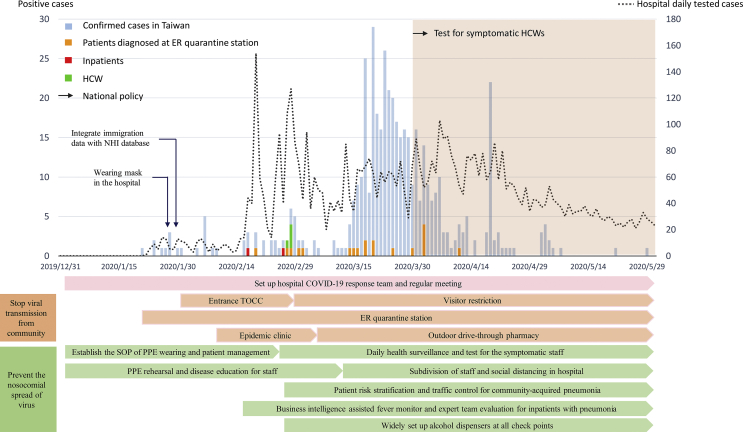
We implemented a series of dynamic infection control policies during the pandemic. A confirmed COVID-19 case was defined by positive real-time reverse transcriptase-polymerase chain reaction (RT-PCR) assay. All healthcare worker (HCW) having symptoms or close contact with the confirmed case received the RT-PCR test.
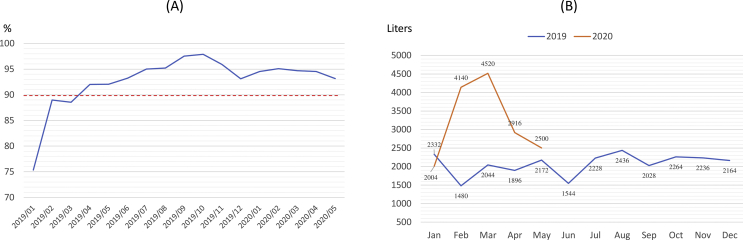
A total of 5,722 patients were tested in our hospital from January to May 2020. Twenty-five patients were confirmed COVID-19, including two inpatients. A cluster of 4 HCWs with COVID-19 associated with the 2nd inpatient was identified in the early stage of epidemic. Our enhanced traffic control bundling, mask wearing, hand hygiene and environmental cleaning were reinforced after the outbreak. All other confirmed cases were identified at our outdoor quarantine station or epidemic clinic afterwards, and the results of testing for 146 symptomatic HCWs were all negative.
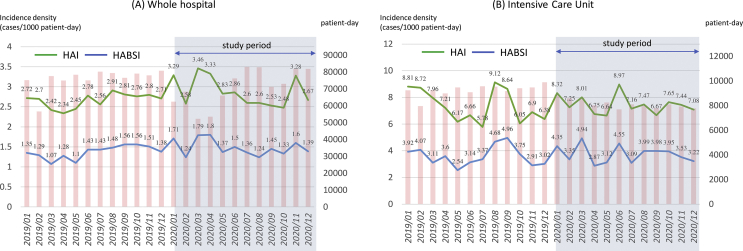
Integrated teamwork, advance deployment of infection control measures and efficient diagnostic testing and response protected HCW and facilities from large SARS-CoV-2 outbreaks and preserved the capacity and function of the health care system during the pandemic.
导致2019冠状病毒病(COVID-19)的严重急性呼吸综合征冠状病毒2(SARS-CoV-2)具有高度传染性,有可能在医院环境中引发大规模医院感染暴发。我们报告了在一家拥有3700张床位的大型医院提前部署全面、多层次感染控制措施,以预防大流行期间COVID-19的医院感染暴发。
在大流行期间,我们实施了一系列动态感染控制政策。通过实时逆转录聚合酶链反应(RT-PCR)检测呈阳性来定义确诊的COVID-19病例。所有出现症状或与确诊病例有密切接触的医护人员(HCW)均接受RT-PCR检测。
2020年1月至5月,我院共检测了5722例患者。25例患者确诊为COVID-19,其中包括2例住院患者。在疫情早期,发现了一组4名与第2例住院患者相关的COVID-19医护人员。疫情暴发后,我们加强了交通管制、戴口罩、手部卫生和环境清洁。之后,所有其他确诊病例均在我院户外检疫站或疫情诊所被发现,146名有症状的医护人员检测结果均为阴性。
团队协作、提前部署感染控制措施以及高效的诊断检测和应对措施,保护了医护人员和设施免受SARS-CoV-2大规模暴发的影响,并在大流行期间保持了医疗系统的能力和功能。