Paillard Thierry
Laboratoire Mouvement, Equilibre, Performance et Santé (UPRES EA 4445), Département STAPS, Université de Pau et des Pays de l'Adour/E2S, Pau, France.
Front Physiol. 2021 Oct 12;12:700723. doi: 10.3389/fphys.2021.700723. eCollection 2021.
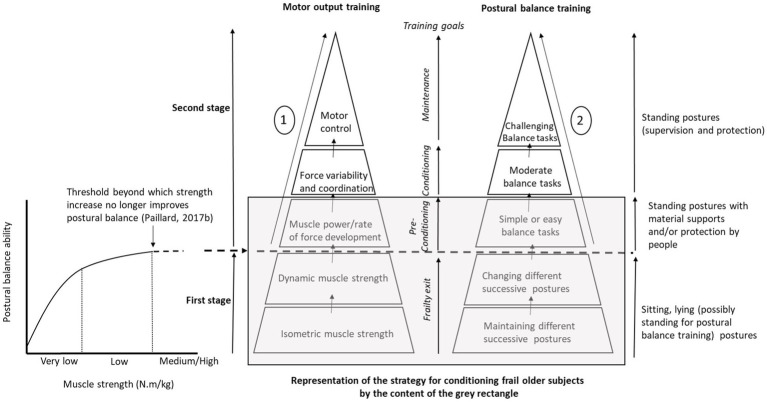
In frail older subjects, the motor output of the antigravity muscles is fundamental in resisting falls. These muscles undergo accelerated involutions when they are inactive and the risk of falling increases during leisure and domestic physical activity. In order to reduce their risk of falling, frail older subjects limit their physical activities/exercises. The problem is that the less they exercise, the less they are able to exercise and the greater the risk in exercising. Hence, a vicious circle sets up and the antigravity muscles inevitably continue to deteriorate. This vicious circle must be broken by starting a reconditioning program based on developing the strength of antigravity muscles (especially lower-limb muscles). To begin with, for each increase in muscle strength, postural balance is improved. Once this increase reaches the threshold beyond which postural balance no longer improves, it seems appropriate to implement exercises aimed at concomitantly improving motor output and postural balance in order to counteract or even reverse the involution process of the postural balance system. Methods and strategies toward this end are proposed in this present communication. However, the transfer effects between strength increase and postural balance ability are not yet totally known and future research should evaluate the relationship between muscle strength and postural balance throughout rehabilitation programs (i.e., program follow-ups) in frail older subjects in order to advance knowledge of this relationship.
在体弱的老年受试者中,抗重力肌的运动输出对于防止跌倒至关重要。当这些肌肉不活动时,它们会加速退化,并且在休闲和日常身体活动期间跌倒风险会增加。为了降低跌倒风险,体弱的老年受试者会限制他们的身体活动/锻炼。问题在于,他们锻炼得越少,就越没有能力锻炼,并且锻炼时的风险就越大。因此,恶性循环就此形成,抗重力肌不可避免地会持续退化。必须通过启动基于增强抗重力肌(尤其是下肢肌肉)力量的康复计划来打破这个恶性循环。首先,随着肌肉力量的每一次增强,姿势平衡都会得到改善。一旦这种增强达到姿势平衡不再改善的阈值,似乎就适合实施旨在同时改善运动输出和姿势平衡的锻炼,以抵消甚至逆转姿势平衡系统的退化过程。本文提出了实现这一目标的方法和策略。然而,力量增强与姿势平衡能力之间的转移效应尚未完全明确,未来的研究应该在体弱的老年受试者的整个康复计划(即计划随访)中评估肌肉力量与姿势平衡之间的关系,以便增进对这种关系的了解。