Liu Luyang, Sheng Chao, Lyu Zhangyan, Dai Hongji, Chen Kexin
Department of Epidemiology and Biostatistics, National Clinical Research Center for Cancer, Key Laboratory of Molecular Cancer Epidemiology of Tianjin, Tianjin Medical University Cancer Institute and Hospital, Tianjin, China.
Front Nutr. 2021 Oct 12;8:755834. doi: 10.3389/fnut.2021.755834. eCollection 2021.
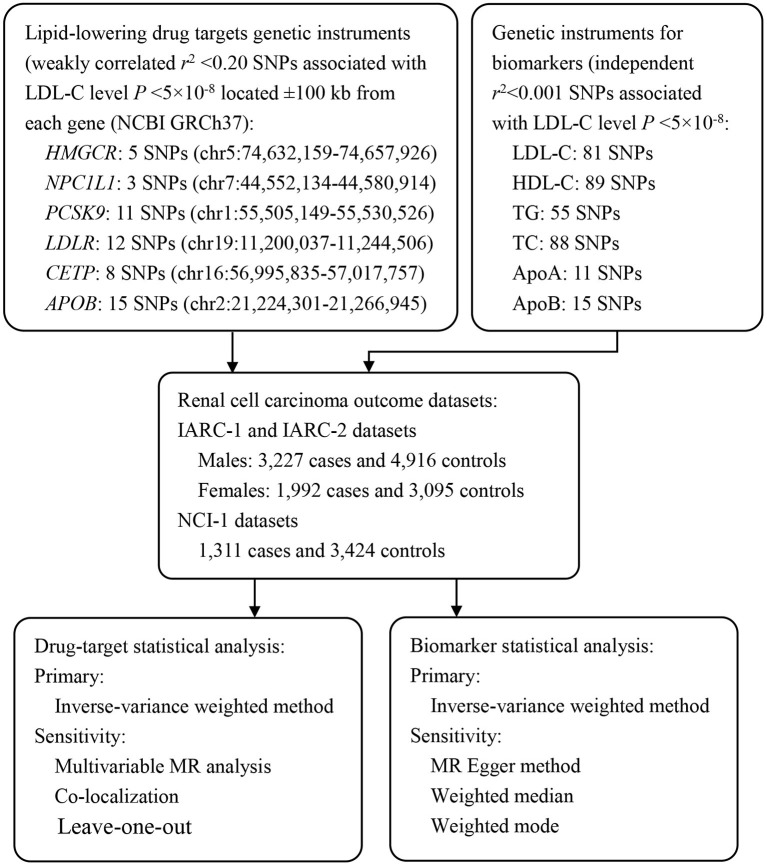
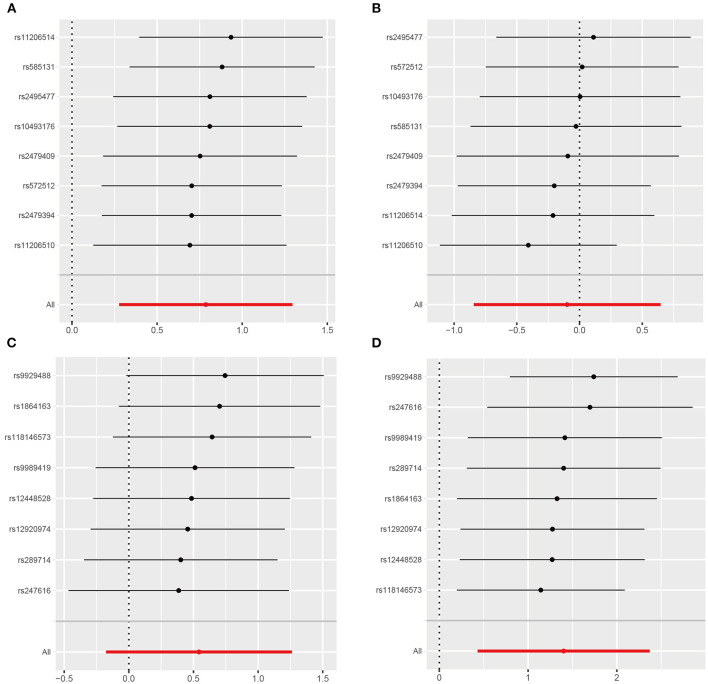
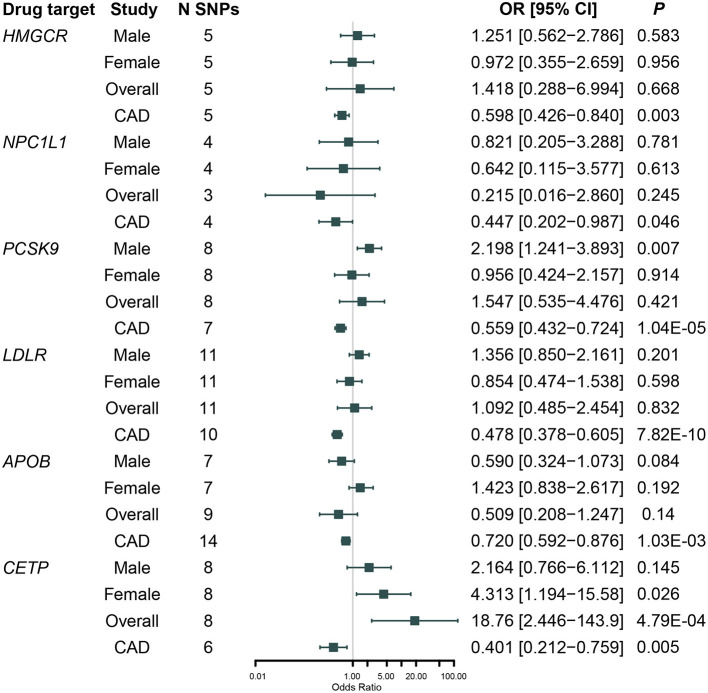
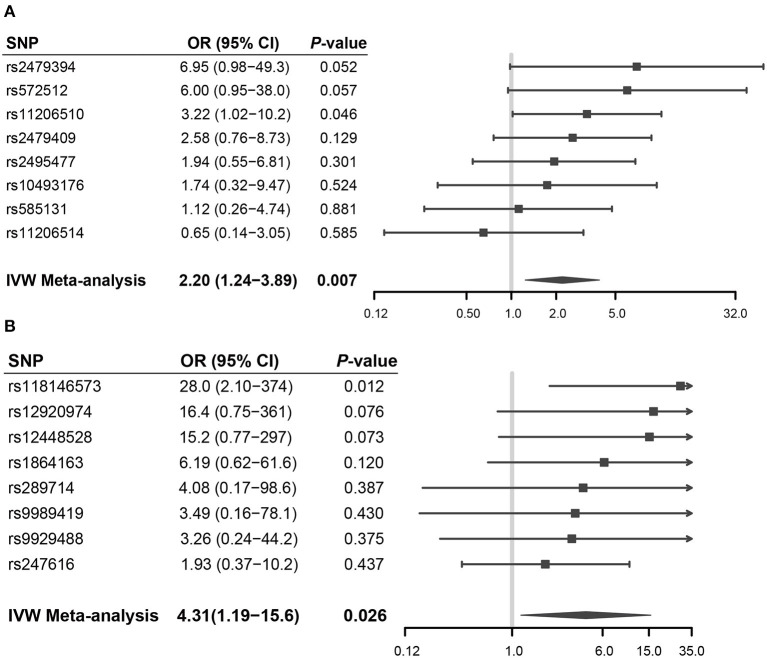
Observational studies suggested inconsistent associations between lipid-lowering drugs, such as statins, and renal cell carcinoma (RCC) risk. In a two-sample Mendelian randomization (MR) framework, we assessed the causal influence of lipid-lowering agents and circulating lipid traits on overall and sex-specific RCC risk. Genetic variants of six drug-target genes were selected to proxy the effects of low-density lipoprotein cholesterol (LDL-C) lowering therapies. Instrumental variables for circulating lipid traits were constructed from two large genome-wide association studies. We used endpoints for RCC from summary statistics of two studies [International Agency for Research on Cancer [IARC], = 13,230; National Cancer Institute [NCI], = 4,735]. The robustness of results was assessed through conventional MR sensitivity analyses. Overall, there was no significant association between genetically proxied HMG-CoA reductase (HMGCR) inhibition and RCC risk [Odds ratio [OR] = 1.42, 95% CI, 0.29-6.99]. In the sex-stratified analysis, we observed a positive association for genetically proxied drug targets with RCC risk. Specifically, genetically proxied proprotein convertase subtilisin/kexin type 9 (PCSK9) inhibition was associated with a higher risk of RCC in men [OR = 2.20 [95% CI, 1.24-3.89]], and the difference by sex was moderate. This study suggested genetically proxied inhibition of HMGCR was not associated with RCC risk, while genetically proxied PCSK9 inhibition might be associated with a higher risk of RCC in male.
观察性研究表明,他汀类等降脂药物与肾细胞癌(RCC)风险之间的关联并不一致。在两样本孟德尔随机化(MR)框架中,我们评估了降脂药物和循环脂质特征对总体及性别特异性RCC风险的因果影响。选择六个药物靶点基因的遗传变异来代表低密度脂蛋白胆固醇(LDL-C)降低疗法的效果。循环脂质特征的工具变量由两项大型全基因组关联研究构建。我们使用两项研究[国际癌症研究机构(IARC),n = 13230;美国国立癌症研究所(NCI),n = 4735]汇总统计中的RCC终点。通过传统的MR敏感性分析评估结果的稳健性。总体而言,基因代理的HMG-CoA还原酶(HMGCR)抑制与RCC风险之间无显著关联[比值比(OR)= 1.42,95%置信区间(CI),0.29 - 6.99]。在按性别分层的分析中,我们观察到基因代理的药物靶点与RCC风险呈正相关。具体而言,基因代理的前蛋白转化酶枯草溶菌素/kexin 9型(PCSK9)抑制与男性RCC风险较高相关[OR = 2.20(95% CI,1.24 - 3.89)],且性别差异中等。这项研究表明,基因代理的HMGCR抑制与RCC风险无关,而基因代理的PCSK9抑制可能与男性RCC风险较高相关。