Research Institute of Atherosclerotic Disease, Xi'an Jiaotong University Cardiovascular Research Centre, Xi'an, Shaanxi 710061, P.R. China.
Laboratory Animal Center, Xi'an Jiaotong University Health Science Centre, Xi'an, Shaanxi 710061, P.R. China.
Mol Med Rep. 2021 Dec;24(6). doi: 10.3892/mmr.2021.12511. Epub 2021 Oct 29.
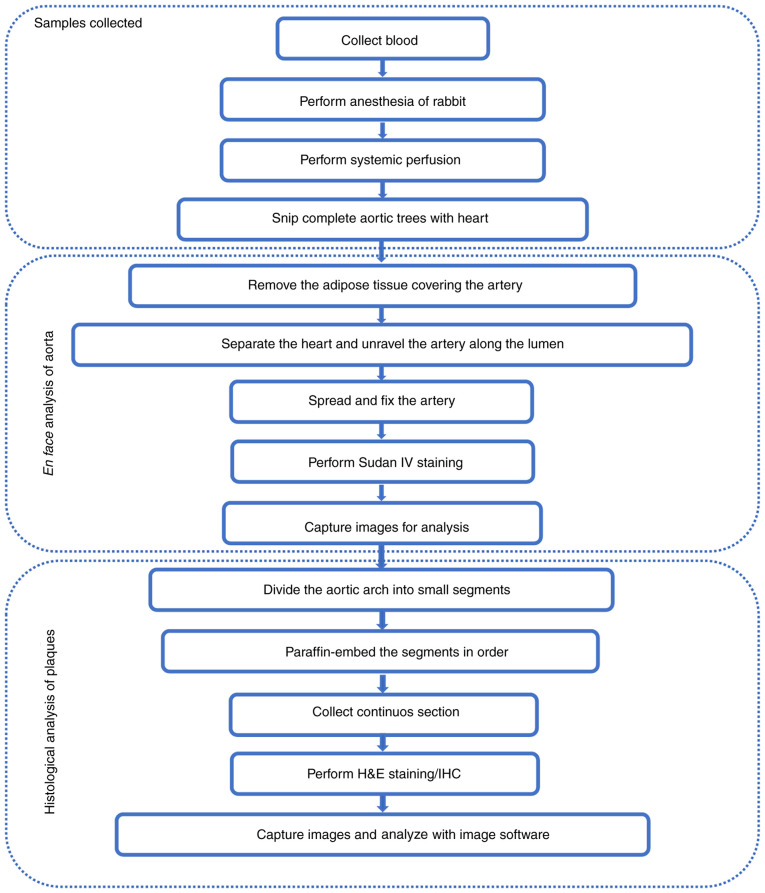
Atherosclerosis is a chronic inflammatory disease that threatens human health and lives by causing vascular stenosis and plaque rupture. Various animal models have been employed for elucidating the pathogenesis, drug development and treatment validation studies for atherosclerosis. To the best of our knowledge, the species used for atherosclerosis research include mice, rats, hamsters, rabbits, pigs, dogs, non‑human primates and birds, among which the most commonly used ones are mice and rabbits. Notably, apolipoprotein E knockout (KO) or low‑density lipoprotein receptor KO mice have been the most widely used animal models for atherosclerosis research since the late 20th century. Although the aforementioned animal models can form atherosclerotic lesions, they cannot completely simulate those in humans with respect to lesion location, lesion composition, lipoprotein composition and physiological structure. Hence, an appropriate animal model needs to be selected according to the research purpose. Additionally, it is necessary for atherosclerosis research to include quantitative analysis results of atherosclerotic lesion size and plaque composition. Laboratory animals can provide not only experimental tissues for studies but also cells needed for experiments. The present review first summarizes the common animal models and their practical applications, followed by focus on mouse and rabbit models and elucidating the methods to quantify atherosclerotic lesions. Finally, the methods of culturing endothelial cells, macrophages and smooth muscle cells were elucidated in detail and the experiments involved in atherosclerosis research were discussed.
动脉粥样硬化是一种慢性炎症性疾病,通过引起血管狭窄和斑块破裂来威胁人类健康和生命。已经使用了各种动物模型来阐明动脉粥样硬化的发病机制、药物开发和治疗验证研究。据我们所知,用于动脉粥样硬化研究的物种包括小鼠、大鼠、仓鼠、兔子、猪、狗、非人类灵长类动物和鸟类,其中最常用的是小鼠和兔子。值得注意的是,自 20 世纪后期以来,载脂蛋白 E 敲除 (KO) 或低密度脂蛋白受体 KO 小鼠已成为动脉粥样硬化研究中最广泛使用的动物模型。尽管上述动物模型可以形成动脉粥样硬化病变,但它们在病变位置、病变组成、脂蛋白组成和生理结构方面不能完全模拟人类的病变。因此,需要根据研究目的选择合适的动物模型。此外,动脉粥样硬化研究还需要包括动脉粥样硬化病变大小和斑块组成的定量分析结果。实验动物不仅可以提供研究用的实验组织,还可以提供实验所需的细胞。本综述首先总结了常见的动物模型及其实际应用,然后重点介绍了小鼠和兔子模型,并阐明了定量动脉粥样硬化病变的方法。最后,详细阐明了培养内皮细胞、巨噬细胞和平滑肌细胞的方法,并讨论了涉及动脉粥样硬化研究的实验。