Department of Otorhinolaryngology-Head and Neck Surgery, Osaka University Graduate School of Medicine, Osaka, Japan.
PLoS One. 2021 Oct 29;16(10):e0259288. doi: 10.1371/journal.pone.0259288. eCollection 2021.
The objective of this study was to compare the prognostic impact of sarcopenia in patients with head and neck cancer (HNC) treated with surgery or radiation.
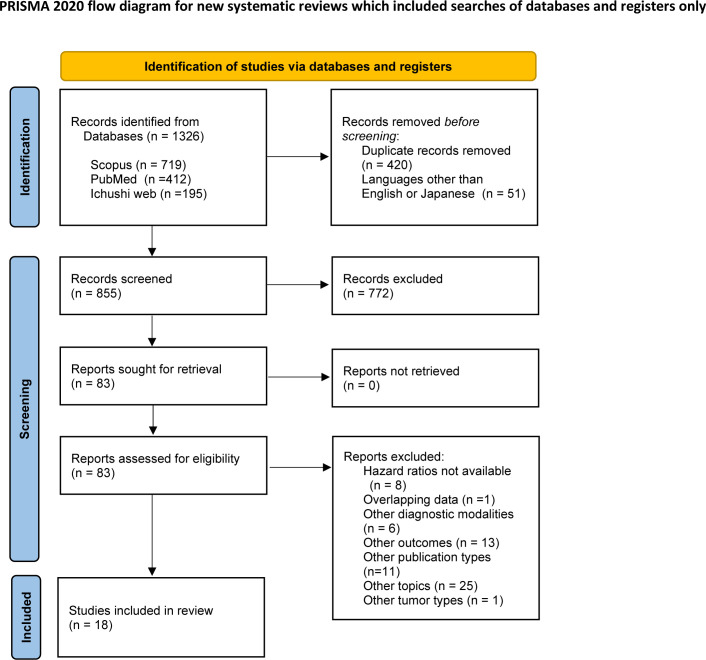
We systematically searched electronic databases to identify articles reporting the impact of sarcopenia on the prognosis of patients with HNC. Hazard ratios (HRs) and 95% confidence intervals (CIs) for overall survival (OS), disease-free survival (DFS), and disease-specific survival (DSS) were extracted and pooled. HR according to treatment modality were estimated using random-effects models. Statistical analyses were carried out using the Comprehensive Meta-Analysis software.
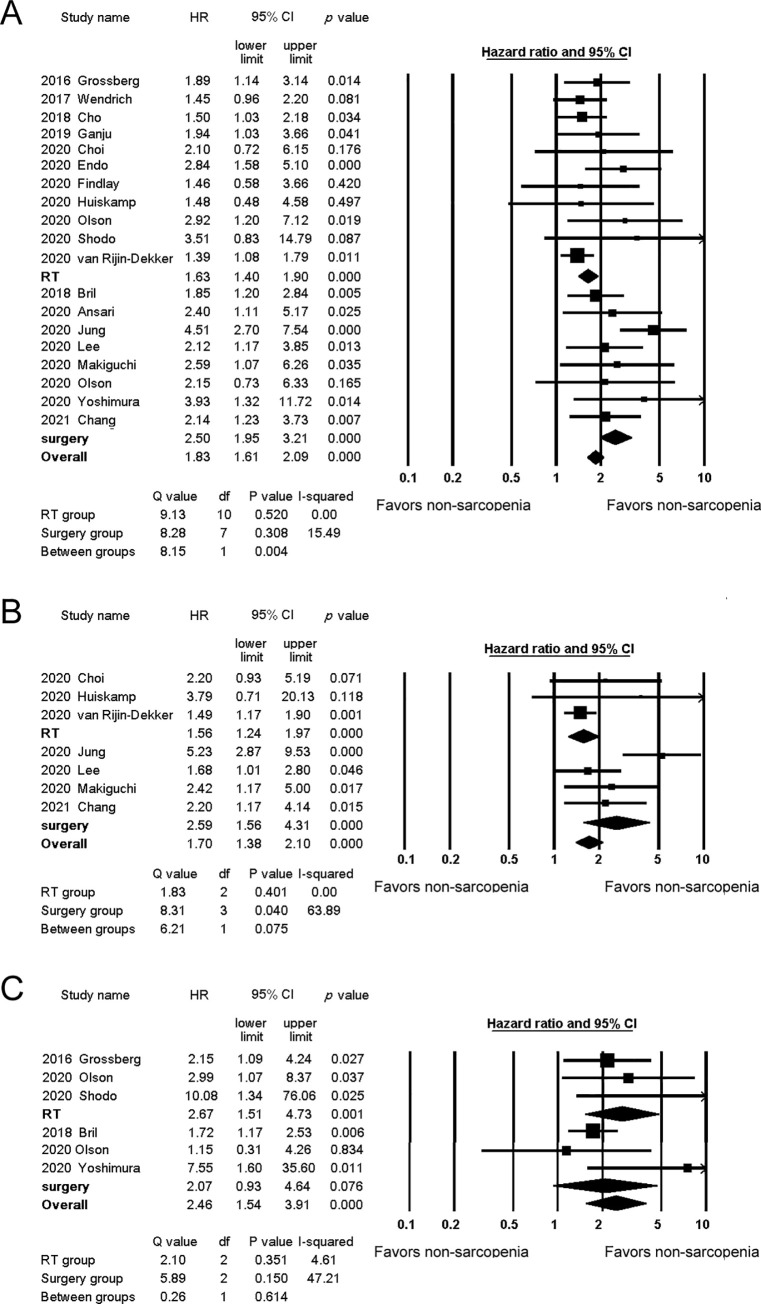
In total, 18 studies enrolling 3,233 patients were included. Sarcopenia was associated with poor OS in both surgery and radiotherapy groups (hazard ratio [HR] 2.50, 95% confidence interval [CI] 1.95-3.21; HR 1.63, 95% CI 1.40-1.90, respectively). The HR was significantly higher in the surgery group than in the radiotherapy group (p = 0.004), with similar results obtained for DFS (HR 2.59, 95% CI 1.56-4.31; HR 1.56, 95% CI 1.24-1.97 for the surgery and radiotherapy groups, respectively) and DSS (HR 2.96, 95% CI 0.73-11.95; HR 2.67, 95% CI 1.51-4.73 for the surgery and RT groups, respectively).
Sarcopenia was a poor prognostic factor for HNC, regardless of the treatment modality. However, the adverse effects of sarcopenia on survival were more prominent in the surgery group than in the radiotherapy group. Sarcopenia assessment is required for appropriate treatment decision-making.
本研究旨在比较头颈部癌症(HNC)患者接受手术或放疗后,肌肉减少症对预后的影响。
我们系统地检索了电子数据库,以确定报道肌肉减少症对 HNC 患者预后影响的文章。提取并汇总总生存期(OS)、无病生存期(DFS)和疾病特异性生存期(DSS)的风险比(HR)和 95%置信区间(CI)。使用随机效应模型估计根据治疗方式的 HR。使用 Comprehensive Meta-Analysis 软件进行统计分析。
共纳入 18 项研究,共纳入 3233 例患者。肌肉减少症与手术和放疗组的 OS 不良相关(HR 2.50,95%CI 1.95-3.21;HR 1.63,95%CI 1.40-1.90)。手术组的 HR 明显高于放疗组(p=0.004),DFS(HR 2.59,95%CI 1.56-4.31;HR 1.56,95%CI 1.24-1.97)和 DSS(HR 2.96,95%CI 0.73-11.95;HR 2.67,95%CI 1.51-4.73)也有类似结果。
肌肉减少症是 HNC 的不良预后因素,与治疗方式无关。然而,肌肉减少症对生存的不良影响在手术组比在放疗组更为显著。需要进行肌肉减少症评估以做出适当的治疗决策。