School of Medicine and Health Management, Tongji Medical College, Huazhong University of Science & Technology, Wuhan, China.
School of Medicine and Health Management, Tongji Medical College, Huazhong University of Science & Technology, Wuhan, China; Hubei Provincial Research Center for Health Technology Assessment, Wuhan, China; Institute of Smart Health, Huazhong University of Science & Technology, Wuhan, China.
Comput Methods Programs Biomed. 2021 Nov;212:106468. doi: 10.1016/j.cmpb.2021.106468. Epub 2021 Oct 14.
With outbreaks of COVID-19 around the world, lockdown restrictions are routinely imposed to limit the spread of the virus. During periods of lockdown, social media has become the main channel for citizens to exchange information with others. Public emotions are being generated and shared rapidly online with citizens using internet platforms to reduce anxiety and stress, and stay connected while isolated.
This study aims to explore the regularity of emotional evolution by examining public emotions expressed in online discussions about the Wuhan lockdown event in January 2020.
Data related to the Wuhan lockdown was collected from Sina Weibo by web crawler. In this study, the Ortony, Clore, and Collins (OCC) model, Word2Vec, and Bi-directional Long Short-Term Memory model were employed to determine emotional types, train vectorization of words, and identify each text emotion for the training set. Latent Dirichlet Allocation models were also employed to mine the various topic categories, while topic emotional evolution was visualized.
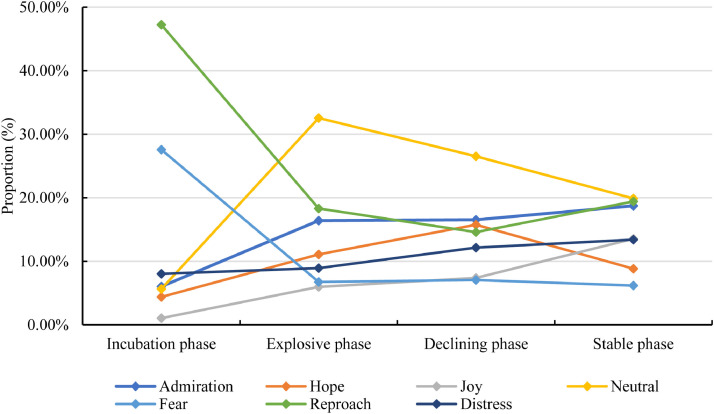
Seven types of emotions and four phases were categorized to describe emotional evolution on the Wuhan lockdown event. The study found that negative emotions such as blame and fear dominated in the early days, and public attitudes towards the lockdown gradually alleviated and reached a balance as the situation improved. Emotional expression about Wuhan lockdown event were significantly related to users' gender, location, and whether or not their account was verified. There were statistically significant correlations between different emotions within the subtle emotional categories. In addition, the evolution of emotions presented a different path due to different topics.
Multiple emotional categories were determined in our study, providing a detailed and explainable emotion analysis to explored emotional appeal of citizen. The public emotions were gradually easing related to the Wuhan lockdown event, there yet exists regional discrimination and post-traumatic stress disorder in this process, which would lead us to pay continuous attention to citizens lives and psychological status post-pandemic. In addition, this study provided an appropriate method and reference case for the government's public opinion control and emotional appeasement.
随着世界各地 COVID-19 的爆发,为了限制病毒的传播,通常会实施封锁限制措施。在封锁期间,社交媒体已成为公民之间交流信息的主要渠道。公众情绪在网上迅速产生和分享,公民利用互联网平台来减轻焦虑和压力,并在隔离期间保持联系。
本研究旨在通过考察 2020 年 1 月武汉封城事件中在线讨论中表达的公众情绪,探索情绪演变的规律。
通过网络爬虫从新浪微博上收集与武汉封城相关的数据。在这项研究中,采用了 Ortony、Clore 和 Collins(OCC)模型、Word2Vec 和双向长短期记忆模型来确定情绪类型、训练词的向量化以及为训练集识别每个文本的情绪。还采用了潜在狄利克雷分配模型来挖掘各种主题类别,同时可视化主题情感的演变。
确定了七种情绪类型和四个阶段来描述武汉封城事件的情绪演变。研究发现,在早期,责备和恐惧等负面情绪占主导地位,随着情况的改善,公众对封城的态度逐渐缓解并达到平衡。关于武汉封城事件的情绪表达与用户的性别、位置以及其账户是否经过验证显著相关。在微妙的情感类别中,不同情绪之间存在显著的相关性。此外,由于不同的主题,情绪的演变呈现出不同的路径。
本研究确定了多个情感类别,提供了详细且可解释的情绪分析,以探讨公民的情感诉求。与武汉封城事件相关的公众情绪逐渐缓解,但在此过程中仍存在地域歧视和创伤后应激障碍,这将导致我们在疫情后持续关注公民的生活和心理状态。此外,本研究为政府的舆情控制和情绪安抚提供了一种适当的方法和参考案例。