Department of Parasitology, Faculty of Medicine, Universiti Malaya, Kuala Lumpur, Malaysia.
Malaria Research Centre, Faculty of Medicine and Health Sciences, Universiti Malaysia Sarawak (UNIMAS), 94300, Kota Samarahan, Sarawak, Malaysia.
Malar J. 2021 Oct 29;20(1):426. doi: 10.1186/s12936-021-03963-0.
Plasmodium knowlesi, a simian malaria parasite infection, increases as Plasmodium falciparum and Plasmodium vivax infections decrease in Johor, Malaysia. Therefore, this study aimed to identify the distribution of vectors involved in knowlesi malaria transmission in Johor. This finding is vital in estimating hotspot areas for targeted control strategies.
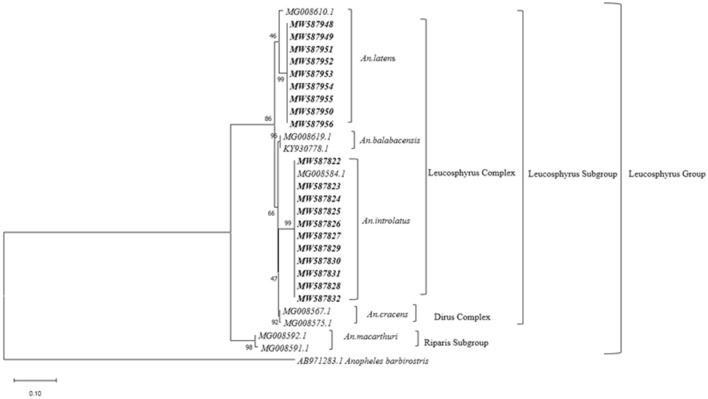
Anopheles mosquitoes were collected from the location where P. knowlesi cases were reported. Cases of knowlesi malaria from 2011 to 2019 in Johor were analyzed. Internal transcribed spacers 2 (ITS2) and cytochrome c oxidase subunit I (COI) genes were used to identify the Leucosphyrus Group of Anopheles mosquitoes. In addition, spatial analysis was carried out on the knowlesi cases and vectors in Johor.
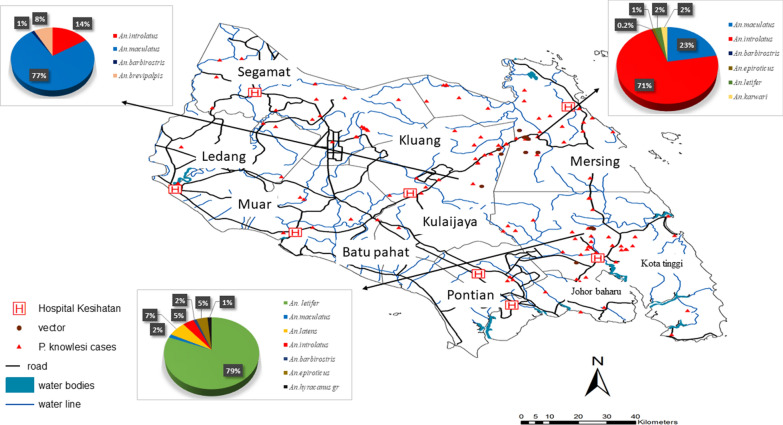
One hundred and eighty-nine cases of P. knowlesi were reported in Johor over 10 years. Young adults between the ages of 20-39 years comprised 65% of the cases. Most infected individuals were involved in agriculture and army-related occupations (22% and 32%, respectively). Four hundred and eighteen Leucosphyrus Group Anopheles mosquitoes were captured during the study. Anopheles introlatus was the predominant species, followed by Anopheles latens. Spatial analysis by Kriging interpolation found that hotspot regions of P. knowlesi overlapped or were close to the areas where An. introlatus and An. latens were found. A significantly high number of vectors and P. knowlesi cases were found near the road within 0-5 km.
This study describes the distribution of P. knowlesi cases and Anopheles species in malaria-endemic transmission areas in Johor. Geospatial analysis is a valuable tool for studying the relationship between vectors and P. knowlesi cases. This study further supports that the Leucosphyrus Group of mosquitoes might be involved in transmitting knowlesi malaria cases in Johor. These findings may provide initial evidence to prioritize diseases and vector surveillance.
在马来西亚柔佛州,随着恶性疟原虫和间日疟原虫感染的减少,食蟹猴疟原虫感染呈上升趋势。因此,本研究旨在确定柔佛州与传播食蟹猴疟原虫相关的媒介的分布。这一发现对于估计有针对性控制策略的热点地区至关重要。
从报告有食蟹猴疟病例的地点收集按蚊。分析了 2011 年至 2019 年柔佛州的食蟹猴疟病例。使用内转录间隔区 2(ITS2)和细胞色素 c 氧化酶亚单位 I(COI)基因来鉴定按蚊的 Leucosphyrus 组。此外,还对柔佛州的食蟹猴病例和媒介进行了空间分析。
在 10 年的时间里,柔佛州报告了 189 例食蟹猴疟病例。20-39 岁的年轻人占病例的 65%。大多数受感染的人从事农业和军队相关的职业(分别为 22%和 32%)。在研究期间共捕获了 418 只 Leucosphyrus 组按蚊。按蚊 introlatus 是主要的物种,其次是按蚊 latens。Kriging 插值的空间分析发现,食蟹猴疟的热点区域与发现按蚊 introlatus 和按蚊 latens 的区域重叠或接近。在 0-5 公里范围内靠近道路的地方发现了大量的媒介和食蟹猴疟病例。
本研究描述了柔佛州疟疾传播地区食蟹猴疟病例和按蚊种类的分布。地理空间分析是研究媒介与食蟹猴疟病例之间关系的一种有价值的工具。本研究进一步表明,Leucosphyrus 组蚊子可能参与了柔佛州食蟹猴疟的传播。这些发现可能为优先考虑疾病和媒介监测提供初步证据。