Clinical Research Centre, Hospital Taiping, Ministry of Health, 34000, Taiping, Perak, Malaysia.
Department of Parasitology, Faculty of Medicine, University of Malaya, Kuala Lumpur, Malaysia.
Malar J. 2020 Jan 31;19(1):55. doi: 10.1186/s12936-020-3135-x.
To date, most of the recent publications on malaria in Malaysia were conducted in Sabah, East Malaysia focusing on the emergence of Plasmodium knowlesi. This analysis aims to describe the incidence, mortality and case fatality rate of malaria caused by all Plasmodium species between Peninsular Malaysia and East Malaysia (Sabah and Sarawak) over a 5-year period (2013-2017).
This is a secondary data review of all diagnosed and reported malaria confirmed cases notified to the Ministry of Health, Malaysia between January 2013 and December 2017.
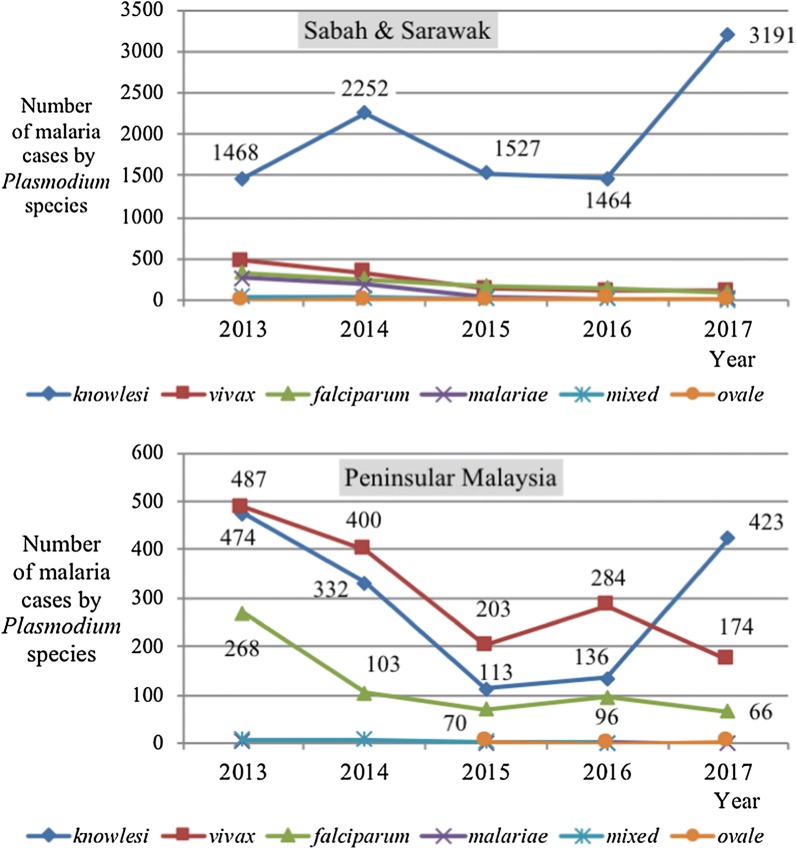
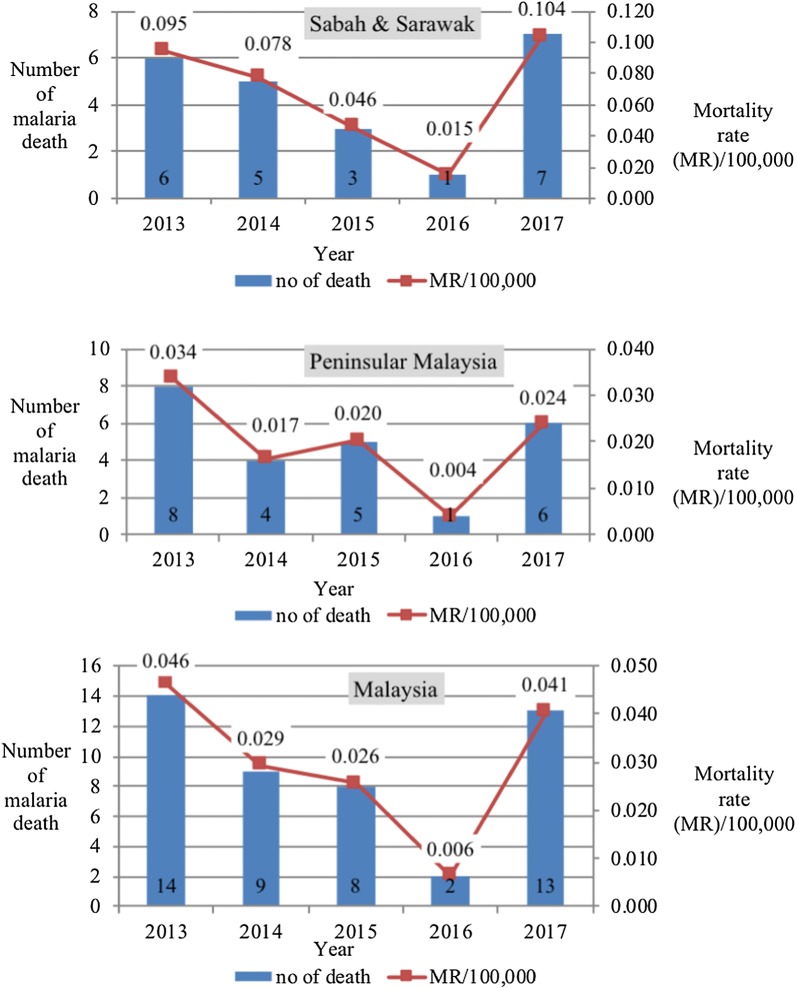
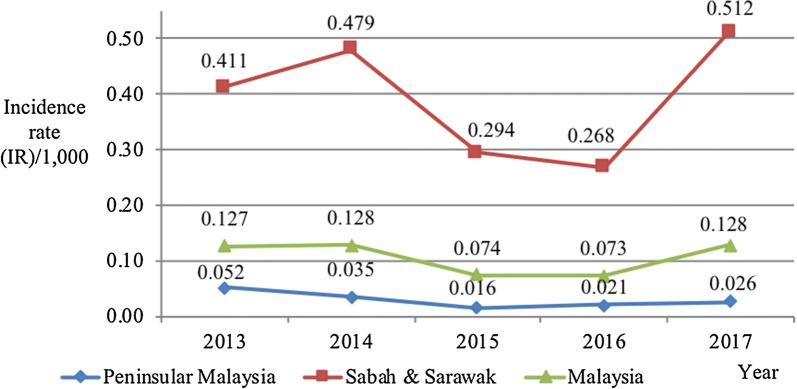
From 2013 to 2017, a total of 16,500 malaria cases were notified in Malaysia. The cases were mainly contributed from Sabah (7150; 43.3%) and Sarawak (5684; 34.4%). Majority of the patients were male (13,552; 82.1%). The most common age group in Peninsular Malaysia was 20 to 29 years (1286; 35.1%), while Sabah and Sarawak reported highest number of malaria cases in age group of 30 to 39 years (2776; 21.6%). The top two races with malaria in Sabah and Sarawak were Bumiputera Sabah (5613; 43.7%) and Bumiputera Sarawak (4512; 35.1%), whereas other ethnic group (1232; 33.6%) and Malays (1025; 28.0%) were the two most common races in Peninsular Malaysia. Plasmodium knowlesi was the commonest species in Sabah and Sarawak (9902; 77.1%), while there were more Plasmodium vivax cases (1548; 42.2%) in Peninsular Malaysia. The overall average incidence rate, mortality rate and case fatality rates for malaria from 2013 to 2017 in Malaysia were 0.106/1000, 0.030/100,000 and 0.27%, respectively. Sarawak reported the highest average incidence rate of 0.420/1000 population followed by Sabah (0.383/1000). Other states in Peninsular Malaysia reported below the national average incidence rate with less than 0.100/1000.
There were different trends and characteristics of notified malaria cases in Peninsular Malaysia and Sabah and Sarawak. They provide useful information to modify current prevention and control measures so that they are customised to the peculiarities of disease patterns in the two regions in order to successfully achieve the pre-elimination of human-only species in the near future.
迄今为止,马来西亚最近发表的大多数疟疾相关出版物均来自东马来西亚的沙巴州,重点关注疟原虫 knowlesi 的出现。本分析旨在描述在过去 5 年(2013-2017 年)期间,马来西亚半岛和东马来西亚(沙巴和砂拉越)所有疟原虫引起的疟疾的发病率、死亡率和病死率。
这是对 2013 年 1 月至 2017 年 12 月期间向马来西亚卫生部报告和确诊的所有疟疾确诊病例的二次数据分析。
2013 年至 2017 年期间,马来西亚共报告了 16500 例疟疾病例。这些病例主要来自沙巴州(7150 例;43.3%)和砂拉越州(5684 例;34.4%)。大多数患者为男性(13552 例;82.1%)。在马来西亚半岛,最常见的年龄组为 20 至 29 岁(1286 例;35.1%),而沙巴州和砂拉越州报告的 30 至 39 岁年龄组疟疾病例数量最多(2776 例;21.6%)。沙巴州和砂拉越州疟疾病例最多的两个种族是沙巴土著(5613 例;43.7%)和砂拉越土著(4512 例;35.1%),而其他种族(1232 例;33.6%)和马来人(1025 例;28.0%)是马来西亚半岛最常见的两个种族。在沙巴州和砂拉越州,疟原虫 knowlesi 是最常见的物种(9902 例;77.1%),而在马来西亚半岛,疟原虫 vivax 病例更多(1548 例;42.2%)。2013 年至 2017 年期间,马来西亚疟疾的总发病率、死亡率和病死率分别为 0.106/1000、0.030/100000 和 0.27%。砂拉越州报告的疟疾发病率最高,为 0.420/1000 人,其次是沙巴州(0.383/1000)。马来西亚半岛的其他州报告的发病率低于全国平均水平,低于 0.100/1000。
马来西亚半岛和沙巴州、砂拉越州的疟疾病例报告有不同的趋势和特征。这些信息有助于修改当前的预防和控制措施,以便根据这两个地区疾病模式的特点进行调整,以便在不久的将来成功实现人类疟原虫的消除目标。