Sambal Hilla, Bohon Cara, Weinbach Noam
School of Psychological Sciences, University of Haifa, Abba Khoushy Ave 199, 3498838, Haifa, Israel.
Department of Psychiatry and Behavioral Sciences, Stanford University School of Medicine, Stanford, CA, USA.
J Eat Disord. 2021 Oct 29;9(1):140. doi: 10.1186/s40337-021-00497-3.
Emotional eating refers to overeating triggered by emotional experiences and may cause significant psychological distress and health problems. Thus, it is important to better understand its underlying mechanisms. The study examined if the ability to ignore task-irrelevant information, namely, interference control, is modulated by mood and exposure to food stimuli among females who are high and low on emotional eating.
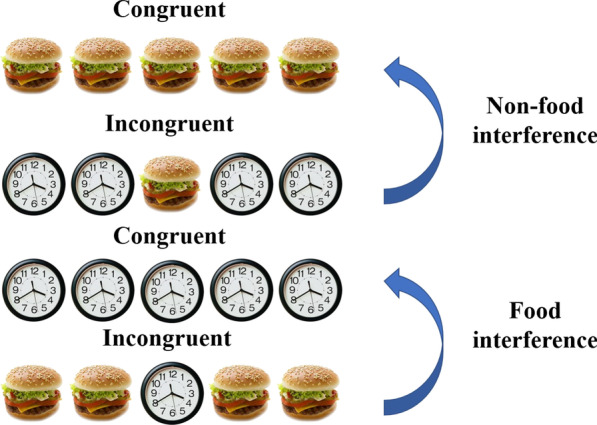
The study's sample included 80 women who were high (N = 40) or low (N = 40) on an emotional eating scale. Participants were divided to a negative or neutral mood induction group. Following the mood induction, they completed a food-flanker task that allowed assessing attentional interference caused by food and non-food stimuli separately.
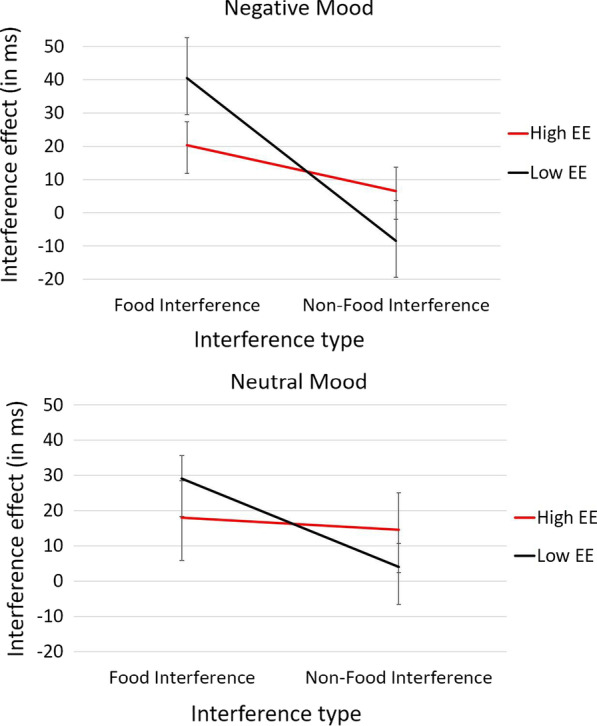
The low emotional eating group had significantly greater food compared to non-food interference, suggesting difficulty at ignoring food stimuli while attending a neutral target. In the high emotional eating group, there was no difference between food and non-food interference. However, higher levels of emotional eating predicted lower levels of food interference.
The pattern of results suggests a food-avoidance attentional tendency among those with higher levels of emotional eating. The mood manipulation did not influence food-related interference in either group. The lack of an effect of mood on food-related interference questions the impact of negative emotions on basic attentional processes among individuals with emotional eating.
情绪化进食是指由情绪体验引发的暴饮暴食,可能会导致严重的心理困扰和健康问题。因此,更好地理解其潜在机制很重要。该研究考察了在情绪化进食程度高和低的女性中,忽略与任务无关信息的能力,即干扰控制,是否会受到情绪和食物刺激暴露的调节。
该研究样本包括80名女性,她们在情绪化进食量表上得分高(N = 40)或低(N = 40)。参与者被分为消极或中性情绪诱导组。情绪诱导后,她们完成了一项食物侧抑制任务,该任务允许分别评估由食物和非食物刺激引起的注意力干扰。
与非食物干扰相比,低情绪化进食组的食物干扰明显更大,这表明在关注中性目标时难以忽略食物刺激。在高情绪化进食组中,食物干扰和非食物干扰之间没有差异。然而,更高水平的情绪化进食预示着更低水平的食物干扰。
结果模式表明,在情绪化进食水平较高的人群中存在一种避免食物的注意力倾向。情绪操纵对两组中的食物相关干扰均无影响。情绪对食物相关干扰缺乏影响,这对消极情绪对情绪化进食个体基本注意力过程产生的影响提出了质疑。