Department of Public Health, Institute of Health Sciences, Wollega University, Nekemte, Oromia, Ethiopia
School of Public Health, University of Technology Sydney, Sydney, New South Wales, Australia.
BMJ Glob Health. 2021 Oct;6(10). doi: 10.1136/bmjgh-2021-007074.
Improved access to and quality obstetric care in health facilities reduces maternal and neonatal morbidity and mortality. We examined spatial patterns, within-country wealth-related inequalities and predictors of inequality in skilled birth attendance and caesarean deliveries in sub-Saharan Africa.
We analysed the most recent Demographic and Health Survey data from 25 sub-Saharan African countries. We used the concentration index to measure within-country wealth-related inequality in skilled birth attendance and caesarean section. We fitted a multilevel Poisson regression model to identify predictors of inequality in having skilled attendant at birth and caesarean section.
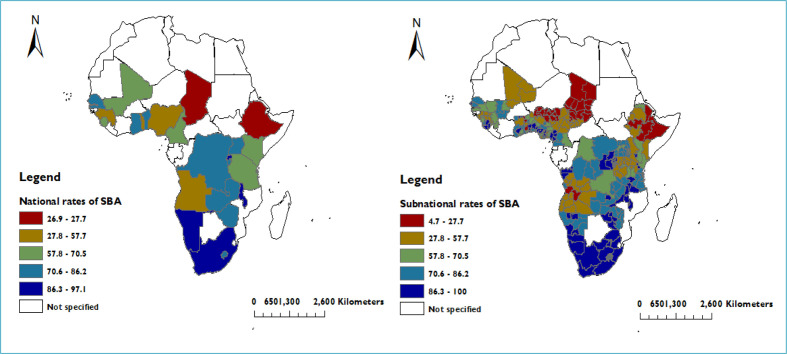
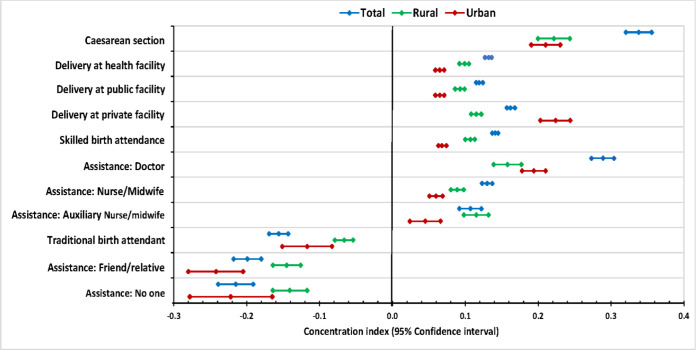
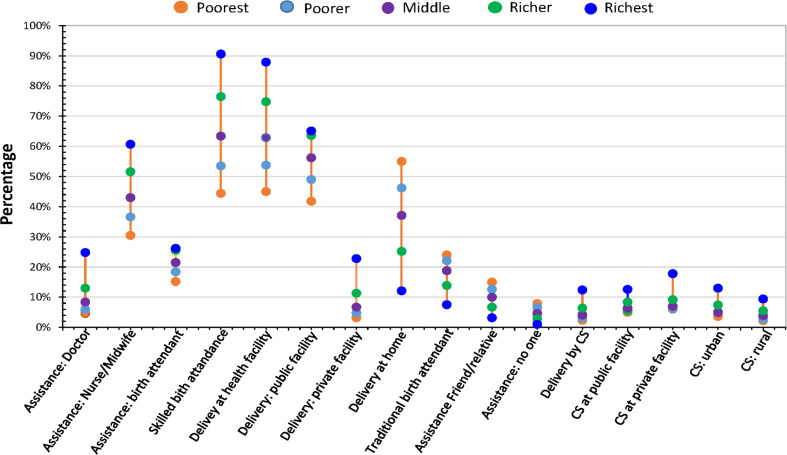
The rate of skilled birth attendance ranged from 24.3% in Chad to 96.7% in South Africa. The overall coverage of caesarean delivery was 5.4% (95% CI 5.2% to 5.6%), ranging from 1.4% in Chad to 24.2% in South Africa. The overall wealth-related absolute inequality in having a skilled attendant at birth was extremely high, with a difference of 46.2 percentage points between the poorest quintile (44.4%) and the richest quintile (90.6%). In 10 out of 25 countries, the caesarean section rate was less than 1% among the poorest quintile, but the rate was more than 15% among the richest quintile in nine countries. Four or more antenatal care contacts, improved maternal education, higher household wealth status and frequently listening to the radio increased the rates of having skilled attendant at birth and caesarean section. Women who reside in rural areas and those who have to travel long distances to access health facilities were less likely to have skilled attendant at birth or caesarean section.
There were significant within-country wealth-related inequalities in having skilled attendant at birth and caesarean delivery. Efforts to improve access to birth at the facility should begin in areas with low coverage and directly consider the needs and experiences of vulnerable populations.
改善卫生机构获得和提供产科护理的机会并提高其质量,可以降低孕产妇和新生儿发病率和死亡率。我们研究了撒哈拉以南非洲国家熟练接生和剖宫产的空间模式、国内与财富相关的不平等现象以及不平等的预测因素。
我们分析了来自撒哈拉以南非洲 25 个国家的最新人口与健康调查数据。我们使用集中指数来衡量国内与财富相关的熟练接生和剖宫产不平等现象。我们拟合了多水平泊松回归模型,以确定影响熟练接生和剖宫产的不平等的预测因素。
熟练接生率从乍得的 24.3%到南非的 96.7%不等。剖宫产的总体覆盖率为 5.4%(95%CI 5.2%至 5.6%),从乍得的 1.4%到南非的 24.2%不等。在有熟练接生人员接生的情况下,总体财富相关的绝对不平等程度极高,最贫穷的五分之一(44.4%)和最富有的五分之一(90.6%)之间的差异为 46.2 个百分点。在 25 个国家中的 10 个国家,最贫穷的五分之一中剖宫产率不到 1%,而在 9 个国家中最富有的五分之一中剖宫产率超过 15%。有 4 次或更多次产前保健接触、母亲教育水平提高、家庭财富状况较好以及经常听广播,这些都提高了熟练接生和剖宫产的比率。居住在农村地区的妇女和需要长途跋涉才能获得医疗服务的妇女不太可能接受熟练的接生或剖宫产。
国内熟练接生和剖宫产存在显著的与财富相关的不平等现象。改善在机构内分娩的机会的努力应从覆盖率较低的地区开始,并直接考虑弱势群体的需求和经验。