Human Nutrition Research Centre, Population Health Sciences Institute, Newcastle University, Newcastle upon Tyne, NE2 4HH, UK.
Biosciences Institute, Newcastle University, Newcastle upon Tyne, NE2 4HH, UK.
Int J Obes (Lond). 2022 Feb;46(2):333-341. doi: 10.1038/s41366-021-01005-y. Epub 2021 Oct 29.
BACKGROUND/OBJECTIVES: Obesity increases colorectal cancer (CRC) risk. However, the effects of weight loss on CRC risk are unclear. Epigenetic mechanisms involving microRNAs that lead to dysregulated gene expression may mediate the effects of obesity and weight loss on CRC risk. We examined the effects of obesity and weight loss following Roux-en-Y gastric bypass (RYGB) on microRNA expression in the human rectal mucosa.
SUBJECTS/METHODS: We collected rectal mucosal biopsies from obese patients (n = 22) listed for RYGB and age- and sex-matched healthy non-obese Controls (n = 20), at baseline and six months post-surgery. We quantified microRNA expression in rectal mucosal biopsies using Next Generation Sequencing and bioinformatics analysis to investigate the likely functional consequences of these epigenetic changes.
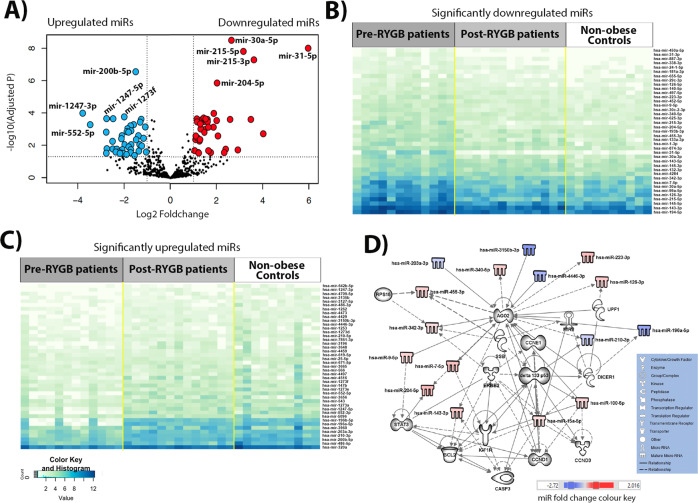
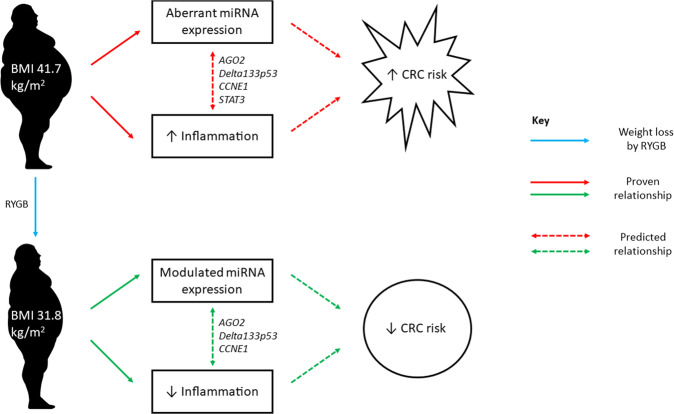
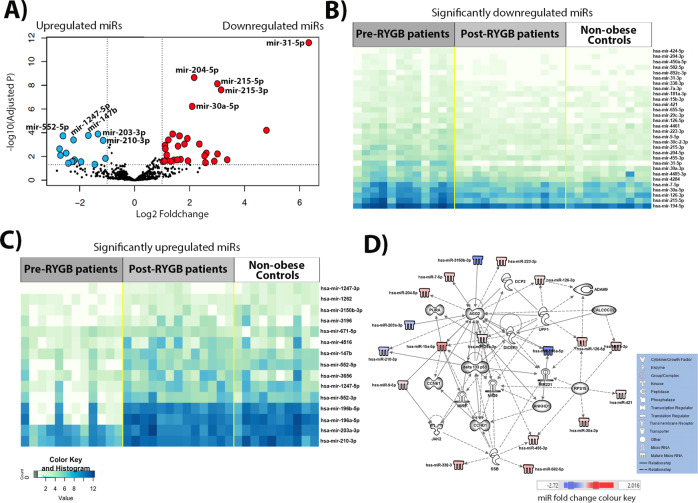
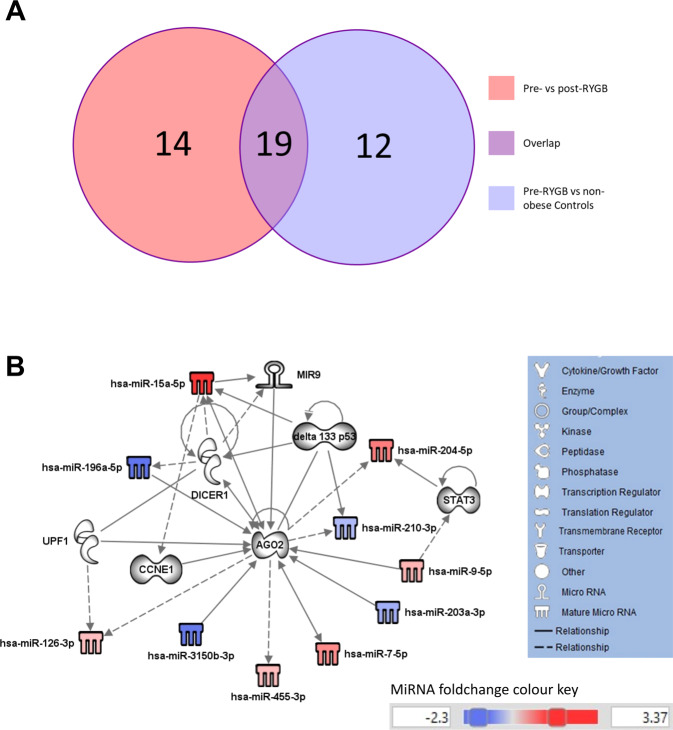
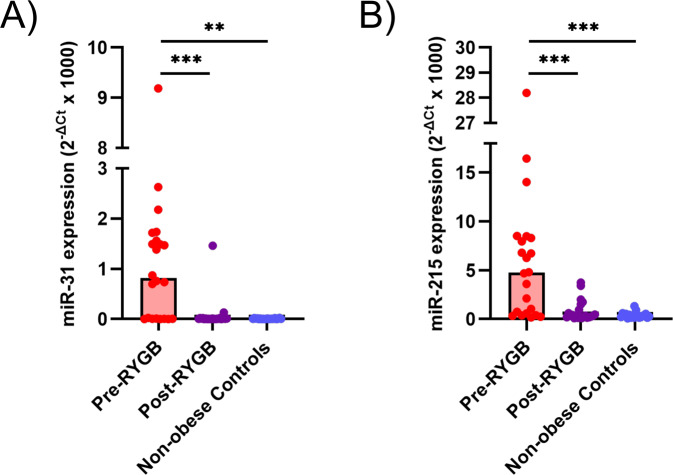
Compared with non-obese individuals, obese individuals showed differential expression of 112 microRNAs (p < 0.05). At six-months post-RYGB, when mean body mass had fallen by 27 kg, 60 microRNAs were differentially expressed, compared with baseline (p < 0.05). The expression of 36 microRNAs differed significantly between both i) obese and non-obese individuals and ii) obese individuals pre- and post-RYGB. Quantitative polymerase chain reaction (qPCR) demonstrated that expression of miR-31 and miR-215 was significantly (p < 0.05) higher, 143-fold and 15-fold respectively, in obese than in non-obese individuals. Weight loss, following RYGB, reduced expression of miR-31 and miR-215 to levels comparable with Controls. These differentially expressed microRNAs are implicated in pathways linked with inflammation, obesity and cancer.
Our findings show, for the first time, that obesity is associated with dysregulated microRNA expression in the human rectal mucosa. Further, surgically-induced weight loss may normalise microRNA expression in this tissue.
背景/目的:肥胖会增加结直肠癌(CRC)的风险。然而,减肥对 CRC 风险的影响尚不清楚。涉及 microRNA 的表观遗传机制可能导致基因表达失调,从而介导肥胖和减肥对 CRC 风险的影响。我们研究了肥胖和 Roux-en-Y 胃旁路手术后(RYGB)减肥对人直肠黏膜中 microRNA 表达的影响。
受试者/方法:我们收集了 22 名接受 RYGB 治疗的肥胖患者(肥胖组)和 20 名年龄和性别匹配的健康非肥胖对照者(对照组)的直肠黏膜活检组织,分别在基线和术后 6 个月时采集。我们使用下一代测序和生物信息学分析来定量直肠黏膜活检组织中的 microRNA 表达,以研究这些表观遗传变化的可能功能后果。
与非肥胖个体相比,肥胖个体的 112 种 microRNA 表达存在差异(p<0.05)。在 RYGB 术后 6 个月时,当平均体重下降 27kg 时,与基线相比,有 60 种 microRNA 表达发生差异(p<0.05)。肥胖和非肥胖个体之间以及肥胖个体术前和术后之间存在显著差异的 microRNA 表达有 36 种。定量聚合酶链反应(qPCR)显示,与非肥胖个体相比,miR-31 和 miR-215 的表达分别高出 143 倍和 15 倍(p<0.05)。RYGB 后的体重减轻使 miR-31 和 miR-215 的表达降低到与对照组相当的水平。这些差异表达的 microRNA 与炎症、肥胖和癌症相关的途径有关。
我们的研究结果首次表明,肥胖与人类直肠黏膜中 microRNA 表达失调有关。此外,手术诱导的体重减轻可能使该组织中的 microRNA 表达恢复正常。