School of Exercise and Nutrition Sciences, Faculty of Health, Queensland University of Technology (QUT), Brisbane, Australia.
Menzies Health Institute Queensland, The Hopkins Centre, Griffith University, Brisbane, Australia.
Geroscience. 2021 Dec;43(6):2719-2735. doi: 10.1007/s11357-021-00478-z. Epub 2021 Oct 30.
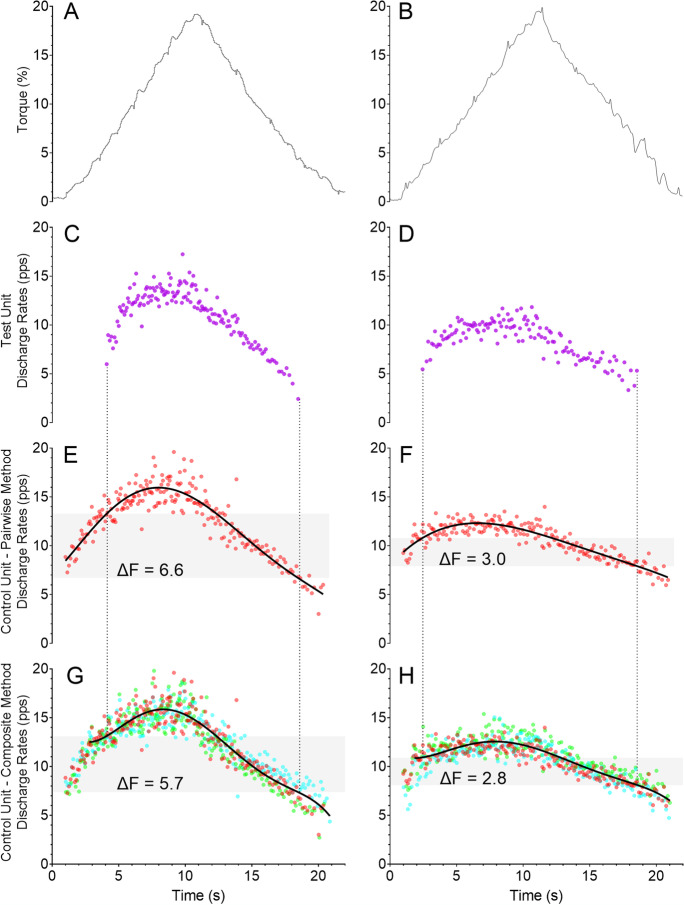
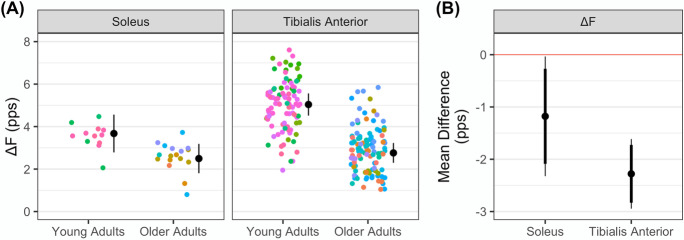
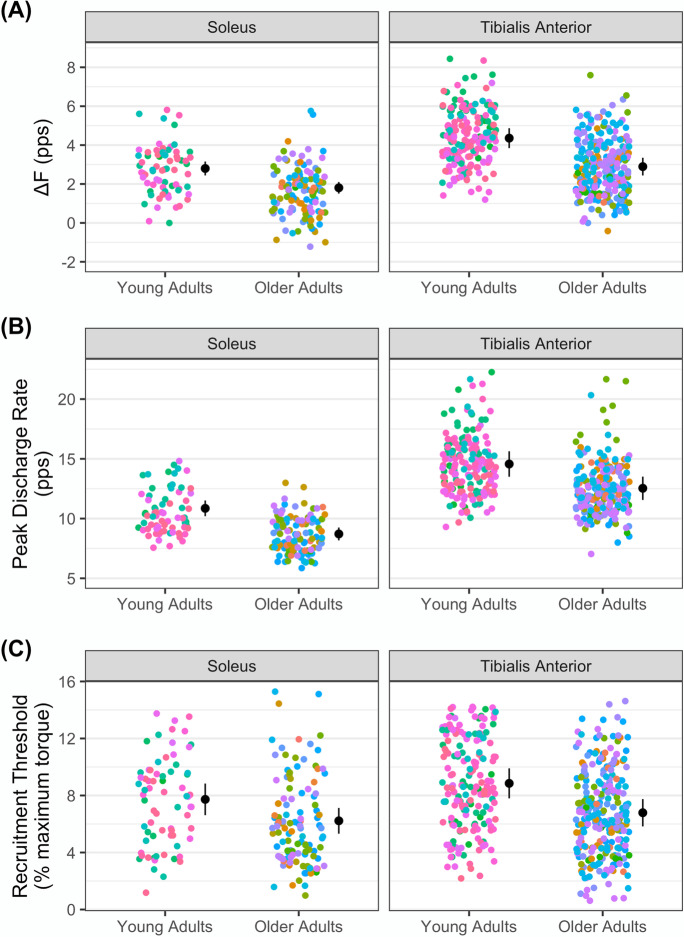
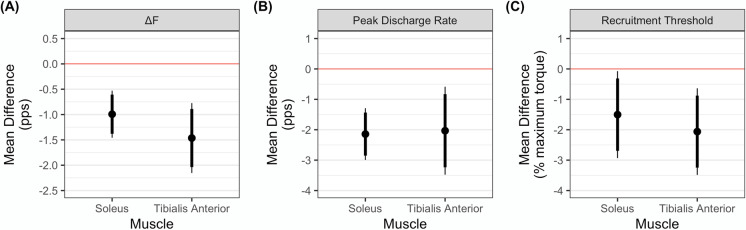
Age-related deterioration within both motoneuron and monoaminergic systems should theoretically reduce neuromodulation by weakening motoneuronal persistent inward current (PIC) amplitude. However, this assumption remains untested. Surface electromyographic signals were collected using two 32-channel electrode matrices placed on soleus and tibialis anterior of 25 older adults (70 ± 4 years) and 17 young adults (29 ± 5 years) to investigate motor unit discharge behaviors. Participants performed triangular-shaped plantar and dorsiflexion contractions to 20% of maximum torque at a rise-decline rate of 2%/s of each participant's maximal torque. Pairwise and composite paired-motor unit analyses were adopted to calculate delta frequency (ΔF), which has been used to differentiate between the effects of synaptic excitation and intrinsic motoneuronal properties and is assumed to be proportional to PIC amplitude. Soleus and tibialis anterior motor units in older adults had lower ΔFs calculated with either the pairwise [-0.99 and -1.46 pps; -35.4 and -33.5%, respectively] or composite (-1.18 and -2.28 pps; -32.1 and -45.2%, respectively) methods. Their motor units also had lower peak discharge rates (-2.14 and -2.03 pps; -19.7 and -13.9%, respectively) and recruitment thresholds (-1.50 and -2.06% of maximum, respectively) than young adults. These results demonstrate reduced intrinsic motoneuron excitability during low-force contractions in older adults, likely mediated by decreases in the amplitude of persistent inward currents. Our findings might be explained by deterioration in the motoneuron or monoaminergic systems and could contribute to the decline in motor function during aging; these assumptions should be explicitly tested in future investigations.
年龄相关的运动神经元和单胺能系统的退化理论上会削弱运动神经元持续内向电流(PIC)的幅度,从而降低神经调节作用。然而,这一假设仍未得到验证。本研究使用两个 32 通道电极矩阵分别采集 25 名老年人(70±4 岁)和 17 名年轻人(29±5 岁)的比目鱼肌和胫骨前肌的表面肌电信号,以研究运动单位放电行为。参与者以 2%/s 的上升-下降速率进行 20%最大扭矩的三角型跖屈和背屈收缩,该速率为每个参与者最大扭矩的 2%。采用成对和复合成对运动单位分析来计算ΔF(ΔF 已被用于区分突触兴奋和内在运动神经元特性的影响,并且假定与 PIC 幅度成正比)。与年轻人相比,老年人的比目鱼肌和胫骨前肌运动单位的ΔF 值较低(分别为-0.99 和-1.46pps;-35.4 和-33.5%),复合分析方法的计算结果更低(-1.18 和-2.28pps;-32.1 和-45.2%)。他们的运动单位的峰值放电率(-2.14 和-2.03pps;-19.7 和-13.9%)和募集阈值(分别为-1.50 和-2.06%的最大,分别)也较低。这些结果表明,老年人在低力收缩时内在运动神经元兴奋性降低,这可能是由于持续内向电流幅度的降低所致。我们的发现可以用运动神经元或单胺能系统的退化来解释,并可能导致衰老过程中运动功能的下降;这些假设应该在未来的研究中得到明确验证。