Department of Critical Care Medicine, The Second Affiliated Hospital of Harbin Medical University, Harbin 150086, Heilongjiang Province, China.
Department of Critical Care Medicine, The First Affiliated Hospital of Harbin Medical University, Harbin 150001, Heilongjiang Province, China.
World J Gastroenterol. 2021 Oct 14;27(38):6453-6464. doi: 10.3748/wjg.v27.i38.6453.
Acute kidney injury (AKI) is one of the most common acute pancreatitis (AP)-associated complications that has a significant effect on AP, but the factors affecting the AP patients' survival rate remains unclear.
To assess the influences of AKI on the survival rate in AP patients.
A total of 139 AP patients were included in this retrospective study. Patients were divided into AKI group ( = 72) and non-AKI group ( = 67) according to the occurrence of AKI. Data were collected from medical records of hospitalized patients. Then, these data were compared between the two groups and further analysis was performed.
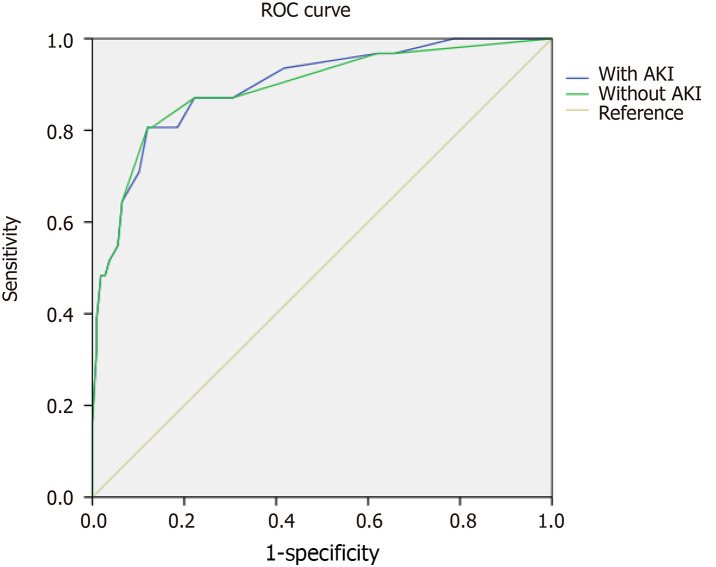
AKI is more likely to occur in male AP patients ( = 0.009). AP patients in AKI group exhibited a significantly higher acute physiologic assessment and chronic health evaluation II score, higher Sequential Organ Failure Assessment score, lower Glasgow Coma Scale score, and higher demand for mechanical ventilation, infusion of vasopressors, and renal replacement therapy than AP patients in non-AKI group ( < 0.01, < 0.01, = 0.01, = 0.001, < 0.01, < 0.01, respectively). Significant differences were noted in dose of norepinephrine and adrenaline, duration of mechanical ventilation, maximum and mean values of intra-peritoneal pressure (IPP), maximum and mean values of procalcitonin, maximum and mean serum levels of creatinine, minimum platelet count, and length of hospitalization. Among AP patients with AKI, the survival rate of surgical intensive care unit and in-hospital were only 23% and 21% of the corresponding rates in AP patients without AKI, respectively. The factors that influenced the AP patients' survival rate included body mass index (BMI), mean values of IPP, minimum platelet count, and hospital day, of which mean values of IPP showed the greatest impact.
AP patients with AKI had a lower survival rate and worse relevant clinical outcomes than AP patients without AKI, which necessitates further attention to AP patients with AKI in surgical intensive care unit.
急性肾损伤(AKI)是急性胰腺炎(AP)最常见的并发症之一,对 AP 有重大影响,但影响 AP 患者生存率的因素尚不清楚。
评估 AKI 对 AP 患者生存率的影响。
本回顾性研究纳入了 139 例 AP 患者。根据 AKI 的发生情况,患者被分为 AKI 组(n=72)和非 AKI 组(n=67)。从住院患者的病历中收集数据。然后,对两组数据进行比较,并进行进一步分析。
AKI 更易发生于男性 AP 患者(=0.009)。AKI 组的 AP 患者急性生理和慢性健康评估 II 评分更高,序贯器官衰竭评估评分更高,格拉斯哥昏迷量表评分更低,对机械通气、血管加压素输注和肾脏替代治疗的需求更高,而非 AKI 组的 AP 患者则更低(<0.01,<0.01,=0.01,=0.001,<0.01,<0.01,分别)。两组患者的去甲肾上腺素和肾上腺素剂量、机械通气时间、腹腔内压(IPP)的最大值和平均值、降钙素原的最大值和平均值、血清肌酐的最大值和平均值、血小板计数的最小值和住院时间均存在显著差异。在 AKI 的 AP 患者中,外科重症监护病房和院内的生存率分别仅为非 AKI 的 AP 患者的 23%和 21%。影响 AP 患者生存率的因素包括体重指数(BMI)、IPP 的平均值、血小板计数的最小值和住院天数,其中 IPP 的平均值影响最大。
与非 AKI 的 AP 患者相比,AKI 的 AP 患者的生存率更低,临床相关结局更差,因此需要对外科重症监护病房中 AKI 的 AP 患者给予进一步关注。