Jiang Yutong, Yang Mingcan, Zhang Yanli, Huang Yefei, Wu Jialing, Xie Ya, Wei Qiujing, Liao Zetao, Gu Jieruo
Department of Rheumatology and Immunology, Third Affiliated Hospital of Sun Yat-sen University, Guangzhou, China.
Front Pharmacol. 2021 Oct 14;12:738316. doi: 10.3389/fphar.2021.738316. eCollection 2021.
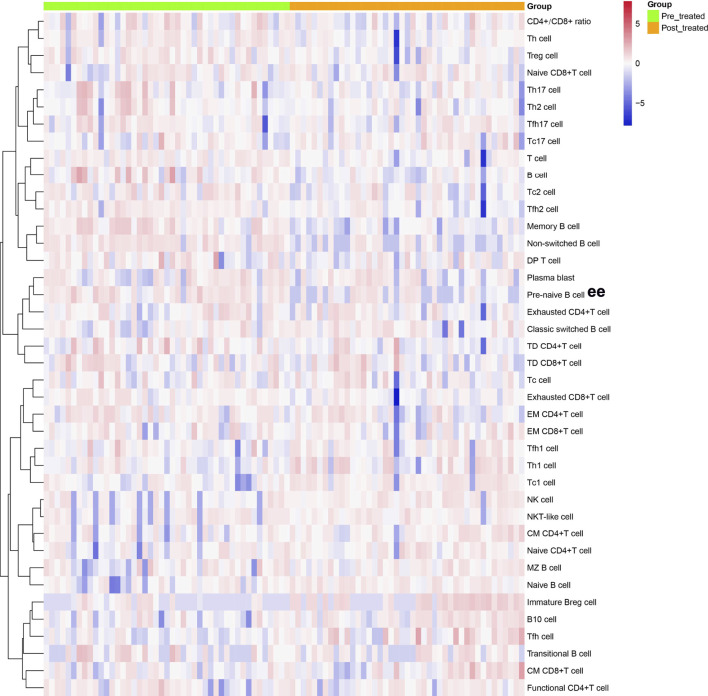
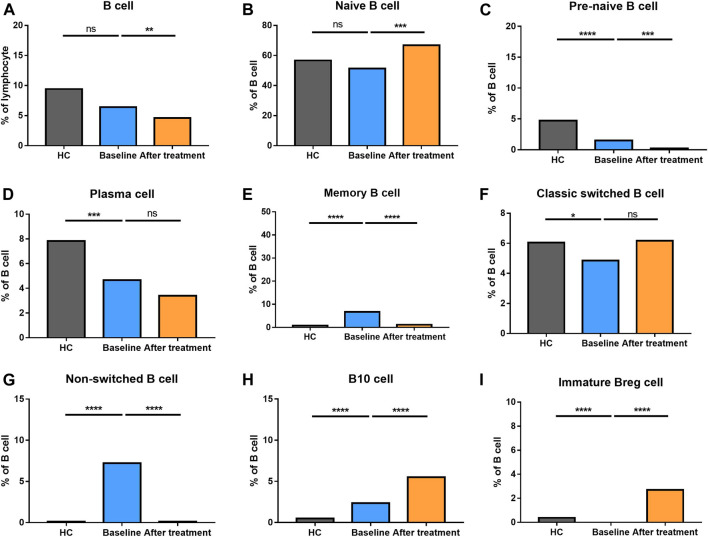
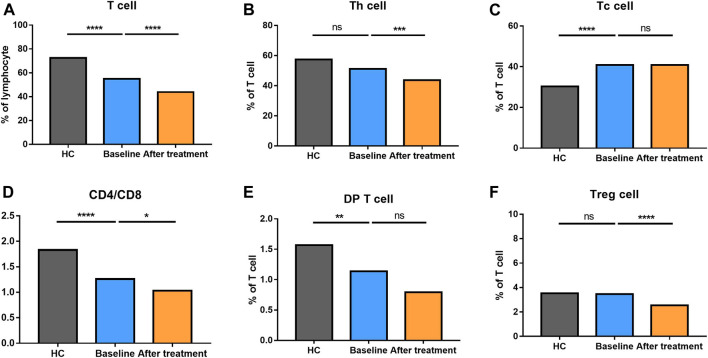
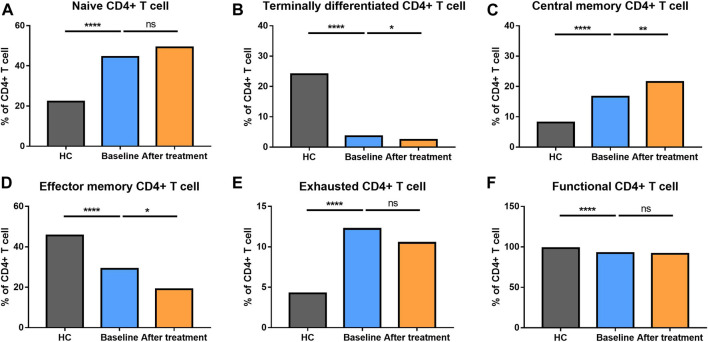
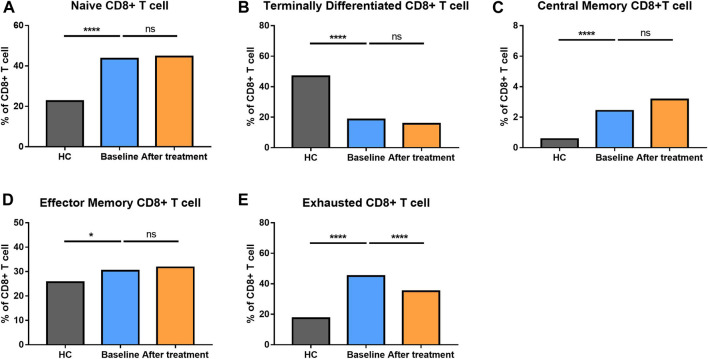
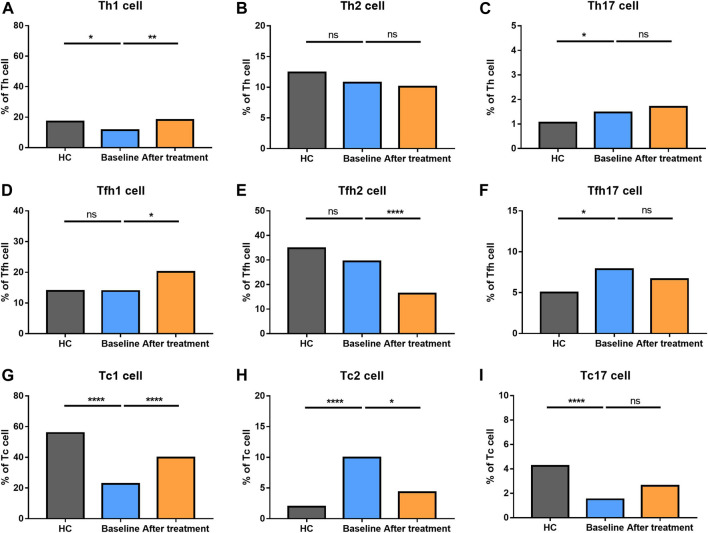
Anti-IL-17A therapy is generally effectively applied in patients with Ankylosing Spondylitis (AS) to achieve and maintain remission. However, the influence of anti-IL-17A on the composition of the immune system is not apparent. Our prospective study was to explore the changes in immune imbalance regarding T cell, B cell and natural killer (NK) cell subsets after secukinumab treatment in AS patients. Immune cell distribution of 43 AS patients treated with secukinumab for 12 weeks and 47 healthy controls (HC) were evaluated. Flow cytometry using monoclonal antibodies against 25 surface markers was accomplished to explore the frequencies of lineage subsets. The differences between HC, AS pre-treatment, and post-treatment were compared using the paired Wilcoxon test, Mann-Whitney test, and ANOVA. AS patients had altered immune cell distribution regarding T cell and B cell subsets. Apart from activated differentiation of CD4 T cell, CD8 T cell and B cell, higher levels of cytotoxic T (Tc) two cells and Tc17 cells were noted in AS patients. We confirmed that helper T (Th) one cell became decreased; however, Th17 cells and T follicular helper (Tfh) 17 cells went increased in AS. After 12 weeks of secukinumab therapy, CRP and ASDAS became significantly decreased, and meanwhile, the proportions of Th1 cells, Tfh17 cells and classic switched B cells were changed towards those of HC. A decreased CRP was positively correlated with a decrease in the frequency of naïve CD8 T cells ( 0.039) and B cells ( 0.007) after secukinumab treatment. An elevated level of T cells at baseline was detected in patients who had a good response to secukinumab ( = 0.005). Our study confirmed that AS patients had significant multiple immune cell dysregulation. Anti-IL-17A therapy (Secukinumab) could reverse partial immune cell imbalance.
抗白细胞介素-17A(IL-17A)疗法通常有效地应用于强直性脊柱炎(AS)患者,以实现并维持病情缓解。然而,抗IL-17A对免疫系统组成的影响尚不明显。我们的前瞻性研究旨在探讨司库奇尤单抗治疗AS患者后T细胞、B细胞和自然杀伤(NK)细胞亚群免疫失衡的变化。评估了43例接受司库奇尤单抗治疗12周的AS患者和47例健康对照(HC)的免疫细胞分布。使用针对25种表面标志物的单克隆抗体进行流式细胞术,以探究谱系亚群的频率。使用配对威尔科克森检验、曼-惠特尼检验和方差分析比较HC、AS治疗前和治疗后的差异。AS患者的T细胞和B细胞亚群免疫细胞分布发生改变。除了CD4 T细胞、CD8 T细胞和B细胞的活化分化外,AS患者中细胞毒性T(Tc)2细胞和Tc17细胞水平较高。我们证实辅助性T(Th)1细胞减少;然而,AS患者中Th17细胞和滤泡辅助性T(Tfh)17细胞增加。司库奇尤单抗治疗12周后,C反应蛋白(CRP)和强直性脊柱炎疾病活动度评分(ASDAS)显著降低,同时,Th1细胞、Tfh17细胞和经典转换B细胞的比例向HC的比例变化。司库奇尤单抗治疗后CRP降低与初始CD8 T细胞(r = 0.039)和B细胞(r = 0.007)频率降低呈正相关。对司库奇尤单抗反应良好的患者在基线时检测到T细胞水平升高(P = 0.005)。我们的研究证实AS患者存在明显的多种免疫细胞失调。抗IL-17A疗法(司库奇尤单抗)可逆转部分免疫细胞失衡。