Department of Health Sciences and Sport Medicine, Hungarian University of Sports Science, 1123 Budapest, Hungary.
Department of Ophthalmology, Semmelweis University, 1085 Budapest, Hungary.
Int J Mol Sci. 2023 Oct 22;24(20):15455. doi: 10.3390/ijms242015455.
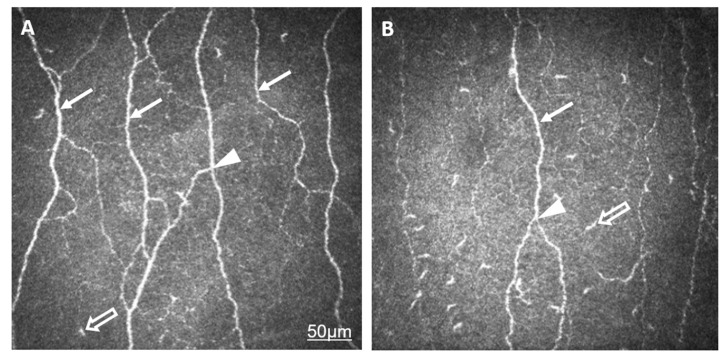
This study aimed at analyzing the corneal neural regeneration in ankylosing spondylitis patients using in vivo corneal confocal microscopy in correlation with Langerhans cell density, morphology, and dry eye parameters. Approximately 24 ankylosing spondylitis subjects and 35 age- and gender-matched control subjects were enrolled. Data analysis showed that all corneal nerve-fiber descriptives were lower in the ankylosing spondylitis group, implicating disrupted neural regeneration. Peripheral Langerhans cell density showed a negative correlation with nerve fiber descriptions. A negative correlation between tear film break-up time and corneal nerve fiber total branch density was detected. The potential role of somatosensory terminal Piezo2 channelopathy in the pathogenesis of dry eye disease and ankylosing spondylitis is highlighted in our study, exposing the neuroimmunological link between these diseases. We hypothesized earlier that spinal neuroimmune-induced sensitization due to this somatosensory terminal primary damage could lead to Langerhans cell activation in the cornea, in association with downregulated Piezo1 channels on these cells. This activation could lead to a Th17/Treg imbalance in dry eye secondary to ankylosing spondylitis. Hence, the corneal Piezo2 channelopathy-induced impaired Piezo2-Piezo1 crosstalk could explain the disrupted neural regeneration. Moreover, the translation of our findings highlights the link between Piezo2 channelopathy-induced gateway to pathophysiology and the gateway reflex, not to mention the potential role of spinal wide dynamic range neurons in the evolution of neuropathic pain and the flare-ups in ankylosing spondylitis and dry eye disease.
本研究旨在通过活体角膜共聚焦显微镜分析强直性脊柱炎患者的角膜神经再生,并与朗格汉斯细胞密度、形态和干眼参数相关联。共纳入 24 名强直性脊柱炎患者和 35 名年龄和性别匹配的对照组。数据分析显示,强直性脊柱炎组的所有角膜神经纤维描述均较低,表明神经再生受损。周围朗格汉斯细胞密度与神经纤维描述呈负相关。泪膜破裂时间与角膜神经纤维总分支密度呈负相关。我们的研究强调了感觉终末 Piezo2 通道病在干眼疾病和强直性脊柱炎发病机制中的潜在作用,揭示了这些疾病之间的神经免疫联系。我们之前假设,由于这种感觉终末原发性损伤引起的脊髓神经免疫诱导的致敏可能导致角膜朗格汉斯细胞的激活,同时这些细胞上的 Piezo1 通道下调。这种激活可能导致强直性脊柱炎继发的干眼 Th17/Treg 失衡。因此,角膜 Piezo2 通道病引起的受损 Piezo2-Piezo1 串扰可以解释神经再生的中断。此外,我们研究结果的转化突出了 Piezo2 通道病诱导的病理生理学和反射性通路之间的联系,更不用说脊髓宽动态范围神经元在神经病理性疼痛的演变和强直性脊柱炎和干眼疾病中的发作中的潜在作用。