Gao Xiang, Sun Zuoli, Ma Guangwei, Li Yuhong, Liu Min, Zhang Guofu, Xu Hong, Gao Yane, Zhou Jixuan, Deng Qi, Li Rena
Laboratory of Brain Disorders, Ministry of Science and Technology, Beijing Institute of Brain Disorders, Collaborative Innovation Center for Brain Disorders, Capital Medical University, Beijing, China.
Beijing Key Laboratory of Mental Disorders, Beijing Anding Hospital, Capital Medical University, Beijing, China.
Front Psychiatry. 2021 Oct 13;12:682691. doi: 10.3389/fpsyt.2021.682691. eCollection 2021.
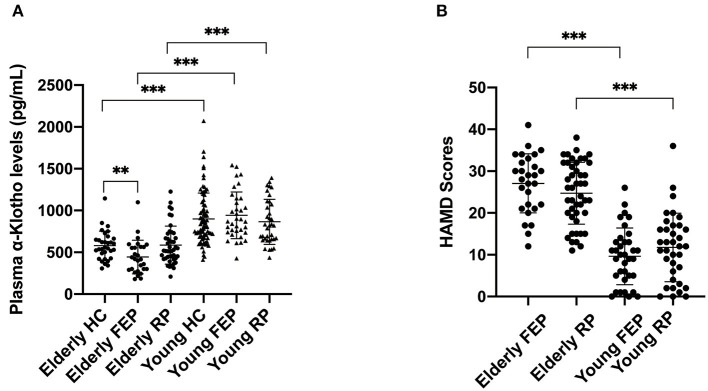
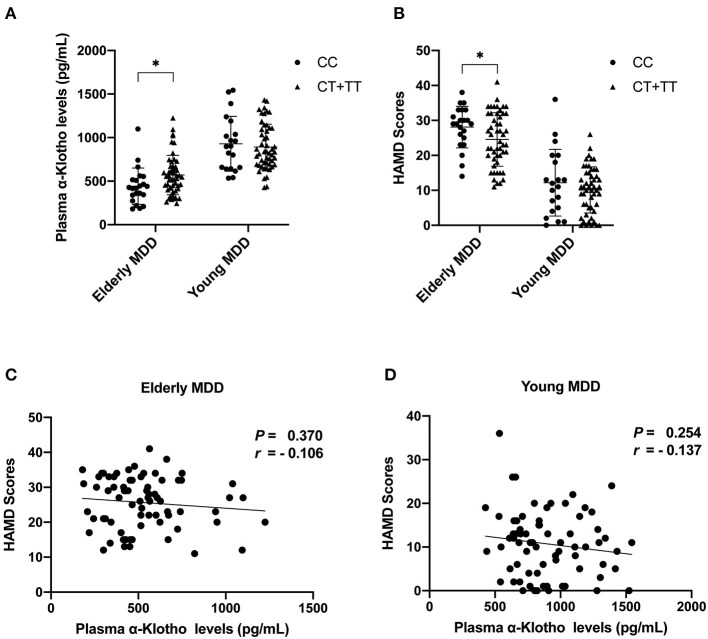
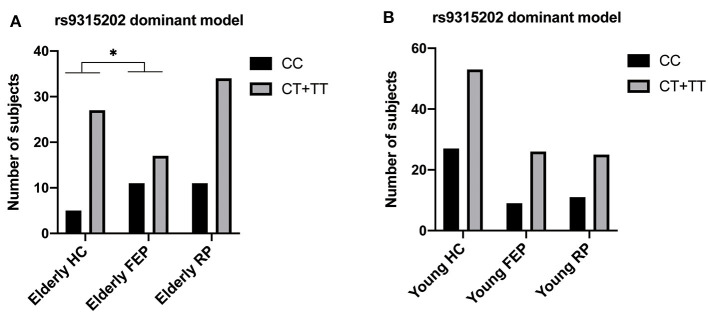
Recent literature suggests that α-Klotho, a widely recognized anti-aging protein, is involved in longevity as well as in many diseases, including Alzheimer's disease, and depression. Although the gene encodes α-Klotho, a single transmembrane protein with intracellular and extracellular domains, the relationship between gene polymorphism and circulating α-Klotho levels in patients with major depressive disorder (MDD) is not clear. A total of 144 MDD patients and 112 age-matched healthy controls were included in this study. The genetic polymorphisms (rs9536314, rs9527025, and rs9315202) and plasma α-Klotho levels were measured by PCR and ELISA, respectively. The severity of depressive symptoms was estimated using the Hamilton Depression Scale (HAMD). We found a significantly lower level of plasma α-Klotho in the MDD patients than in controls. Among them, only elderly MDD patients (first episode) showed significantly lower α-Klotho levels than the age-matched controls, while elderly recurrent and young MDD patients showed no difference in plasma α-Klotho levels from age-matched controls. The young MDD group showed a significantly earlier onset age, higher plasma α-Klotho levels, and lower HAMD scores than those in the elderly MDD group. While the plasma α-Klotho levels were higher in rs9315202 T alleles carrier regardless age or sex, the rs9315202 T allele was negatively correlated with disease severity only in the elderly MDD patients. The results of our study showed that only elderly MDD patients showed a decrease in plasma α-Klotho levels along with an increase in disease severity as well as an association with the number of rs9315202 T alleles, and not young MDD patients compared to age-matched controls. Our data suggest that circulating α-Klotho levels combined with genetic polymorphisms are important in elderly MDD patients, particularly carriers of the gene rs9315202 T allele.
近期文献表明,α-klotho是一种广为人知的抗衰老蛋白,与长寿以及包括阿尔茨海默病和抑郁症在内的多种疾病有关。尽管该基因编码α-klotho,一种具有细胞内和细胞外结构域的单跨膜蛋白,但在重度抑郁症(MDD)患者中,基因多态性与循环α-klotho水平之间的关系尚不清楚。本研究共纳入144例MDD患者和112例年龄匹配的健康对照。分别通过聚合酶链反应(PCR)和酶联免疫吸附测定(ELISA)检测基因多态性(rs9536314、rs9527025和rs9315202)和血浆α-klotho水平。使用汉密尔顿抑郁量表(HAMD)评估抑郁症状的严重程度。我们发现,MDD患者血浆α-klotho水平显著低于对照组。其中,只有老年首发MDD患者的α-klotho水平显著低于年龄匹配的对照组,而老年复发型和年轻MDD患者的血浆α-klotho水平与年龄匹配的对照组无差异。年轻MDD组的发病年龄显著更早,血浆α-klotho水平更高,HAMD评分低于老年MDD组。无论年龄或性别,rs9315202 T等位基因携带者的血浆α-klotho水平较高,但rs9315202 T等位基因仅在老年MDD患者中与疾病严重程度呈负相关。我们的研究结果表明,与年龄匹配的对照组相比,只有老年MDD患者的血浆α-klotho水平降低,疾病严重程度增加,且与rs9315202 T等位基因数量相关,而年轻MDD患者并非如此。我们的数据表明,循环α-klotho水平与基因多态性相结合在老年MDD患者中很重要,尤其是基因rs9315202 T等位基因的携带者。