Chang Xiaozan, Zhang Xiaoxi, Zhang Guanglin
Neurosurgery Department of Stroke Center, Henan Provincial People's Hospital, Zhengzhou, China.
Cerebrovascular Department of Interventional Center, Zhengzhou University People's Hospital, Zhengzhou, China.
Evid Based Complement Alternat Med. 2021 Oct 21;2021:2468052. doi: 10.1155/2021/2468052. eCollection 2021.
To evaluate the value of the Alberta stroke project early CT score (ASPECTS), DRAGON score, SEDAN score, and HAT score in predicting hemorrhagic transformation (HT) after intravenous thrombolysis in patients with acute ischemic stroke (AIS).
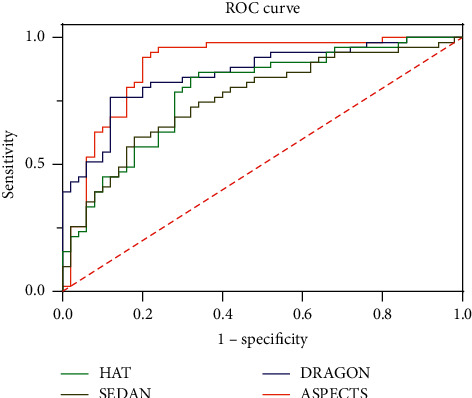
The clinical data of 248 AIS patients treated with intravenous thrombolysis in our hospital from December 2017 to December 2019 were analyzed. According to the prognosis, all patients were divided into the non-HT group ( = 200) and the HT group ( = 48). Univariate analysis and multivariate logistic regression models were used to analyze clinical data to determine the influencing factors of HT after intravenous thrombolysis in AIS patients. The receiver operating characteristic curve was used to evaluate the ASPECTS, DRAGON, SEDAN, and HAT scores to the value of predicting HT after intravenous thrombolysis in AIS patients.
The lower the ASPECTS score and the higher the DRAGON, SEDAN, and HAT scores, the higher the incidence of HT after intravenous thrombolysis in AIS patients ( < 0.05). The results of multivariate logistic regression analysis showed that the patient's age, atrial fibrillation, baseline NIHSS score, early signs of infarction on admission with head CT, time from onset to thrombolytic therapy, and thrombolytic drugs were all independent factors affecting intravenous thrombolysis in AIS patients ( < 0.05). The area under the curve (AUC) of the predictive value of ASPECTS for HT is 0.895 (95% CI 0.813-0.977). When the optimal cutoff value is 0.607, the sensitivity is 100% and the specificity is 60.7%. The AUC of the predictive value of DRAGON for HT is 0.877 (95% CI 0.790-0.964). When the optimal cutoff value is 0.665, the sensitivity is 84.4% and the specificity is 82.1%. The AUC of the predictive value of SEDAN for HT is 0.764 (95% CI 0.638-0.890). When the optimal cutoff value is 0.474, the sensitivity is 78.6% and the specificity is 68.8%. The AUC of the predictive value of HAT for HT is 0.777 (95% CI 0.651-0.903). When the optimal cutoff value is 0.509, the sensitivity is 68.8% and the specificity is 82.1%.
The lower the ASPECTS score and the higher the DRAGON, SEDAN, and HAT scores, the higher the incidence of HT in AIS patients. The patient's age, atrial fibrillation, baseline NIHSS score, early signs of infarction on admission with head CT, time from onset to thrombolytic therapy, and thrombolytic drugs are all independent factors affecting HT in AIS patients. The scores of ASPECTS, DRAGON, SEDAN and HAT have certain value in predicting HT after intravenous thrombolysis in AIS patients, and the predicted value of ASPECTS score is the best.
评估阿尔伯塔卒中项目早期CT评分(ASPECTS)、DRAGON评分、SEDAN评分和HAT评分在预测急性缺血性卒中(AIS)患者静脉溶栓后出血转化(HT)中的价值。
分析2017年12月至2019年12月在我院接受静脉溶栓治疗的248例AIS患者的临床资料。根据预后情况,将所有患者分为非HT组(n = 200)和HT组(n = 48)。采用单因素分析和多因素逻辑回归模型分析临床资料,以确定AIS患者静脉溶栓后HT的影响因素。采用受试者工作特征曲线评估ASPECTS、DRAGON、SEDAN和HAT评分对AIS患者静脉溶栓后HT的预测价值。
AIS患者静脉溶栓后,ASPECTS评分越低,DRAGON、SEDAN和HAT评分越高,HT发生率越高(P < 0.05)。多因素逻辑回归分析结果显示,患者年龄、心房颤动、基线美国国立卫生研究院卒中量表(NIHSS)评分、入院时头部CT梗死早期征象、发病至溶栓治疗时间及溶栓药物均为影响AIS患者静脉溶栓的独立因素(P < 0.05)。ASPECTS对HT预测价值的曲线下面积(AUC)为0.895(95%可信区间0.813 - 0.977)。当最佳截断值为0.607时,灵敏度为100%,特异度为60.7%。DRAGON对HT预测价值的AUC为0.877(95%可信区间0.790 - 0.964)。当最佳截断值为0.665时,灵敏度为84.4%,特异度为82.1%。SEDAN对HT预测价值的AUC为0.764(95%可信区间0.638 - 0.890)。当最佳截断值为0.474时,灵敏度为78.6%,特异度为68.8%。HAT对HT预测价值的AUC为0.777(95%可信区间0.651 - 0.903)。当最佳截断值为0.509时,灵敏度为68.8%,特异度为82.1%。
AIS患者中,ASPECTS评分越低,DRAGON、SEDAN和HAT评分越高,HT发生率越高。患者年龄、心房颤动、基线NIHSS评分、入院时头部CT梗死早期征象、发病至溶栓治疗时间及溶栓药物均为影响AIS患者HT的独立因素。ASPECTS、DRAGON、SEDAN和HAT评分在预测AIS患者静脉溶栓后HT方面具有一定价值,其中ASPECTS评分的预测价值最佳。