Cheng Feon W, Ford Nikki A, Taylor Matthew K
Avocado Nutrition Center, Mission Viejo, CA, United States.
Medical Center Department of Dietetics and Nutrition, University of Kansas, Kansas City, KS, United States.
Front Nutr. 2021 Oct 14;8:746453. doi: 10.3389/fnut.2021.746453. eCollection 2021.
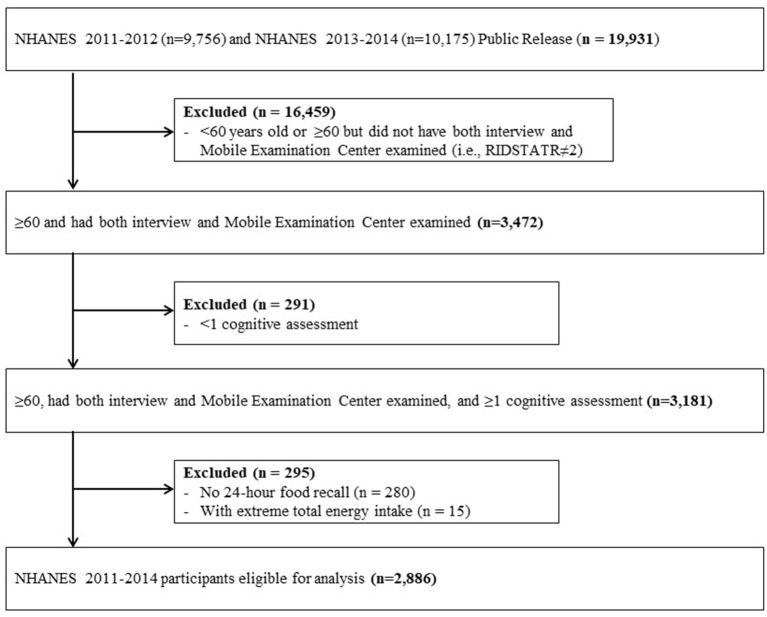
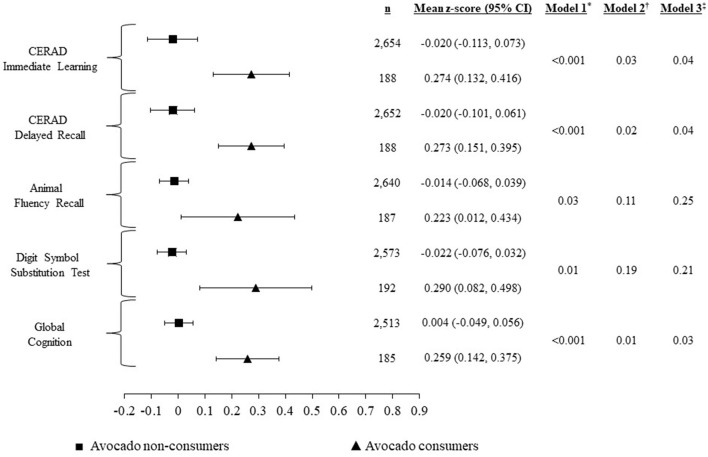
The goal of this study is to examine how avocado relates to cognitive function among older adults. A total of 2,886 National Health and Nutrition Examination Survey 2011-2014 participants aged 60 or older met the eligibility criteria and were included of our cross-sectional study. Participants were binarily classified as avocado consumers (i.e., reported consuming any avocado/guacamole in either 24-h dietary recalls) or non-consumers. Cognitive performance was evaluated with: Consortium to Establish a Registry for Alzheimer's disease (CERAD)-immediate and delayed recall (IWR/DWR), the Animal Fluency test, and the Digit Symbol Substitution Test. We calculated the education-dependent z-scores for each subject because education level can impact cognitive function. Global cognitive score, an average of the z-scores for each cognitive test, was calculated in participants who had completed all four tests. To account for relevant covariates, we tested for mean differences in cognition between consumers and non-consumers using independent sample -tests and ANCOVA, special cases of ordinary least squares regression. Avocado consumers had significantly better cognitive scores across all cognitive tests and the global cognition score ( < 0.05) in the unadjusted model. Some mean differences attenuated after adjusting for potential confounders, but others remained significant. Compared to non-consumers, avocado consumers had significantly higher z-scores of 0.15, 0.15, and 0.11 for CERAD IWR and DWR, and global cognition score, respectively (all < 0.05 in adjusted models). Avocado consumption was associated with significantly better IWR, DWR, and the overall global cognition score, which remained significant when controlling for all relevant confounders.
本研究的目的是探究鳄梨与老年人认知功能之间的关系。共有2886名年龄在60岁及以上、参加了2011 - 2014年国家健康和营养检查调查的参与者符合入选标准,并被纳入我们的横断面研究。参与者被二元分类为鳄梨消费者(即在24小时饮食回忆中报告食用过任何鳄梨/鳄梨酱)或非消费者。认知表现通过以下方式评估:阿尔茨海默病注册联合会(CERAD)即时和延迟回忆(IWR/DWR)、动物流畅性测试以及数字符号替换测试。我们计算了每个受试者的受教育程度相关z分数,因为教育水平会影响认知功能。在完成所有四项测试的参与者中计算了全球认知分数,即每个认知测试z分数的平均值。为了考虑相关协变量,我们使用独立样本t检验和协方差分析(普通最小二乘法回归的特殊情况)来检验消费者和非消费者在认知方面的均值差异。在未调整模型中,鳄梨消费者在所有认知测试和全球认知分数方面的表现均显著更好(P < 0.05)。在调整潜在混杂因素后,一些均值差异有所减弱,但其他差异仍然显著。与非消费者相比,鳄梨消费者在CERAD IWR、DWR和全球认知分数方面的z分数分别显著高出0.15、0.15和0.11(在调整模型中均P < 0.05)。食用鳄梨与显著更好的IWR、DWR以及整体全球认知分数相关,在控制所有相关混杂因素后,这种相关性仍然显著。