Tayebi Mourad, Pinczowski Pedro, Habiba Umma, Khan Rizwan, David Monique A, Summers Brian A
Department of Neuroimmunology, School of Medicine, Western Sydney University, Campbelltown, NSW, Australia.
New South Wales Department of Primary Industries, Elizabeth Macarthur Agricultural Institute, Menangle, NSW, Australia.
Front Vet Sci. 2021 Oct 14;8:736567. doi: 10.3389/fvets.2021.736567. eCollection 2021.
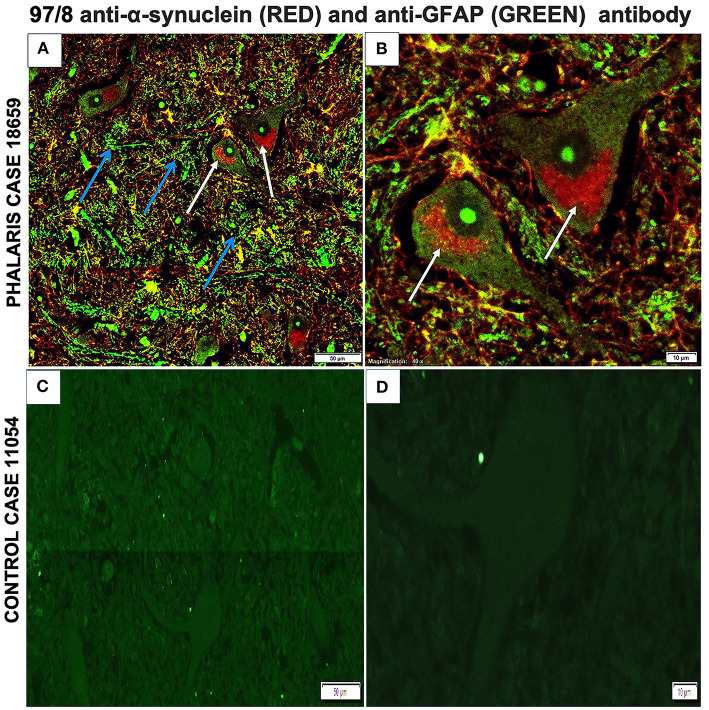
Chronic intoxication with tryptamine-alkaloid-rich species (spp.) pasture plants is known colloquially as staggers syndrome, a widely occurring neurological disorder of sheep, cattle, horses, and kangaroos. Of comparative interest, structurally analogous tryptamine-alkaloids cause experimental parkinsonism in primates. This study aimed to investigate the neuropathological changes associated with spontaneous cases of staggers in sheep with respect to those encountered in human synucleinopathy. In sheep affected with staggers, histological, immunohistochemical, and immunofluorescence analysis revealed significant accumulation of neuromelanin and aggregated α-synuclein in the perikaryon of neurons in the cerebral cortex, thalamus, brainstem, and spinal cord. Neuronal intracytoplasmic Lewy bodies inclusions were not observed in these cases of ovine staggers. These important findings established a clear link between synucleinopathy and the neurologic form of plant poisoning in sheep, demonstrated in six of six affected sheep. Synucleinopathy is a feature of a number of progressive and fatal neurodegenerative disorders of man and may be a common endpoint of such disorders, which in a variety of ways perturb neuronal function. However, whether primary to the degenerative process or a consequence of it awaits clarification in an appropriate model system.
长期摄入富含色胺生物碱的牧草植物而中毒,通俗地称为蹒跚综合征,这是一种在绵羊、牛、马和袋鼠中广泛发生的神经系统疾病。比较有意思的是,结构类似的色胺生物碱会在灵长类动物中引发实验性帕金森病。本研究旨在调查绵羊自发性蹒跚病例的神经病理学变化,并与人类突触核蛋白病中的变化进行比较。在患有蹒跚综合征的绵羊中,组织学、免疫组织化学和免疫荧光分析显示,大脑皮层、丘脑、脑干和脊髓神经元的胞体中神经黑色素和聚集的α-突触核蛋白显著积累。在这些绵羊蹒跚病例中未观察到神经元胞质内路易小体包涵体。这些重要发现明确了突触核蛋白病与绵羊植物中毒神经形式之间的联系,在六只患病绵羊中均得到证实。突触核蛋白病是人类多种进行性和致命性神经退行性疾病的一个特征,可能是这些疾病的共同终点,这些疾病以多种方式干扰神经元功能。然而,它是退化过程的原发性因素还是其结果,还有待在合适的模型系统中加以阐明。