López-Cabrelles Javier, Mañas-Valero Samuel, Vitórica-Yrezábal Iñigo J, Šiškins Makars, Lee Martin, Steeneken Peter G, van der Zant Herre S J, Mínguez Espallargas Guillermo, Coronado Eugenio
Instituto de Ciencia Molecular (ICMol), Universidad de Valencia, c/Catedrático José Beltrán, 2, 46980 Paterna, Spain.
School of Chemistry, University of Manchester, Oxford Road, Manchester M13 9PL, U.K.
J Am Chem Soc. 2021 Nov 10;143(44):18502-18510. doi: 10.1021/jacs.1c07802. Epub 2021 Nov 1.
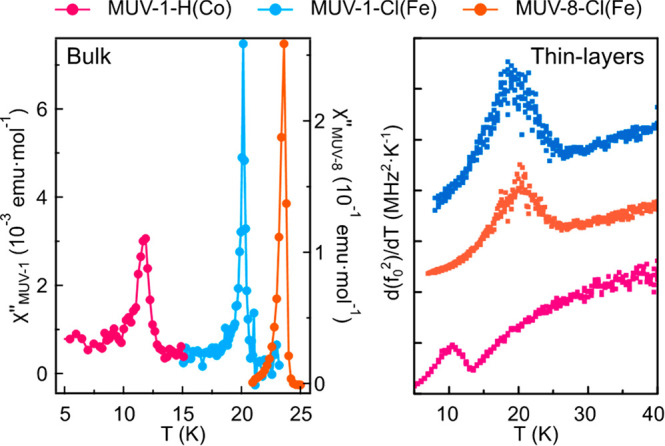
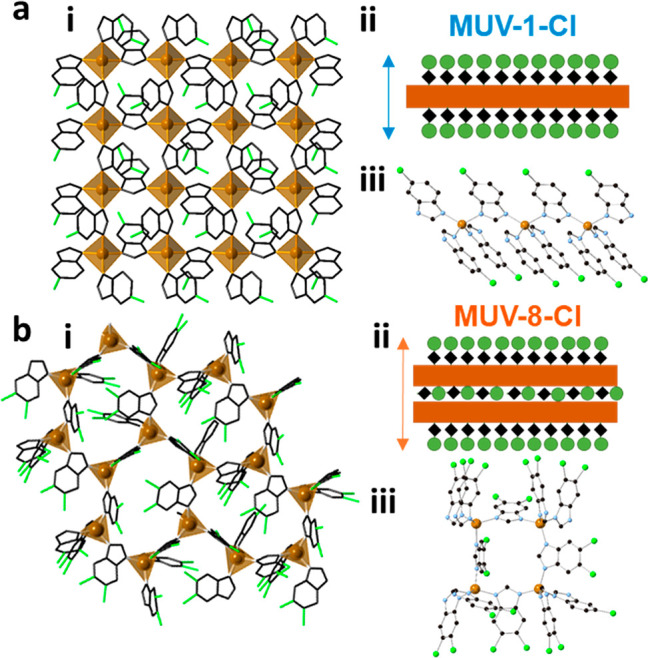
Through rational chemical design, and thanks to the hybrid nature of metal-organic frameworks (MOFs), it is possible to prepare molecule-based 2D magnetic materials stable at ambient conditions. Here, we illustrate the versatility of this approach by changing both the metallic nodes and the ligands in a family of layered MOFs that allows the tuning of their magnetic properties. Specifically, the reaction of benzimidazole-type ligands with different metal centers (M = Fe, Co, Mn, Zn) in a solvent-free synthesis produces a family of crystalline materials, denoted as MUV-1(M), which order antiferromagnetically with critical temperatures that depend on M. Furthermore, the incorporation of additional substituents in the ligand results in a novel system, denoted as MUV-8, formed by covalently bound magnetic double layers interconnected by van der Waals interactions, a topology that is very rare in the field of 2D materials and unprecedented for 2D magnets. These layered materials are robust enough to be mechanically exfoliated down to a few layers with large lateral dimensions. Finally, the robustness and crystallinity of these layered MOFs allow the fabrication of nanomechanical resonators that can be used to detect─through laser interferometry─the magnetic order in thin layers of these 2D molecule-based antiferromagnets.
通过合理的化学设计,得益于金属有机框架(MOF)的混合特性,有可能制备出在环境条件下稳定的基于分子的二维磁性材料。在此,我们通过改变一族层状MOF中的金属节点和配体来说明这种方法的多功能性,这使得它们的磁性得以调节。具体而言,苯并咪唑型配体与不同金属中心(M = Fe、Co、Mn、Zn)在无溶剂合成中的反应产生了一族晶体材料,记为MUV-1(M),它们以反铁磁方式有序排列,其临界温度取决于M。此外,在配体中引入额外的取代基会产生一种新型体系,记为MUV-8,它由通过范德华相互作用相互连接的共价键合磁性双层组成,这种拓扑结构在二维材料领域非常罕见,对于二维磁体来说是前所未有的。这些层状材料足够坚固,可以通过机械剥离得到具有大横向尺寸的几层。最后,这些层状MOF的坚固性和结晶性使得能够制造纳米机械谐振器,可用于通过激光干涉测量法检测这些基于二维分子的反铁磁体薄层中的磁有序。