Department of Radiation Oncology.
Department of Pathology.
Radiat Res. 2021 Nov 1;197(3):0. doi: 10.1667/RADE-21-00166.1.
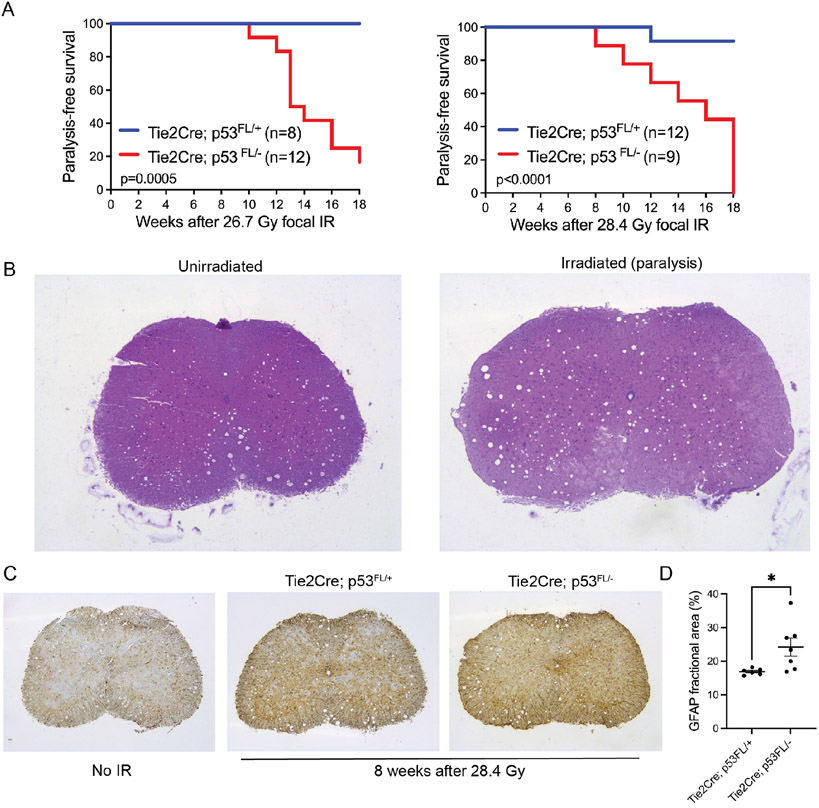
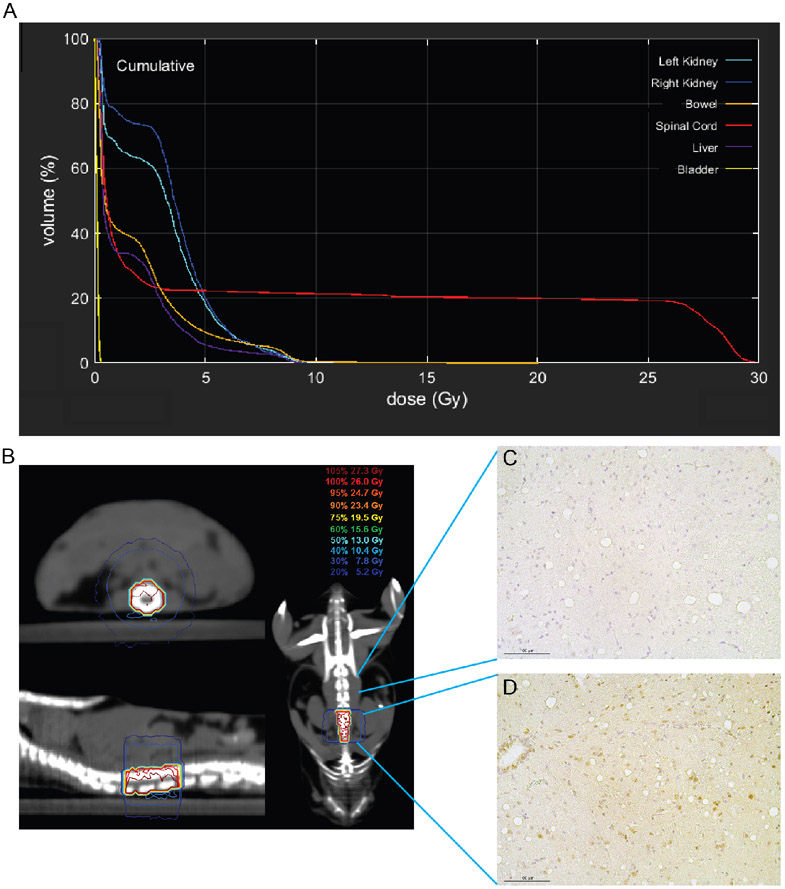
Delayed radiation myelopathy is a rare, but significant late side effect from radiation therapy that can lead to paralysis. The cellular and molecular mechanisms leading to delayed radiation myelopathy are not completely understood but may be a consequence of damage to oligodendrocyte progenitor cells and vascular endothelial cells. Here, we aimed to determine the contribution of endothelial cell damage to the development of radiation-induced spinal cord injury using a genetically defined mouse model in which endothelial cells are sensitized to radiation due to loss of the tumor suppressor p53. Tie2Cre; p53FL/+ and Tie2Cre; p53FL/- mice, which lack one and both alleles of p53 in endothelial cells, respectively, were treated with focal irradiation that specifically targeted the lumbosacral region of the spinal cord. The development of hindlimb paralysis was followed for up to 18 weeks after either a 26.7 Gy or 28.4 Gy dose of radiation. During 18 weeks of follow-up, 83% and 100% of Tie2Cre; p53FL/- mice developed hindlimb paralysis after 26.7 and 28.4 Gy, respectively. In contrast, during this period only 8% of Tie2Cre; p53FL/+ mice exhibited paralysis after 28.4 Gy. In addition, 8 weeks after 28.4 Gy the irradiated spinal cord from Tie2Cre; p53FL/- mice showed a significantly higher fractional area positive for the neurological injury marker glial fibrillary acidic protein (GFAP) compared with the irradiated spinal cord from Tie2Cre; p53FL/+ mice. Together, our findings show that deletion of p53 in endothelial cells sensitizes mice to the development of delayed radiation myelopathy indicating that endothelial cells are a critical cellular target of radiation that regulates myelopathy.
延迟性放射性脊髓病是一种罕见但严重的放射治疗后迟发性副作用,可导致瘫痪。导致延迟性放射性脊髓病的细胞和分子机制尚不完全清楚,但可能是少突胶质前体细胞和血管内皮细胞损伤的结果。在这里,我们旨在使用一种遗传定义的小鼠模型来确定内皮细胞损伤对放射性诱导的脊髓损伤发展的贡献,该模型中由于肿瘤抑制因子 p53 的缺失,内皮细胞对辐射敏感。Tie2Cre;p53FL/+ 和 Tie2Cre;p53FL/- 小鼠分别缺乏内皮细胞中 p53 的一个和两个等位基因,它们的腰骶部脊髓区域接受了特定的局灶性照射。在 26.7 Gy 或 28.4 Gy 剂量的辐射后,最多随访 18 周,观察后肢瘫痪的发展情况。在 18 周的随访期间,26.7 Gy 和 28.4 Gy 后,分别有 83%和 100%的 Tie2Cre;p53FL/- 小鼠发展为后肢瘫痪。相比之下,在此期间,只有 8%的 Tie2Cre;p53FL/+ 小鼠在 28.4 Gy 后出现瘫痪。此外,在 28.4 Gy 后 8 周,与 Tie2Cre;p53FL/+ 小鼠的照射脊髓相比,Tie2Cre;p53FL/- 小鼠的照射脊髓中神经损伤标志物胶质纤维酸性蛋白 (GFAP) 的阳性面积分数明显更高。总之,我们的研究结果表明,内皮细胞中 p53 的缺失使小鼠易发生延迟性放射性脊髓病,表明内皮细胞是调节脊髓病的辐射的关键细胞靶标。