Department of Hematology, Peter MacCallum Cancer Centre, Melbourne, VIC, Australia.
Department of Hematology, St Vincent's Hospital, Fitzroy, VIC, Australia.
Blood Adv. 2022 Feb 22;6(4):1296-1308. doi: 10.1182/bloodadvances.2021005621.
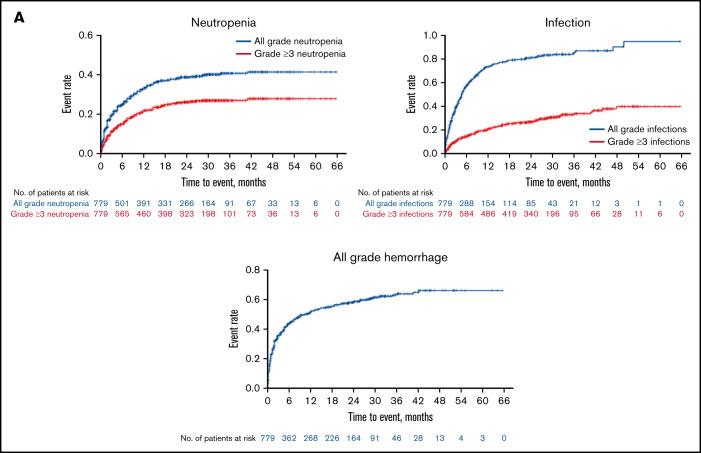
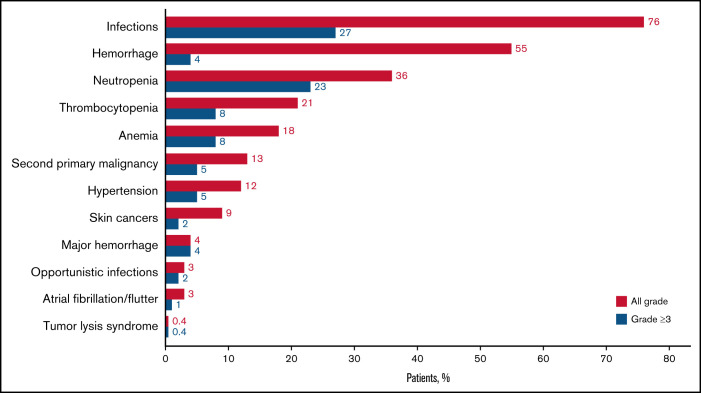
Zanubrutinib is a selective Bruton tyrosine kinase (BTK) inhibitor evaluated in multiple B-cell malignancy studies. We constructed a pooled safety analysis to better understand zanubrutinib-associated treatment-emergent adverse events (TEAEs) and identify treatment-limiting toxicities. Data were pooled from 6 studies (N = 779). Assessments included type, incidence, severity, and outcome of TEAEs. Median age was 65 years; 20% were ≥75 years old. Most patients had Waldenström macroglobulinemia (33%), chronic lymphocytic leukemia/small lymphocytic lymphoma (29%), or mantle-cell lymphoma (19%). Median treatment duration was 26 months (range, 0.1-65); 16% of patients were treated for ≥3 years. Common nonhematologic TEAEs were upper respiratory tract infection (URI, 39%), rash (27%), bruising (25%), musculoskeletal pain (24%), diarrhea (23%), cough (21%), pneumonia (21%), urinary tract infection (UTI), and fatigue (15% each). Most common grade ≥3 TEAEs were pneumonia (11%), hypertension (5%), URI, UTI, sepsis, diarrhea, and musculoskeletal pain (2% each). Atrial fibrillation and major hemorrhage occurred in 3% and 4% of patients, respectively. Atrial fibrillation, hypertension, and diarrhea occurred at lower rates than those reported historically for ibrutinib. Grade ≥3 adverse events included neutropenia (23%), thrombocytopenia (8%), and anemia (8%). Serious TEAEs included pneumonia (11%), sepsis (2%), and pyrexia (2%).Treatment discontinuations and dose reductions for adverse events occurred in 10% and 8% of patients, respectively. Thirty-nine patients (4%) had fatal TEAEs, including pneumonia (n = 9), sepsis (n = 4), unspecified cause (n = 4), and multiple organ dysfunction syndrome (n = 5). This analysis demonstrates that zanubrutinib is generally well tolerated with a safety profile consistent with known BTK inhibitor toxicities; these were manageable and mostly reversible.
赞布替尼是一种选择性布鲁顿酪氨酸激酶(BTK)抑制剂,已在多项 B 细胞恶性肿瘤研究中进行了评估。我们构建了一个汇总安全性分析,以更好地了解赞布替尼相关的治疗后出现的不良事件(TEAEs),并确定治疗相关的毒性。数据来自 6 项研究(N=779)。评估包括 TEAEs 的类型、发生率、严重程度和结局。中位年龄为 65 岁;20%的患者年龄≥75 岁。大多数患者患有华氏巨球蛋白血症(33%)、慢性淋巴细胞白血病/小淋巴细胞淋巴瘤(29%)或套细胞淋巴瘤(19%)。中位治疗持续时间为 26 个月(范围:0.1-65);16%的患者治疗时间≥3 年。常见的非血液学 TEAEs 是上呼吸道感染(URI,39%)、皮疹(27%)、瘀伤(25%)、肌肉骨骼疼痛(24%)、腹泻(23%)、咳嗽(21%)、肺炎(21%)、尿路感染(UTI)和疲劳(各 15%)。最常见的≥3 级 TEAEs 是肺炎(11%)、高血压(5%)、URI、UTI、败血症、腹泻和肌肉骨骼疼痛(各 2%)。心房颤动和大出血分别发生在 3%和 4%的患者中。与历史上ibrutinib 报道的数据相比,心房颤动、高血压和腹泻的发生率较低。≥3 级不良事件包括中性粒细胞减少症(23%)、血小板减少症(8%)和贫血(8%)。严重的 TEAEs 包括肺炎(11%)、败血症(2%)和发热(2%)。因不良事件停药和剂量减少的患者分别占 10%和 8%。39 名患者(4%)发生了致命的 TEAEs,包括肺炎(n=9)、败血症(n=4)、原因不明(n=4)和多器官功能障碍综合征(n=5)。这项分析表明,赞布替尼通常具有良好的耐受性,安全性与已知的 BTK 抑制剂毒性一致;这些毒性是可管理的,且大多是可逆的。