Asadian Sanaz, Farzin Mahta, Tabesh Faezeh, Rezaeian Nahid, Bakhshandeh Hooman, Hosseini Leila, Toloueitabar Yaser, Hemmati Komasi Mohammad Mehdi
Rajaie Cardiovascular Medical and Research Center, Iran University of Medical Sciences, Tehran, Iran.
Iran University of Medical Sciences, Tehran, Iran.
Cardiol Res Pract. 2021 Oct 23;2021:2045493. doi: 10.1155/2021/2045493. eCollection 2021.
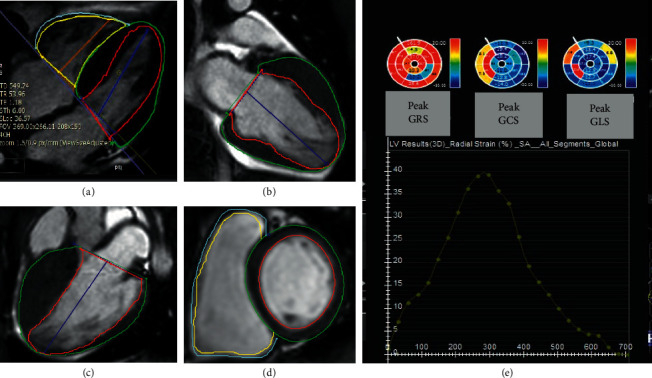
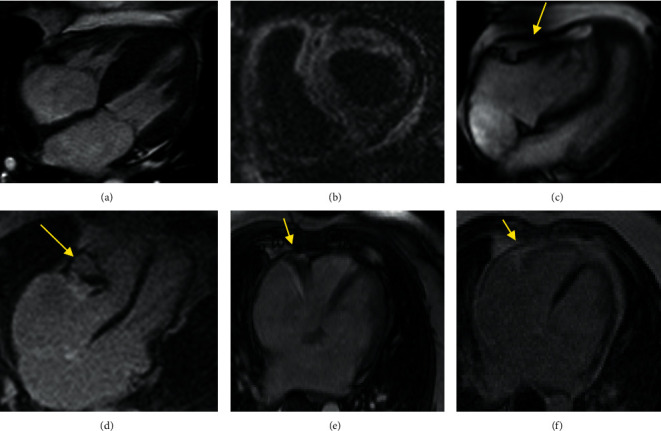
Cardiac amyloidosis (CA) and constrictive pericarditis (CP) are described as the differential diagnoses of restrictive hemodynamic alterations of the heart. We aimed to explain cardiac magnetic resonance (CMR) imaging findings (especially feature tracking (FT)) of CA and CP cases and compare them with healthy controls. Moreover, we evaluated the role of biventricular FT parameters in differentiating CA from CP.
Thirty-eight patients who underwent CMR between February 2016 and January 2018 with the ultimate diagnosis of CA (19 patients) or CP (19 patients) were enrolled. We included biopsy-proven light-chain amyloidosis patients. The data of 28 healthy controls were utilized for comparison. The patients were followed up for 8-23 months to register mortality and their surveillance. All CMR morphological and functional data, including FT parameters, were recorded and analyzed.
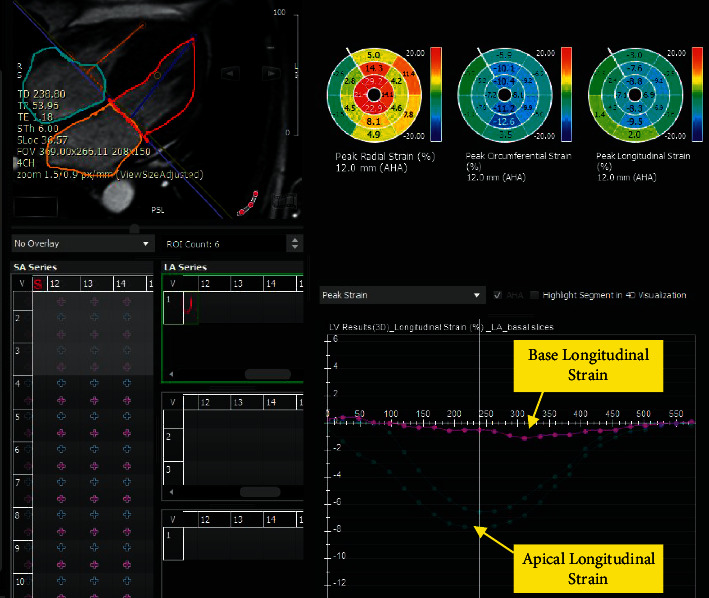
Of only 13/19 (68.4%) CA patients who had the follow-up data, 11/13 (84.6%) died. One of The CP patients (5.3%) expired during the follow-up. Significant between-group differences were noted concerning the biventricular ejection fraction as well as global longitudinal, circumferential, and radial strain values ( < 0.001). The left ventricular (LV) global longitudinal strain (GLS) ≤10% was detected in 13/19 (68.4%) of the CA and 1/19 (5.3%) of CP cases ( < 0.001). A significant difference between the mean value of the LVGLS and LV global circumferential strain (GCS) of the basal LV level compared to the mid and apical levels was observed ( < 0.001) in the CA patients. The differences between the mean LVGLS and the GCS measures of the mid and apical LV levels were not significant (=1 and =0.06, respectively).
In our study, CA and CP severely disrupted ventricular strains. Biventricular GLS was meaningfully lower in the CA subjects. Therefore, strain analysis, especially in the longitudinal direction, could be helpful to differentiate CA from CP.
心脏淀粉样变性(CA)和缩窄性心包炎(CP)被视为心脏限制性血流动力学改变的鉴别诊断。我们旨在解释CA和CP病例的心脏磁共振(CMR)成像结果(尤其是特征追踪(FT)),并将其与健康对照进行比较。此外,我们评估了双心室FT参数在区分CA与CP中的作用。
纳入2016年2月至2018年1月期间接受CMR检查并最终诊断为CA(19例)或CP(19例)的38例患者。我们纳入了经活检证实的轻链淀粉样变性患者。使用28例健康对照的数据进行比较。对患者进行8 - 23个月的随访,记录死亡率并进行监测。记录并分析所有CMR形态学和功能数据,包括FT参数。
在仅13/19(68.4%)有随访数据的CA患者中,11/13(84.6%)死亡。1例CP患者(5.3%)在随访期间死亡。在双心室射血分数以及整体纵向、圆周和径向应变值方面,组间存在显著差异(<0.001)。在13/19(68.4%)的CA病例和1/19(5.3%)的CP病例中检测到左心室(LV)整体纵向应变(GLS)≤10%(<0.001)。在CA患者中,观察到与左心室中部和心尖水平相比,左心室基底水平的左心室GLS平均值与左心室整体圆周应变(GCS)之间存在显著差异(<0.001)。左心室中部和心尖水平的左心室GLS平均值与GCS测量值之间的差异不显著(分别为=1和=0.06)。
在我们的研究中,CA和CP严重破坏了心室应变。CA受试者的双心室GLS明显较低。因此,应变分析,尤其是纵向应变分析,可能有助于区分CA与CP。