Division of Infectious Diseases, Department of Medicine, University of Miami Miller School of Medicine, Miami, FL, USA.
Jackson Memorial Hospital, Jackson Health System, Miami, FL, USA.
Ann Med. 2021 Dec;53(1):1960-1968. doi: 10.1080/07853890.2021.1993326.
Hospitalizations for severe injection-related infections (SIRI), such as endocarditis, osteomyelitis, and skin and soft tissue infections (SSTI) are increasingly common. People who inject drugs (PWID) experiencing SIRIs often receive inadequate substance use disorder (SUD) treatment and lack of access to harm reduction services. This translates into lengthy hospitalizations with high rates of patient-directed discharge, readmissions, and post-hospitalization mortality. The purpose of this study was to describe the development of an integrated "SIRI Team" and its initial barriers and facilitators to success.
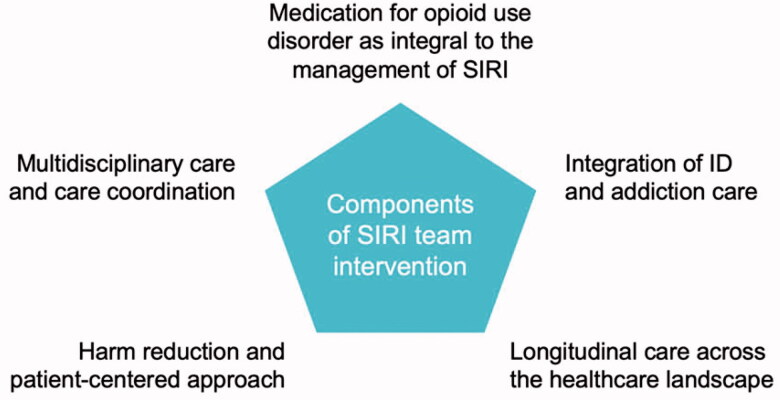
The Jackson SIRI Team was developed to improve both hospital and patient-level outcomes for individuals hospitalized with SIRIs at Jackson Memorial Hospital, a 1550-bed public hospital in Miami, Florida, United States. The SIRI Team provides integrated infectious disease and SUD treatment across the healthcare system starting from the inpatient setting and continuing for 90-days post-hospital discharge. The team uses a harm reduction approach, provides care coordination, focuses on access to medications for opioid use disorder (MOUD), and utilizes a variety of infection and addiction treatment modalities to suit each individual patient.
Over the initial 8-months of the SIRI Team, 21 patients were treated with 20 surviving until discharge. Infections included osteomyelitis, endocarditis, bacteraemia/fungemia, SSTIs, and septic arthritis. All patients had OUD and 95% used stimulants. All patients were discharged on MOUD and 95% completed their prescribed antibiotic course. At 90-days post-discharge, 25% had been readmitted and 70% reported taking MOUD.
A model of integrated infectious disease and SUD care for the treatment of SIRIs has the potential to improve infection and addiction outcomes. Providing attentive, patient-centered care, using a harm reduction approach can facilitate engagement of this marginalized population with the healthcare system.KEY MESSAGESIntegrated infectious disease and addiction treatment is a novel approach to treating severe injection-related infections.Harm reduction should be applied to treating patients with severe injection-related infections with a goal of facilitating antibiotic completion, remission from substance use disorder, and reducing hospital readmissions.
因注射而导致的严重感染(SIRI)住院治疗的案例,如心内膜炎、骨髓炎和皮肤软组织感染(SSTI),正变得越来越常见。因注射药物(PWID)而感染 SIRI 的患者,往往无法获得充分的物质使用障碍(SUD)治疗,也无法获得减少伤害服务。这导致了住院时间延长,患者自行出院率、再入院率和出院后死亡率都很高。本研究旨在描述一个综合的“SIRI 团队”的发展情况,以及其在成功实施过程中面临的障碍和促进因素。
杰克逊 SIRI 团队的建立是为了改善因严重注射相关感染(SIRI)而在佛罗里达州迈阿密杰克逊纪念医院住院的患者的医院和患者层面的治疗效果。该 SIRI 团队在整个医疗体系中提供传染性疾病和物质使用障碍的综合治疗,从住院治疗开始,持续 90 天出院后。该团队采用减少伤害的方法,提供护理协调,注重获得治疗阿片类药物使用障碍(MOUD)的药物,并利用各种感染和成瘾治疗模式来满足每位患者的需求。
在 SIRI 团队成立的最初 8 个月里,有 21 名患者接受了治疗,其中 20 名患者存活至出院。感染包括骨髓炎、心内膜炎、菌血症/真菌感染、SSTI 和化脓性关节炎。所有患者均有物质使用障碍,95%使用兴奋剂。所有患者均出院时开有 MOUD 处方,95%的患者完成了规定的抗生素疗程。在出院后 90 天,有 25%的患者再次入院,70%的患者报告正在使用 MOUD。
针对严重注射相关感染治疗的综合传染性疾病和物质使用障碍护理模式,有改善感染和成瘾治疗效果的潜力。通过采用减少伤害的方法,提供关注患者的、以患者为中心的护理,有助于使这个边缘化的人群与医疗保健系统建立联系。
综合传染性疾病和成瘾治疗是治疗严重注射相关感染的一种新方法。
在治疗严重注射相关感染时,应采用减少伤害的方法,以促进抗生素的完成、物质使用障碍的缓解,并减少医院再入院。