Department of Maternal, Child and Adolescent Health, School of Public Health, Anhui Medical University, No. 81 Meishan Road, Hefei, 230032, Anhui, China.
MOE Key Laboratory of Population Health Across Life Cycle, No. 81 Meishan Road, Hefei, 230032, Anhui, China.
Environ Health Prev Med. 2021 Nov 2;26(1):107. doi: 10.1186/s12199-021-01025-0.
The 2019 novel coronavirus disease (COVID-19) emerges in China, which spreads rapidly and becomes a public health emergency of international concern. Chinese government has promptly taken quarantine measures to block the transmission of the COVID-19, which may cause deleterious consequences on everyone's behaviors and psychological health. Few studies have examined the associations between behavioral and mental health in different endemic areas. This study aimed to describe screen time (ST), physical activity (PA), and depressive symptoms, as well as their associations among Chinese college students according to different epidemic areas.
The study design is cross-sectional using online survey, from 4 to 12 February 2020, 14,789 college students accomplished this online study, participants who did not complete the questionnaire were excluded, and finally this study included 11,787 college students from China.
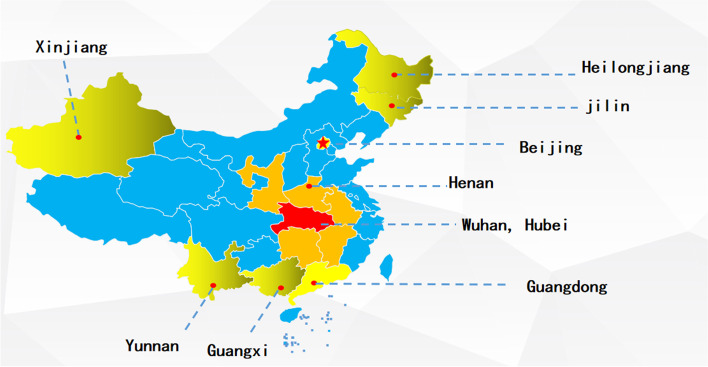
The average age of participants was 20.51 ± 1.88 years. 57.1% of the college students were male. In total, 25.9% of college students reported depression symptoms. ST > 4 h/day was positively correlated with depressive symptoms (β = 0.48, 95%CI 0.37-0.59). COVID-19ST > 1 h/day was positively correlated with depressive symptoms (β = 0.54, 95%CI 0.43-0.65), compared with COVID-19ST ≤ 0.5 h/day. Compared with PA ≥ 3 day/week, PA < 3 day/week was positively associated with depression symptoms (β = 0.01, 95%CI 0.008-0.012). Compared with low ST and high PA, there was an interaction association between high ST and low PA on depression (β = 0.31, 95%CI 0.26-0.36). Compared with low COVID-19ST and high PA, there was an interaction association between high COVID-19ST and low PA on depression (β = 0.37, 95%CI 0.32-0.43). There were also current residence areas differences.
Our findings identified that high ST or low PA was positively associated with depressive symptoms independently, and there was also an interactive effect between ST and PA on depressive symptoms.
2019 年新型冠状病毒病(COVID-19)在中国出现,其传播迅速,成为国际关注的公共卫生紧急事件。中国政府及时采取隔离措施阻断 COVID-19 的传播,这可能对每个人的行为和心理健康造成有害影响。很少有研究检查不同流行地区的行为和心理健康之间的关联。本研究旨在描述屏幕时间(ST)、体力活动(PA)和抑郁症状,以及根据不同流行地区中国大学生之间的关联。
本研究设计为横断面研究,采用在线调查,于 2020 年 2 月 4 日至 12 日进行,共有 14789 名大学生完成了这项在线研究,未完成问卷的参与者被排除在外,最终本研究纳入了来自中国的 11787 名大学生。
参与者的平均年龄为 20.51±1.88 岁。57.1%的大学生为男性。总体而言,25.9%的大学生报告有抑郁症状。ST>4 小时/天与抑郁症状呈正相关(β=0.48,95%CI 0.37-0.59)。与 COVID-19ST≤0.5 小时/天相比,COVID-19ST>1 小时/天与抑郁症状呈正相关(β=0.54,95%CI 0.43-0.65)。与 PA≥3 天/周相比,PA<3 天/周与抑郁症状呈正相关(β=0.01,95%CI 0.008-0.012)。与低 ST 和高 PA 相比,高 ST 和低 PA 之间存在抑郁的交互关联(β=0.31,95%CI 0.26-0.36)。与低 COVID-19ST 和高 PA 相比,高 COVID-19ST 和低 PA 之间存在抑郁的交互关联(β=0.37,95%CI 0.32-0.43)。也存在当前居住地差异。
我们的研究结果表明,高 ST 或低 PA 与抑郁症状呈正相关,ST 和 PA 之间也存在交互作用对抑郁的影响。