Division of Neuro-Oncology, Department of Neurology, Columbia University Vagelos College of Physicians and Surgeons and NewYork-Presbyterian, New York, New York.
Herbert Irving Comprehensive Cancer Center, Columbia University Vagelos College of Physicians and Surgeons and NewYork-Presbyterian, New York, New York.
Clin Cancer Res. 2022 Feb 1;28(3):452-460. doi: 10.1158/1078-0432.CCR-21-2225. Epub 2021 Nov 2.
Selinexor is an oral selective inhibitor of exportin-1 (XPO1) with efficacy in various solid and hematologic tumors. We assessed intratumoral penetration, safety, and efficacy of selinexor monotherapy for recurrent glioblastoma.
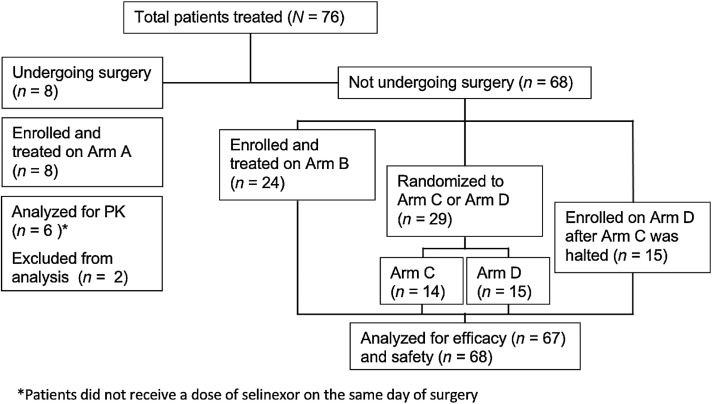
Seventy-six adults with Karnofsky Performance Status ≥ 60 were enrolled. Patients undergoing cytoreductive surgery received up to three selinexor doses (twice weekly) preoperatively (Arm A; = 8 patients). Patients not undergoing surgery received 50 mg/m (Arm B, = 24), or 60 mg (Arm C, = 14) twice weekly, or 80 mg once weekly (Arm D; = 30). Primary endpoint was 6-month progression-free survival rate (PFS6).
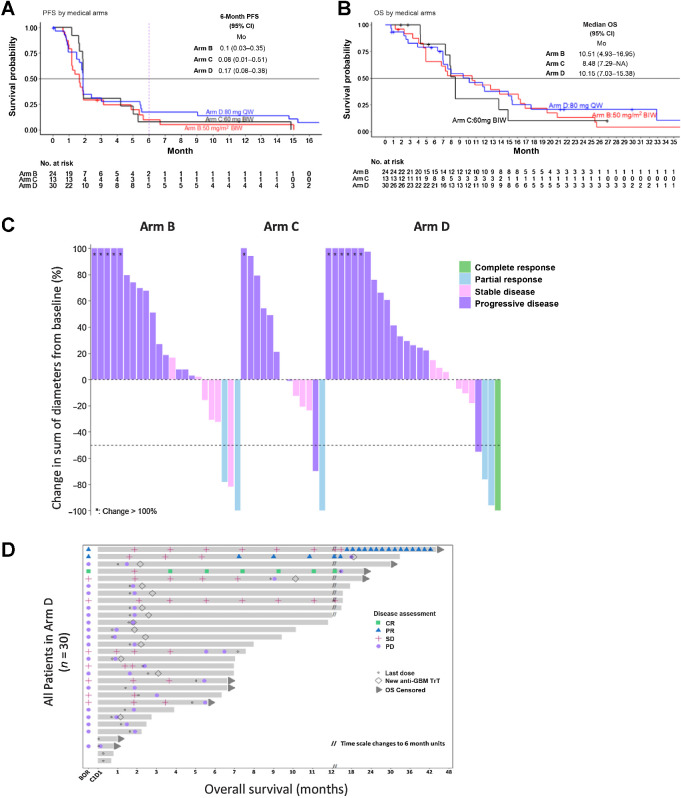
Median selinexor concentrations in resected tumors from patients receiving presurgical selinexor was 105.4 nmol/L (range 39.7-291 nmol/L). In Arms B, C, and D, respectively, the PFS6 was 10% [95% confidence interval (CI), 2.79-35.9], 7.7% (95% CI, 1.17-50.6), and 17% (95% CI, 7.78-38.3). Measurable reduction in tumor size was observed in 19 (28%) and RANO-response rate overall was 8.8% [Arm B, 8.3% (95% CI, 1.0-27.0); C: 7.7% (95% CI, 0.2-36.0); D: 10% (95% CI, 2.1-26.5)], with one complete and two durable partial responses in Arm D. Serious adverse events (AEs) occurred in 26 (34%) patients; 1 (1.3%) was fatal. The most common treatment-related AEs were fatigue (61%), nausea (59%), decreased appetite (43%), and thrombocytopenia (43%), and were manageable by supportive care and dose modification. Molecular studies identified a signature predictive of response (AUC = 0.88).
At 80 mg weekly, single-agent selinexor induced responses and clinically relevant PFS6 with manageable side effects requiring dose reductions. Ongoing trials are evaluating safety and efficacy of selinexor in combination with other therapies for newly diagnosed or recurrent glioblastoma.
Selinexor 是一种口服选择性的 exportin-1(XPO1)抑制剂,在各种实体瘤和血液系统恶性肿瘤中均有疗效。我们评估了 selinexor 单药治疗复发性胶质母细胞瘤的肿瘤内穿透性、安全性和疗效。
76 名 Karnofsky 体能状态评分≥60 的成年人入组。接受细胞减灭术的患者术前接受了多达 3 个 selinexor 剂量(每周 2 次)(A 组,n=8)。未行手术的患者接受 50mg/m(B 组,n=24)、60mg(C 组,n=14)或 80mg 每周一次(D 组,n=30)。主要终点为 6 个月无进展生存期(PFS6)率。
接受术前 selinexor 治疗的患者切除肿瘤中的 selinexor 中位浓度为 105.4nmol/L(范围 39.7-291nmol/L)。在 B、C 和 D 组中,PFS6 分别为 10%(95%CI,2.79-35.9)、7.7%(95%CI,1.17-50.6)和 17%(95%CI,7.78-38.3)。观察到 19 例(28%)肿瘤大小有可测量的缩小,总体 RANO 缓解率为 8.8%(B 组,8.3%(95%CI,1.0-27.0);C 组:7.7%(95%CI,0.2-36.0);D 组:10%(95%CI,2.1-26.5)),D 组有 1 例完全缓解和 2 例持久部分缓解。26 例(34%)患者发生严重不良事件(AE);1 例(1.3%)致死。最常见的治疗相关 AE 是疲劳(61%)、恶心(59%)、食欲下降(43%)和血小板减少(43%),通过支持性治疗和剂量调整可控制。分子研究确定了一个有反应预测价值的特征(AUC=0.88)。
每周 80mg 剂量的 selinexor 诱导了反应,PFS6 有临床意义,且副作用可管理,需要减少剂量。正在进行的试验正在评估 selinexor 联合其他疗法用于新诊断或复发性胶质母细胞瘤的安全性和疗效。