School of Chemical Engineering, College of Engineering and Physical Sciences, University of Birmingham, Edgbaston, Birmingham, B15 2TT, UK.
Centre of Oral, Clinical & Translational Sciences, Faculty of Dentistry, Oral & Craniofacial Sciences, King's College London, Guy's Hospital, London, SE1 9RT, UK.
Sci Rep. 2021 Nov 2;11(1):21449. doi: 10.1038/s41598-021-00341-3.
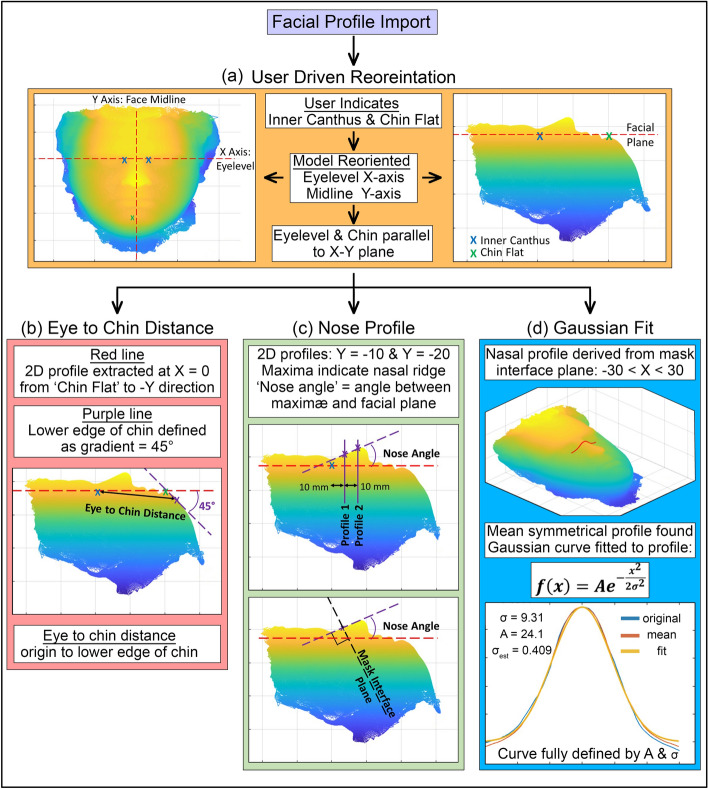
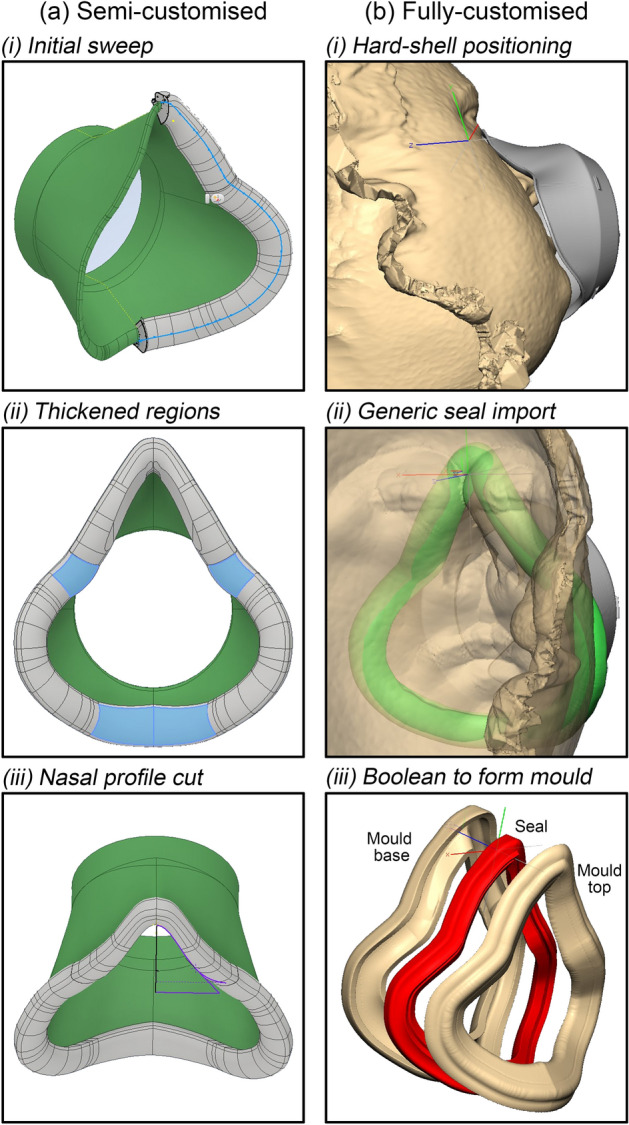
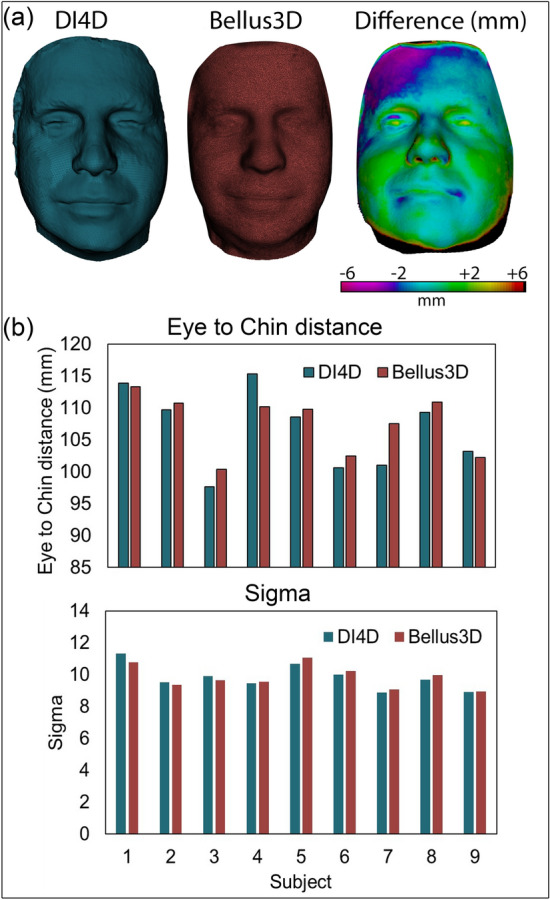
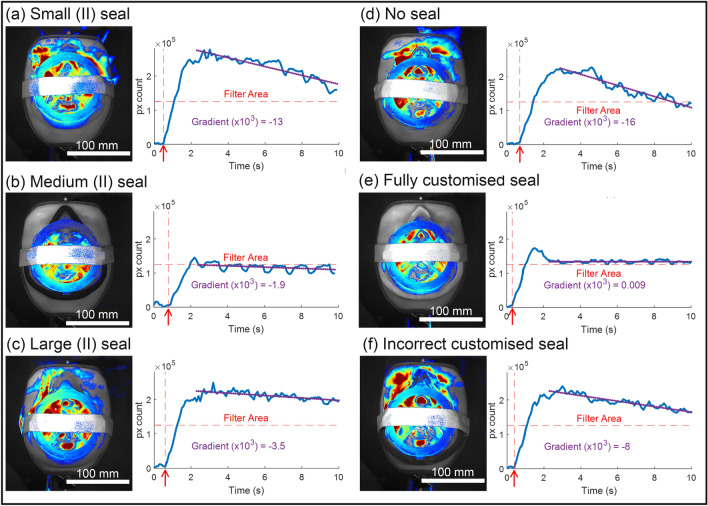
The World Health Organisation has called for a 40% increase in personal protective equipment manufacturing worldwide, recognising that frontline workers need effective protection during the COVID-19 pandemic. Current devices suffer from high fit-failure rates leaving significant proportions of users exposed to risk of viral infection. Driven by non-contact, portable, and widely available 3D scanning technologies, a workflow is presented whereby a user's face is rapidly categorised using relevant facial parameters. Device design is then directed down either a semi-customised or fully-customised route. Semi-customised designs use the extracted eye-to-chin distance to categorise users in to pre-determined size brackets established via a cohort of 200 participants encompassing 87.5% of the cohort. The user's nasal profile is approximated to a Gaussian curve to further refine the selection in to one of three subsets. Flexible silicone provides the facial interface accommodating minor mismatches between true nasal profile and the approximation, maintaining a good seal in this challenging region. Critically, users with outlying facial parameters are flagged for the fully-customised route whereby the silicone interface is mapped to 3D scan data. These two approaches allow for large scale manufacture of a limited number of design variations, currently nine through the semi-customised approach, whilst ensuring effective device fit. Furthermore, labour-intensive fully-customised designs are targeted as those users who will most greatly benefit. By encompassing both approaches, the presented workflow balances manufacturing scale-up feasibility with the diverse range of users to provide well-fitting devices as widely as possible. Novel flow visualisation on a model face is presented alongside qualitative fit-testing of prototype devices to support the workflow methodology.
世界卫生组织呼吁全球个人防护设备制造业增加 40%,认识到在 COVID-19 大流行期间,前线工作人员需要有效的保护。目前的设备存在高适配失败率,导致相当一部分使用者面临病毒感染的风险。受非接触式、便携式和广泛可用的 3D 扫描技术驱动,提出了一种工作流程,使用户的面部能够通过相关面部参数快速分类。然后,设备设计可以沿着半定制或全定制的路线进行。半定制设计使用提取的眼至下巴距离将用户分类到通过包含 200 名参与者的队列建立的预定尺寸组中,该队列涵盖了 87.5%的队列。用户的鼻型近似于高斯曲线,以进一步将选择细化为三个子集之一。柔性硅树脂提供面部接口,适应真实鼻型和近似鼻型之间的微小不匹配,在这个挑战性的区域保持良好的密封。至关重要的是,具有异常面部参数的用户将被标记为全定制路线,其中硅树脂接口映射到 3D 扫描数据。这两种方法允许大规模制造有限数量的设计变体,目前通过半定制方法有九个,同时确保设备的有效适配。此外,劳动密集型的全定制设计被定位为那些将最大受益的用户。通过包含这两种方法,所提出的工作流程在制造规模扩大的可行性与广泛的用户群体之间取得平衡,以尽可能广泛地提供适配良好的设备。模型面部上呈现了新颖的流可视化,并对原型设备进行了定性适配测试,以支持工作流程方法。