Centre for Natural Material Innovation, Department of Architecture, University of Cambridge, Cambridge, United Kingdom.
School of Civil Engineering, University of Queensland, St. Lucia, Australia.
PLoS One. 2021 Feb 8;16(2):e0245737. doi: 10.1371/journal.pone.0245737. eCollection 2021.
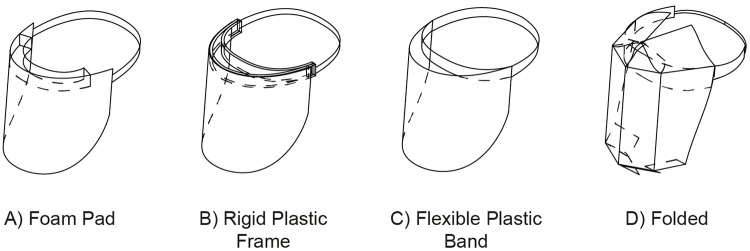
The COVID-19 pandemic has created enormous global demand for personal protective equipment (PPE). Face shields are an important component of PPE for front-line workers in the context of the COVID-19 pandemic, providing protection of the face from splashes and sprays of virus-containing fluids. Existing face shield designs and manufacturing procedures may not allow for production and distribution of face shields in sufficient volume to meet global demand, particularly in Low and Middle-Income countries. This paper presents a simple, fast, and cost-effective curved-crease origami technique for transforming flat sheets of flexible plastic material into face shields for infection control. It is further shown that the design could be produced using a variety of manufacturing methods, ranging from manual techniques to high-volume die-cutting and creasing. This demonstrates the potential for the design to be applied in a variety of contexts depending on available materials, manufacturing capabilities and labour. An easily implemented and flexible physical-digital parametric design methodology for rapidly exploring and refining variations on the design is presented, potentially allowing others to adapt the design to accommodate a wide range of ergonomic and protection requirements.
新冠疫情大流行导致全球对个人防护装备(PPE)的需求巨大。在新冠疫情背景下,面罩是前线工作人员 PPE 的一个重要组成部分,可防止面部被含有病毒的飞沫和喷溅物感染。现有的面罩设计和制造程序可能无法满足全球需求,尤其是在低收入和中等收入国家,大量生产和分发面罩。本文提出了一种简单、快速且具有成本效益的曲面折痕折纸技术,可将柔性塑料薄片转化为用于感染控制的面罩。进一步表明,该设计可以使用各种制造方法来生产,从手动技术到大批量的模切和压痕。这表明该设计具有在各种情况下应用的潜力,具体取决于可用材料、制造能力和劳动力。本文还提出了一种易于实施和灵活的物理数字参数化设计方法,可用于快速探索和改进设计,从而使其他人能够调整设计以适应广泛的人体工程学和保护要求。