Islam Md Rabiul, Quaiyum Sumaiya, Pakhe Sajuti Akter, Repon Md Azim Uddin, Bhuiyan Mohiuddin Ahmed
Department of Pharmacy, University of Asia Pacific, 74/A Green Road, Farmgate, Dhaka 1215, Bangladesh.
Data Brief. 2021 Dec;39:107506. doi: 10.1016/j.dib.2021.107506. Epub 2021 Oct 23.
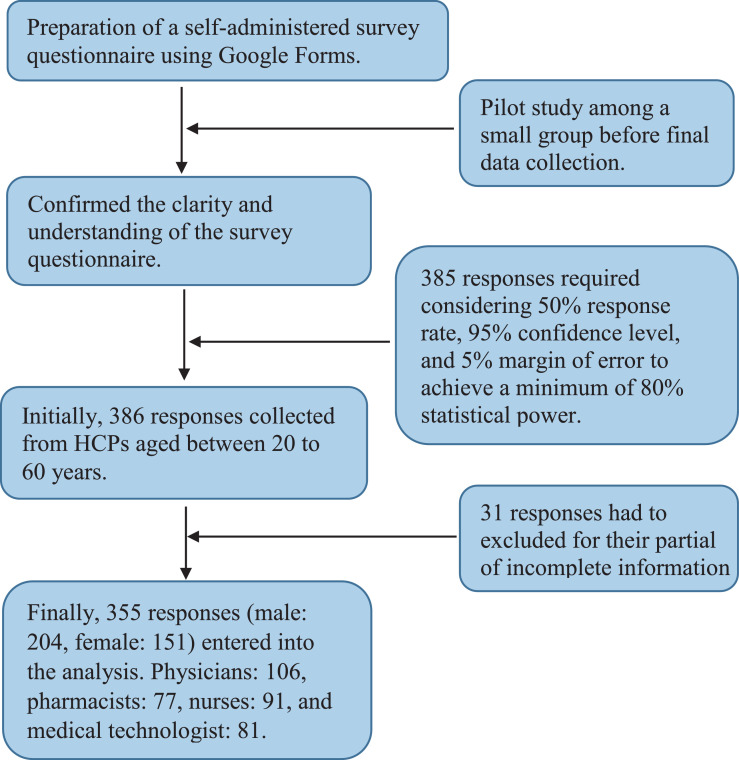
The present dataset is concerned with an article entitled "Effect of COVID-19 pandemic on mental health among Bangladeshi healthcare professionals: A cross-sectional study" [1]. This data article consists of a dataset regarding the mental health of Bangladeshi healthcare professionals (HCPs) during the ongoing COVID-19 pandemic. We collected the data from July 15, 2020, to September 20, 2020, using Google survey tools (Google Forms). A total of 355 complete responses have been obtained from the Bangladeshi HCPs aged between 20-60 years (male: 204, female: 151). We obtained informed consent from all participants for this study. We assessed the sociodemographic profile and four psychometric measures of HCPs working in Bangladesh during the COVID-19 pandemic. A structured questionnaire was used to collect the demographic information. We used the UCLA loneliness scale-8 (UCLA-8), the patient health questionnaire-9 (PHQ-9), the 7-item generalized anxiety disorder scale (GAD-7), and the Pittsburgh sleep quality index (PSQI) were applied to measure loneliness, depression, generalized anxiety, and sleep disturbance, respectively. This dataset presents the descriptive analysis of psychometric variables of participants. Also, the dataset might be used as a platform for future research on psychometric evaluation using the above scales. We included participants regardless of the sociodemographic backgrounds of HCPs. Therefore, the policymakers, government, and non-government organizations can use this data to develop different programs for promoting the mental health of HCPs and the general population in Bangladesh.
本数据集与一篇题为《COVID-19大流行对孟加拉国医护人员心理健康的影响:一项横断面研究》的文章相关[1]。本数据文章包含了关于在当前COVID-19大流行期间孟加拉国医护人员心理健康的数据集。我们于2020年7月15日至2020年9月20日使用谷歌调查工具(谷歌表单)收集了数据。共从20至60岁的孟加拉国医护人员中获得了355份完整回复(男性:204人,女性:151人)。我们获得了所有参与者对本研究的知情同意。我们评估了在COVID-19大流行期间孟加拉国医护人员的社会人口学特征以及四项心理测量指标。使用结构化问卷收集人口统计学信息。我们分别使用加州大学洛杉矶分校孤独量表-8(UCLA-8)、患者健康问卷-9(PHQ-9)、7项广泛性焦虑障碍量表(GAD-7)和匹兹堡睡眠质量指数(PSQI)来测量孤独感、抑郁、广泛性焦虑和睡眠障碍。本数据集呈现了参与者心理测量变量的描述性分析。此外,该数据集可作为未来使用上述量表进行心理测量评估研究的平台。我们纳入了无论社会人口学背景如何的医护人员参与者。因此,政策制定者、政府和非政府组织可以利用这些数据制定不同方案,以促进孟加拉国医护人员和普通民众的心理健康。