
在 DLBCL 中,采用三周一次的 R-CHOP 治疗时利妥昔单抗的暴露-反应:建议使用负荷剂量以改善临床结局。
Rituximab exposure-response in triweekly R-CHOP treatment in DLBCL: A loading dose is recommended to improve clinical outcomes.
机构信息
State Key Laboratory of Oncology in South China, Collaborative Innovation Center for Cancer Medicine, Sun Yat-sen University Cancer Center, Guangzhou, Guangdong, China.
Institute of Clinical Pharmacology, School of Pharmaceutical Sciences, Sun Yat-sen University, Guangzhou, Guangdong, China.
出版信息
Clin Transl Sci. 2022 Mar;15(3):680-690. doi: 10.1111/cts.13186. Epub 2021 Nov 29.
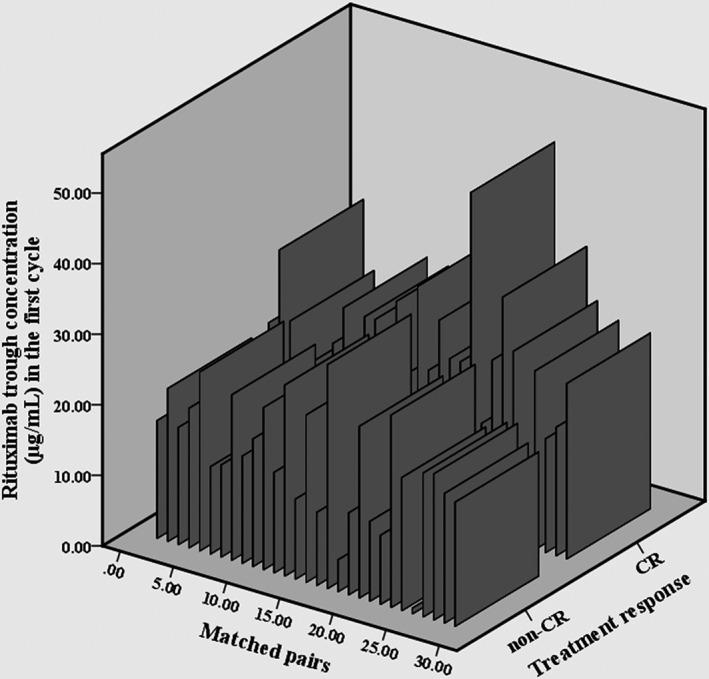
Previous exposure-response analyses for rituximab suggest that higher rituximab concentrations were associated with an improvement in efficacy, however, clinical studies investigating a higher rituximab dose had mixed results. To further explore the exposure-response relationship of rituximab, a prospective observational analysis was performed involving 121 newly diagnosed patients with diffuse large B-cell lymphoma treated with triweekly rituximab plus cyclophosphamide, doxorubicin, vincristine, and prednisone (R-CHOP). The trough concentration in the first cycle (C ) was significantly higher in patients achieving complete response (CR) compared with patients that did not achieve CR (22.00 μg/ml vs. 16.62 μg/ml, p = 0.0016), however, this difference between the two groups disappeared in later cycles. The relationship between rituximab C and achieving a CR was confirmed by matched-pair logistic regression analysis (odds ratio, 0.79; p = 0.0020). In addition, a higher C (≥18.40 μg/ml) was associated with longer progression-free survival (p < 0.0001) and overall survival (p = 0.0038). The percentages of patients that did not achieve a CR and had recurrence after CR within 24 months were 35% and 22.50%, respectively, for patients with a C less than or equal to 18.40 μg/ml, compared with 12.35% and 6.17% for patients with C greater than 18.40 μg/ml. Disease stage was found to be the most significant influencing factor of C , with 51.02% of patients at stage IV with an observed C less than 18.40 μg/ml. For these advanced patients, population pharmacokinetic simulations using an established model suggest that a loading dose of 800 mg/m may help to improve clinical outcomes.
先前针对利妥昔单抗的暴露-反应分析表明,更高的利妥昔单抗浓度与疗效改善相关,然而,研究更高利妥昔单抗剂量的临床研究结果喜忧参半。为了进一步探索利妥昔单抗的暴露-反应关系,进行了一项涉及 121 例新诊断为弥漫性大 B 细胞淋巴瘤患者的前瞻性观察性分析,这些患者接受了每周 3 次利妥昔单抗联合环磷酰胺、多柔比星、长春新碱和泼尼松(R-CHOP)治疗。与未达到完全缓解(CR)的患者相比,达到 CR 的患者在第 1 个周期的谷浓度(C )显著更高(22.00μg/ml 比 16.62μg/ml,p=0.0016),然而,两组之间的这一差异在后续周期中消失。利妥昔单抗 C 与达到 CR 的关系通过匹配对逻辑回归分析得到证实(优势比,0.79;p=0.0020)。此外,更高的 C (≥18.40μg/ml)与无进展生存期(p<0.0001)和总生存期(p=0.0038)更长相关。C 小于或等于 18.40μg/ml 的患者未达到 CR 且在 24 个月内复发的比例分别为 35%和 22.50%,而 C 大于 18.40μg/ml 的患者分别为 12.35%和 6.17%。研究发现疾病分期是 C 的最显著影响因素,4 期患者中有 51.02%的患者观察到 C 小于 18.40μg/ml。对于这些晚期患者,使用已建立模型进行群体药代动力学模拟表明,800mg/m 2 的负荷剂量可能有助于改善临床结局。



 Zotero 插件