MedImmune, Cambridge, UK.
MedImmune, Mountain View, California, USA.
Clin Pharmacol Ther. 2018 Apr;103(4):631-642. doi: 10.1002/cpt.982. Epub 2018 Feb 2.
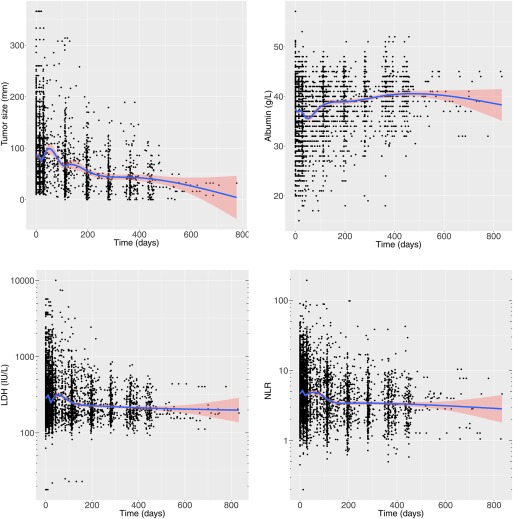
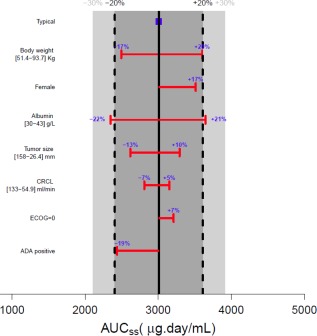
The objectives of this analysis were to develop a population pharmacokinetics (PK) model of durvalumab, an anti-PD-L1 antibody, and quantify the impact of baseline and time-varying patient/disease characteristics on PK. Pooled data from two studies (1,409 patients providing 7,407 PK samples) were analyzed with nonlinear mixed effects modeling. Durvalumab PK was best described by a two-compartment model with both linear and nonlinear clearances. Three candidate models were evaluated: a time-invariant clearance (CL) model, an empirical time-varying CL model, and a semimechanistic time-varying CL model incorporating longitudinal covariates related to disease status (tumor shrinkage and albumin). The data supported a slight decrease in durvalumab clearance with time and suggested that it may be associated with a decrease in nonspecific protein catabolic rate among cancer patients who benefit from therapy. No covariates were clinically relevant, indicating no need for dose adjustment. Simulations indicated similar overall PK exposures following weight-based and flat-dosing regimens.
本分析的目的是建立一种抗 PD-L1 抗体 durvalumab 的群体药代动力学(PK)模型,并定量评估基线和时变患者/疾病特征对 PK 的影响。对来自两项研究(共 1409 例患者,提供 7407 个 PK 样本)的数据进行非线性混合效应模型分析。durvalumab PK 最好通过具有线性和非线性清除率的两室模型来描述。评估了三个候选模型:一个时不变清除率(CL)模型、一个经验时变 CL 模型和一个半机械时变 CL 模型,该模型纳入了与疾病状态相关的纵向协变量(肿瘤缩小和白蛋白)。数据支持 durvalumab 清除率随时间略有下降的结论,并提示其可能与接受治疗的癌症患者非特异性蛋白分解率降低有关。无临床相关的协变量,表明无需调整剂量。模拟表明,基于体重和固定剂量方案的总体 PK 暴露相似。