Seruwagi Gloria, Nakidde Catherine, Otieno Felix, Kayiwa Joshua, Luswata Brian, Lugada Eric, Ochen Eric Awich, Muhangi Denis, Okot Betty, Ddamulira Dunstan, Masaba Andrew, Lawoko Stephen
Centre for Health and Social Economic Improvement (CHASE-i) - Department of Social Work and Social Administration (SWSA), Makerere University, Kampala, Uganda.
Department of Health Policy Planning and Management (HPPM), Makerere University School of Public Health (MakSPH), Kampala, Uganda.
Confl Health. 2021 Nov 3;15(1):79. doi: 10.1186/s13031-021-00415-z.
The negative impact of COVID-19 on population health outcomes raises critical questions on health system preparedness and resilience, especially in resource-limited settings. This study examined healthworker preparedness for COVID-19 management and implementation experiences in Uganda's refugee-hosting districts.
A cross sectional, mixed-method descriptive study in 17 health facilities in 7 districts from 4 major regions. Total sample size was 485 including > 370 health care workers (HCWs). HCW knowledge, attitude and practices (KAP) was assessed by using a pre-validated questionnaire. The quantitative data was processed and analysed using SPSS 26, and statistical significance assumed at p < 0.05 for all statistical tests. Bloom's cutoff of 80% was used to determine threshold for sufficient knowledge level and practices with scores classified as high (80.0-100.0%), average (60.0-79.0%) and low (≤ 59.0%). HCW implementation experiences and key stakeholder opinions were further explored qualitatively using interviews which were audio-recorded, coded and thematically analysed.
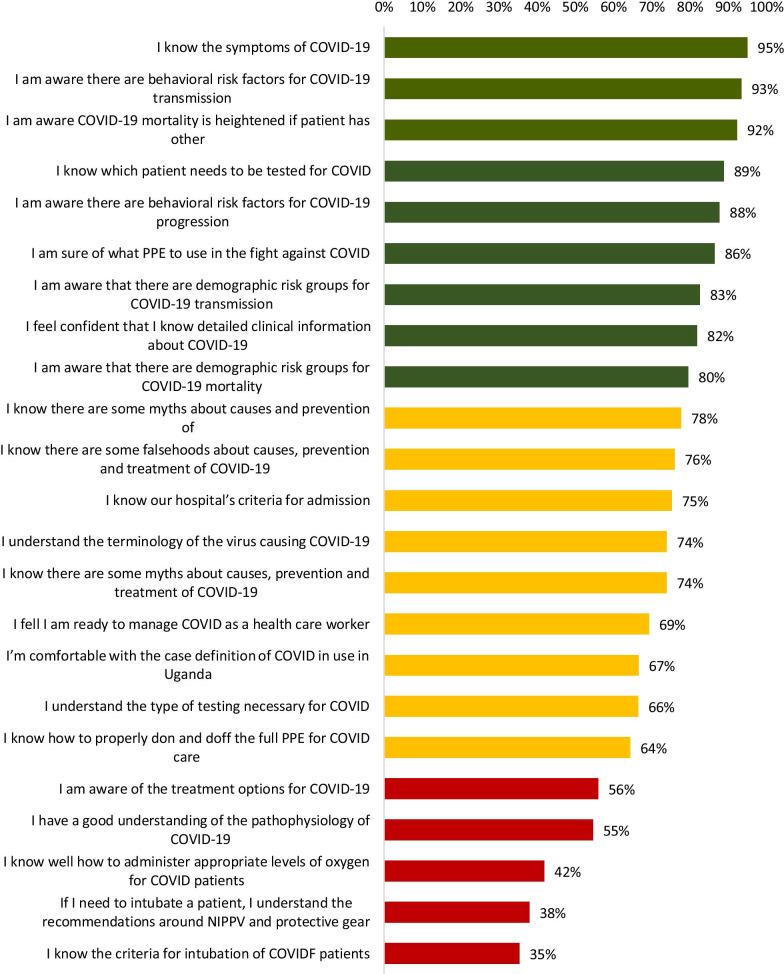
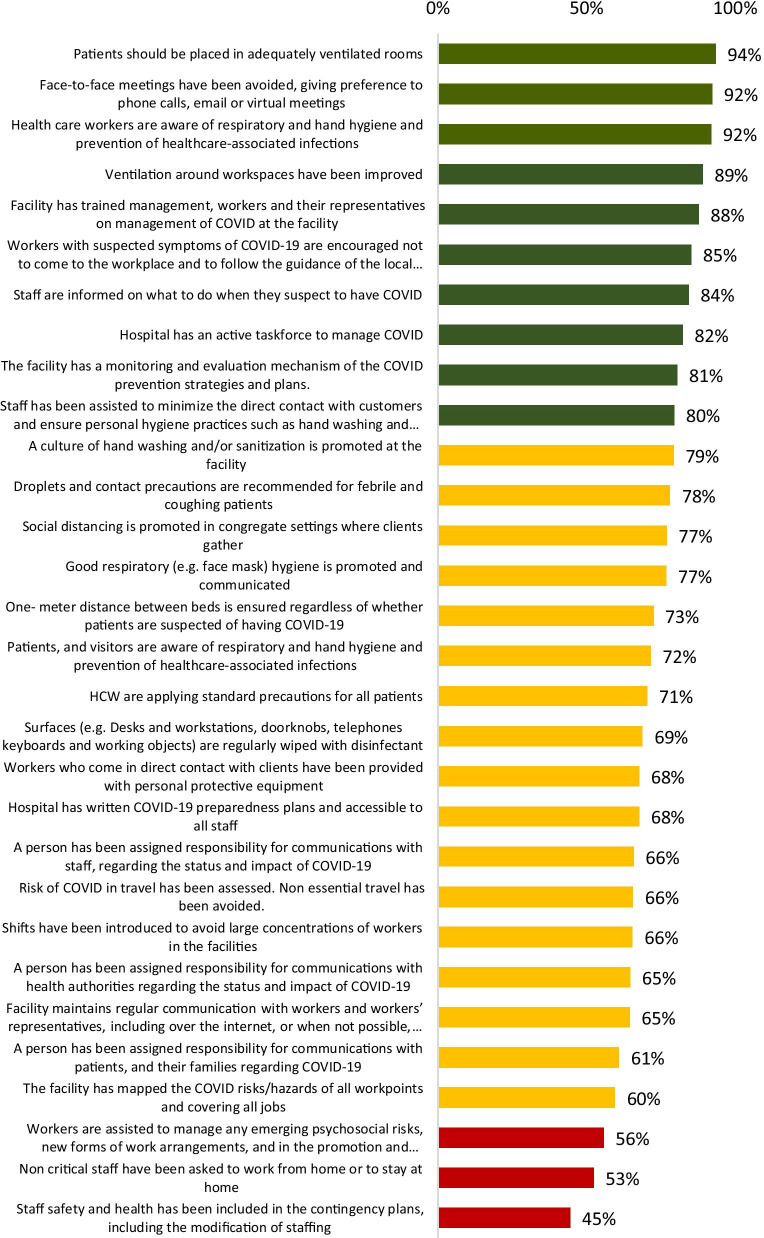
On average 71% of HCWs were knowledgeable on the various aspects of COVID-19, although there is a wide variation in knowledge. Awareness of symptoms ranked highest among 95% (p value < 0.0001) of HCWs while awareness of the criteria for intubation for COVID-19 patients ranked lowest with only 35% (p value < 0.0001). Variations were noted on falsehoods about COVID-19 causes, prevention and treatment across Central (p value < 0.0356) and West Nile (p value < 0.0161) regions. Protective practices include adequate ventilation, virtual meetings and HCW training. Deficient practices were around psychosocial and lifestyle support, remote working and contingency plans for HCW safety. The work environment has immensely changed with increased demands on the amount of work, skills and variation in nature of work. HCWs reported moderate control over their work environment but with a high level of support from supervisors (88%) and colleagues (93%).
HCWs preparedness is inadequate in some aspects. Implementation of healthcare interventions is constrained by the complexity of Uganda's health system design, top-down approach of the national response to COVID-19 and longstanding health system bottlenecks. We recommend continuous information sharing on COVID-19, a design review with capacity strengthening at all health facility levels and investing in community-facing strategies.
新冠病毒病(COVID-19)对人群健康结果产生的负面影响引发了关于卫生系统准备情况和应对能力的关键问题,尤其是在资源有限的环境中。本研究调查了乌干达难民安置地区卫生工作者对COVID-19管理的准备情况及实施经验。
在4个主要地区的7个区的17个卫生机构中开展了一项横断面混合方法描述性研究。总样本量为485人,其中包括370多名医护人员(HCW)。通过使用预先验证的问卷对医护人员的知识、态度和实践(KAP)进行评估。定量数据使用SPSS 26进行处理和分析,所有统计检验的统计学显著性设定为p<0.05。采用布鲁姆80%的临界值来确定足够知识水平和实践的阈值,分数分为高(80.0 - 100.0%)、中(60.0 - 79.0%)和低(≤59.0%)。通过访谈进一步定性探索医护人员的实施经验和关键利益相关者的意见,访谈进行了录音、编码和主题分析。
平均而言,71%的医护人员对COVID-19的各个方面有一定了解,尽管知识水平存在很大差异。95%的医护人员对症状的知晓率最高(p值<0.0001),而对COVID-19患者插管标准的知晓率最低,仅为35%(p值<0.0001)。中部(p值<0.0356)和西尼罗河(p值<0.0161)地区在关于COVID-19病因、预防和治疗的错误观念方面存在差异。防护措施包括充分通风、虚拟会议和医护人员培训。在心理社会和生活方式支持、远程工作以及医护人员安全应急预案方面存在不足。工作环境发生了巨大变化,对工作量、技能和工作性质的多样性要求增加。医护人员报告称对其工作环境有适度控制,但得到上级(88%)和同事(93%)的高度支持。
医护人员在某些方面的准备不足。医疗保健干预措施的实施受到乌干达卫生系统设计的复杂性、国家对COVID-19应对的自上而下方法以及长期存在的卫生系统瓶颈的制约。我们建议持续分享关于COVID-19的信息,对所有卫生机构层面进行能力加强的设计审查,并投资于面向社区的策略。