Pediatrics, University of Helsinki and Helsinki University Hospital, P.O. Box 22, 00014, University of Helsinki, Finland.
Faculty of Medicine, University Diego Portales, Santiago, Chile.
Sci Rep. 2021 Nov 3;11(1):21593. doi: 10.1038/s41598-021-01085-w.
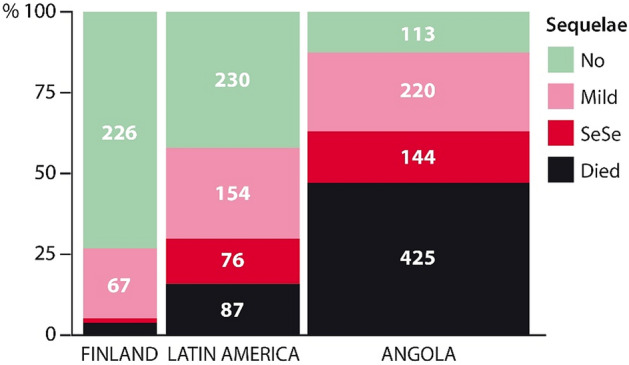
Our objective was to quantify the differences in the outcomes from childhood bacterial meningitis (BM) and to describe the factors associated with them in different parts of the world. This study is a secondary analysis of prospectively collected data from five clinical BM trials conducted in Finland, Latin America (LatAm), and Angola between 1984 and 2017. As all data were collected uniformly, direct comparison of the series was possible. Associations between patient characteristics and death or dismal outcome-the triad of death, severe neurological sequelae, or deafness-were explored. In all, data on 2123 children with BM were analyzed. Etiology was confirmed in 95%, 83%, and 64%, in Finland, LatAm and Angola, respectively. The leading agents were Haemophilus influenzae, Streptococcus pneumoniae, and Neisseria meningitidis. Dismal outcome was the end result for 54%, 31%, and 5% of children in Angola, LatAm, and Finland, respectively. Although underweight, anemia, and tardy arrival worsened prognoses in Angola and LatAm, it was the presenting condition that was central in terms of outcome. In multivariate analysis, the factors independently associated with dismal outcome were the study site (Angola vs. Finland, OR 11.91, 95% CI 5.54-25.63, p < 0.0001 or LatAm vs. Finland, OR 9.46, 95% CI 4.35-20.61, p < 0.0001), Glasgow Coma Score < 13 (OR 4.58, 95% CI 3.31-6.32, p < 0.0001), seizures (OR 1.96, 95% CI 1.43-2.69), age < 1 year (OR 1.55, 95% CI 1.13-2.14, p = 0.007), and pneumococcal etiology (OR 1.49, 95% CI 1.08-2.06, p = 0.015). Greatly dissimilar outcomes from BM reflected the findings on admission on all three continents. Optimizing growth, preventing anemia, and prompt treatment may improve outcomes in resource poor areas.
我们的目标是量化儿童细菌性脑膜炎(BM)结局的差异,并描述世界各地与之相关的因素。本研究是对 1984 年至 2017 年间在芬兰、拉丁美洲(LatAm)和安哥拉进行的五项临床 BM 试验前瞻性收集数据的二次分析。由于所有数据都是统一收集的,因此可以直接比较这些系列。研究人员还探索了患者特征与死亡或不良结局(死亡、严重神经后遗症或耳聋三联征)之间的关联。总共分析了 2123 名患有 BM 的儿童的数据。芬兰、LatAm 和安哥拉分别有 95%、83%和 64%的患儿病因得到了证实。主要病原体分别为流感嗜血杆菌、肺炎链球菌和脑膜炎奈瑟菌。安哥拉、LatAm 和芬兰的儿童不良结局的最终结果分别为 54%、31%和 5%。尽管在安哥拉和 LatAm,体重不足、贫血和延迟到达会使预后恶化,但在安哥拉和 LatAm,影响预后的关键是发病时的情况。多变量分析显示,与不良结局独立相关的因素包括研究地点(安哥拉与芬兰,OR11.91,95%CI5.54-25.63,p<0.0001 或 LatAm 与芬兰,OR9.46,95%CI4.35-20.61,p<0.0001)、格拉斯哥昏迷评分<13(OR4.58,95%CI3.31-6.32,p<0.0001)、癫痫发作(OR1.96,95%CI1.43-2.69)、年龄<1 岁(OR1.55,95%CI1.13-2.14,p=0.007)和肺炎球菌病因(OR1.49,95%CI1.08-2.06,p=0.015)。来自 BM 的截然不同的结果反映了三大洲入院时的发现。优化生长、预防贫血和及时治疗可能会改善资源匮乏地区的结局。