Cheng Shan, Jin Pan, Li Heying, Pei Duanqing, Shu Xiaodong
School of Life Science, Westlake University, Hangzhou, China.
CAS Key Laboratory of Regenerative Biology, Guangdong Provincial Key Laboratory of Stem Cell and Regenerative Medicine, Guangzhou Institutes of Biomedicine and Health, Chinese Academy of Sciences, Guangzhou, China.
Front Pharmacol. 2021 Oct 18;12:740529. doi: 10.3389/fphar.2021.740529. eCollection 2021.
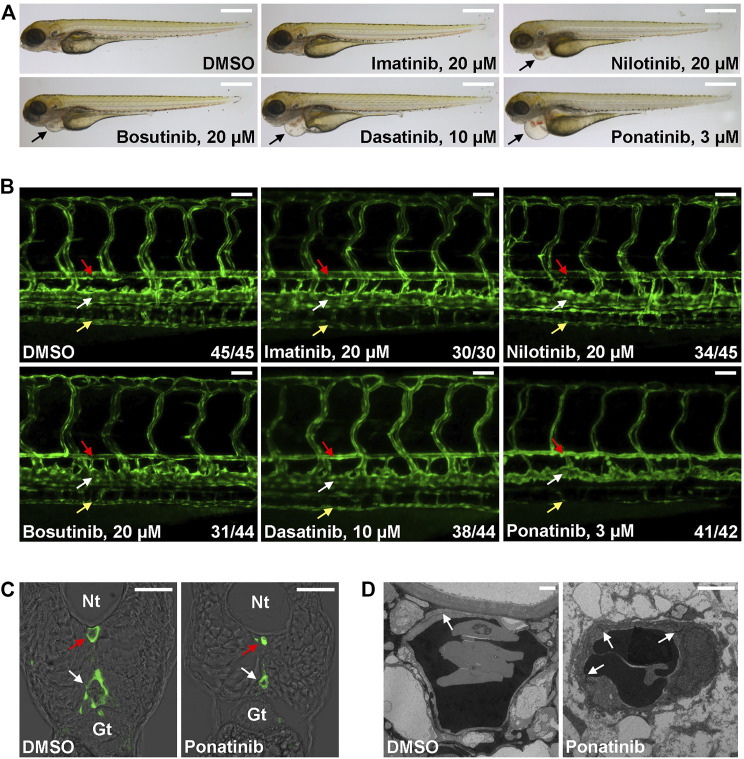
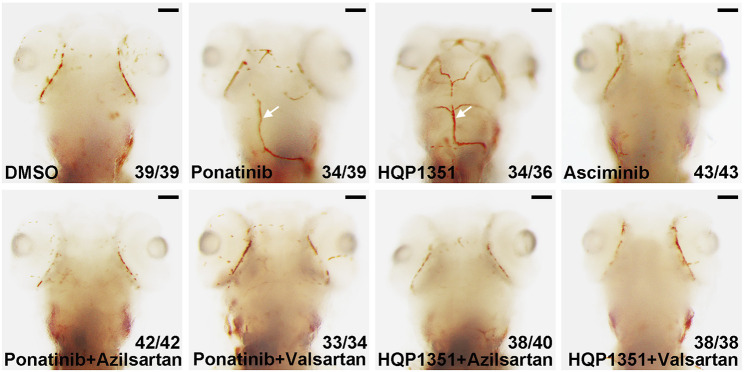
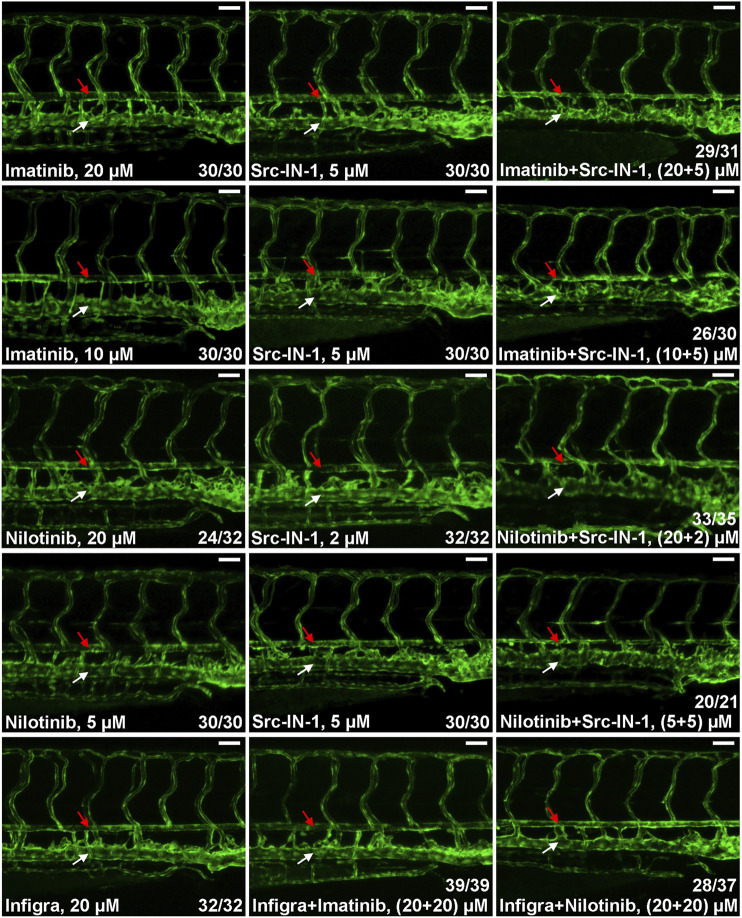
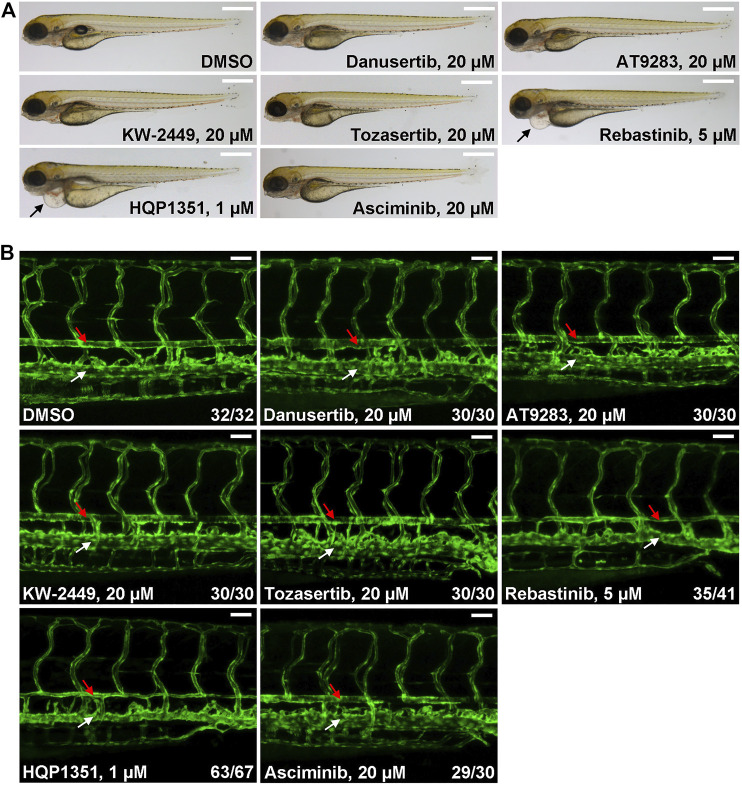
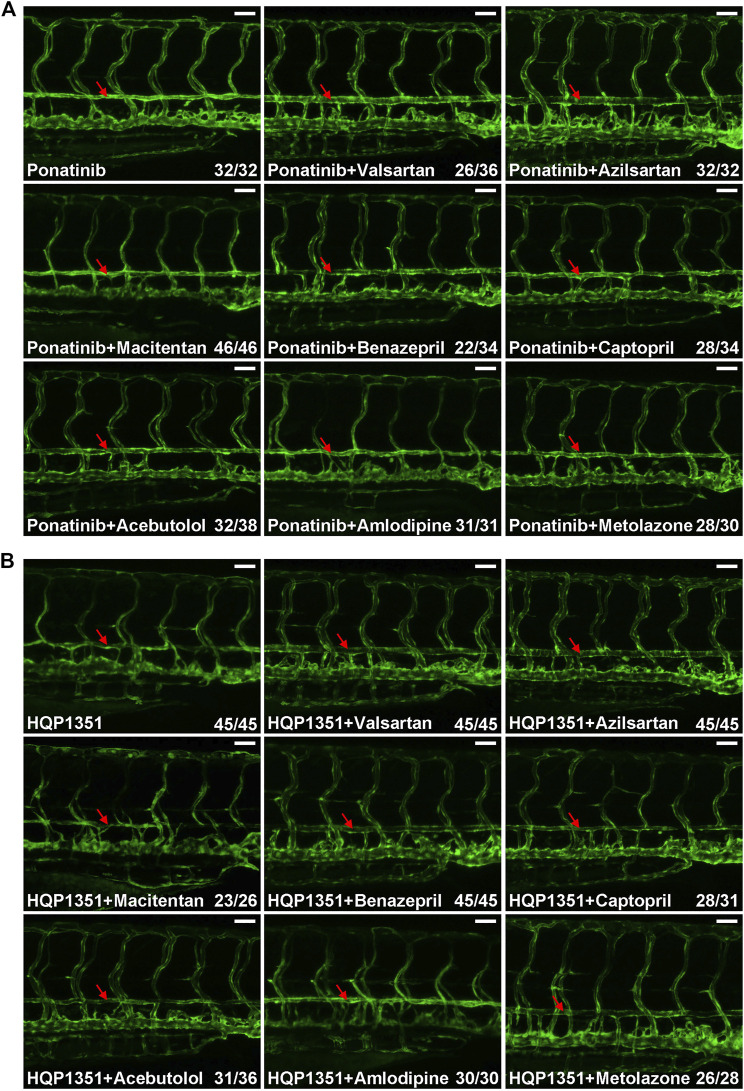
Tyrosine kinase inhibitors (TKIs) to BCR-ABL1 have been successfully used to treat chronic myeloid leukemia (CML), however, multiple TKI-associated adverse events have been reported and become an emerging problem in patients. The mechanisms of TKI-induced toxicity are not fully understood and it remains challenging to predict potential cardiovascular toxicity of a compound. In this study, we established a zebrafish model to evaluate potential cardiovascular toxicity of TKIs. We treated the endothelium labeled transgenic zebrafish embryos with TKIs then performed confocal imaging to evaluate their vascular structure and function. We found that among FDA approved CML TKIs, ponatinib (the only approved TKI that is efficacious to T315I mutation) is the most toxic one. We then evaluated safety profiles of several clinical stage kinase inhibitors that can target T315I and found that HQP1351 treatment leads to vasculopathies similar to those induced by ponatinib while the allosteric ABL inhibitor asciminib does not induce noticeable cardiovascular defects, indicating it could be a promising therapeutic reagent for patients with T315I mutation. We then performed proof-of-principle study to rescue those TKI-induced cardiovascular toxicities and found that, among commonly used anti-hypertensive drugs, angiotensin receptor blockers such as azilsartan and valsartan are able to reduce ponatinib or HQP1351 induced cardiovascular toxicities. Together, this study establishes a zebrafish model that can be useful to evaluate cardiovascular toxicity of TKIs as well as to develop strategies to minimize TKI-induced adverse events.
靶向BCR-ABL1的酪氨酸激酶抑制剂(TKIs)已成功用于治疗慢性粒细胞白血病(CML),然而,多种与TKI相关的不良事件已被报道,并成为患者中一个新出现的问题。TKI诱导毒性的机制尚未完全了解,预测化合物潜在的心血管毒性仍然具有挑战性。在本研究中,我们建立了一个斑马鱼模型来评估TKIs的潜在心血管毒性。我们用TKIs处理内皮标记的转基因斑马鱼胚胎,然后进行共聚焦成像以评估其血管结构和功能。我们发现,在FDA批准的CML TKIs中,波纳替尼(唯一批准的对T315I突变有效的TKI)是毒性最大的一种。然后,我们评估了几种可靶向T315I的临床阶段激酶抑制剂的安全性,发现HQP1351治疗导致的血管病变与波纳替尼诱导的相似,而异构ABL抑制剂阿西替尼不会引起明显的心血管缺陷,这表明它可能是T315I突变患者有前景的治疗试剂。然后,我们进行了原理验证研究以挽救那些TKI诱导的心血管毒性,发现,在常用的抗高血压药物中,阿齐沙坦和缬沙坦等血管紧张素受体阻滞剂能够降低波纳替尼或HQP1351诱导的心血管毒性。总之,本研究建立了一个斑马鱼模型,可用于评估TKIs的心血管毒性以及制定将TKI诱导的不良事件降至最低的策略。