de Meeûs d'Argenteuil Constance, Boshuizen Berit, Vidal Moreno de Vega Carmen, Leybaert Luc, de Maré Lorie, Goethals Klara, De Spiegelaere Ward, Oosterlinck Maarten, Delesalle Cathérine
Department of Translational Physiology, Infectiology and Public Health, Research Group of Comparative Physiology, Faculty of Veterinary Medicine, Research Group of Comparative Physiology, Ghent University, Merelbeke, Belgium.
Wolvega Equine Hospital, Oldeholtpade, Netherlands.
Front Vet Sci. 2021 Oct 18;8:718866. doi: 10.3389/fvets.2021.718866. eCollection 2021.
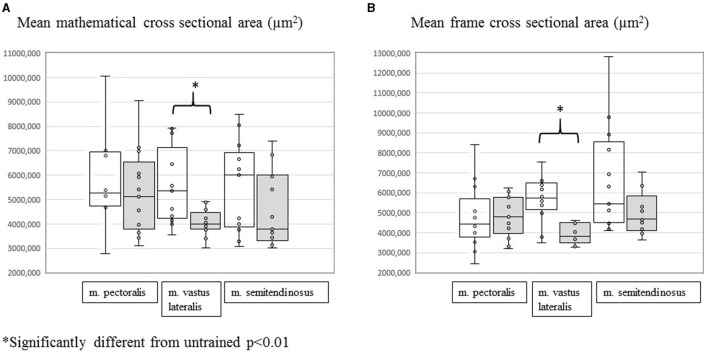
Training-induced follow-up of multiple muscle plasticity parameters in postural stability vs. locomotion muscles provides an integrative physiological view on shifts in the muscular metabolic machinery. It can be expected that not all muscle plasticity parameters show the same expression time profile across muscles. This knowledge is important to underpin results of metabolomic studies. Twelve non-competing Standardbred mares were subjected to standardized harness training. Muscle biopsies were taken on a non-training day before and after 8 weeks. Shifts in muscle fiber type composition and muscle fiber cross-sectional area (CSA) were compared in the m. pectoralis, the m. vastus lateralis, and the m. semitendinosus. In the m. vastus lateralis, which showed most pronounced training-induced plasticity, two additional muscle plasticity parameters (capillarization and mitochondrial density) were assessed. In the m. semitendinosus, additionally the mean minimum Feret's diameter was assessed. There was a significant difference in baseline profiles. The m. semitendinosus contained less type I and more type IIX fibers compatible with the most pronounced anaerobic profile. Though no baseline fiber type-specific and overall mean CSA differences could be detected, there was a clear post-training decrease in fiber type specific CSA, most pronounced for the m. vastus lateralis, and this was accompanied by a clear increase in capillary supply. No shifts in mitochondrial density were detected. The m. semitendinosus showed a decrease in fiber type specific CSA of type IIAX fibers and a decrease of type I fiber Feret's diameter as well as mean minimum Feret's diameter. The training-induced increased capillary supply in conjunction with a significant decrease in muscle fiber CSA suggests that the muscular machinery models itself toward an optimal smaller individual muscle fiber structure to receive and process fuels that can be swiftly delivered by the circulatory system. These results are interesting in view of the recently identified important fuel candidates such as branched-chain amino acids, aromatic amino acids, and gut microbiome-related xenobiotics, which need a rapid gut-muscle gateway to reach these fibers and are less challenging for the mitochondrial system. More research is needed with that respect. Results also show important differences between muscle groups with respect to baseline and training-specific modulation.
对姿势稳定肌与运动肌中多种肌肉可塑性参数进行训练诱导的随访,可为肌肉代谢机制的变化提供综合生理学视角。可以预期,并非所有肌肉可塑性参数在不同肌肉中都呈现相同的表达时间模式。这一知识对于支持代谢组学研究结果很重要。12匹非竞赛型标准bred母马接受了标准化挽具训练。在训练前的非训练日和8周后采集肌肉活检样本。比较了胸肌、股外侧肌和半腱肌的肌纤维类型组成和肌纤维横截面积(CSA)的变化。在股外侧肌中,其显示出最明显的训练诱导可塑性,还评估了另外两个肌肉可塑性参数(毛细血管化和线粒体密度)。在半腱肌中,还评估了平均最小费雷特直径。基线特征存在显著差异。半腱肌中I型纤维较少,IIX型纤维较多,与最明显的无氧特征相符。尽管未检测到基线纤维类型特异性和总体平均CSA差异,但训练后纤维类型特异性CSA明显下降,在股外侧肌中最为明显,同时毛细血管供应明显增加。未检测到线粒体密度的变化。半腱肌中IIAX型纤维的纤维类型特异性CSA下降,I型纤维费雷特直径以及平均最小费雷特直径下降。训练诱导的毛细血管供应增加以及肌肉纤维CSA显著下降表明,肌肉机制将自身塑造为最佳的较小个体肌纤维结构,以接收和处理可由循环系统快速输送的燃料。鉴于最近确定的重要燃料候选物,如支链氨基酸、芳香族氨基酸和与肠道微生物群相关的外源性物质,这些物质需要快速的肠道-肌肉通道才能到达这些纤维,并且对线粒体系统的挑战较小,这些结果很有趣。在这方面还需要更多研究。结果还显示了不同肌肉群在基线和训练特异性调节方面的重要差异。