Shi Yafei, Chen Wei, Zhang Yujun, Bo Mingming, Li Chunyu, Zhang Mingyu, Li Guohui
Department of Pharmacy, National Cancer Center/National Clinical Research Center for Cancer/Cancer Hospital, Chinese Academy of Medical Sciences and Peking Union Medical College, Beijing, China.
Ann Transl Med. 2021 Sep;9(18):1480. doi: 10.21037/atm-21-4178.
Pharmacoeconomic information for pembrolizumab as a second-line lung cancer treatment is insufficient in China, so we aimed to assess its cost-effectiveness versus docetaxel as a second-line treatment for patients with non-small cell lung cancer (NSCLC) in China.
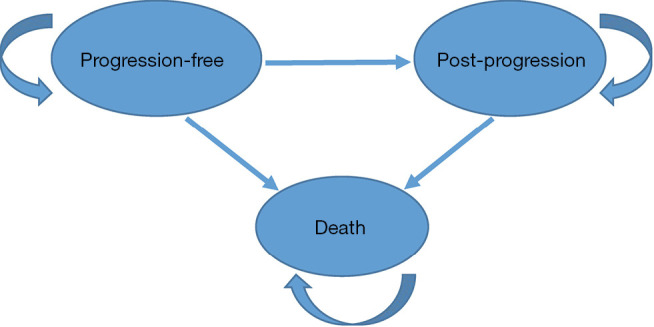
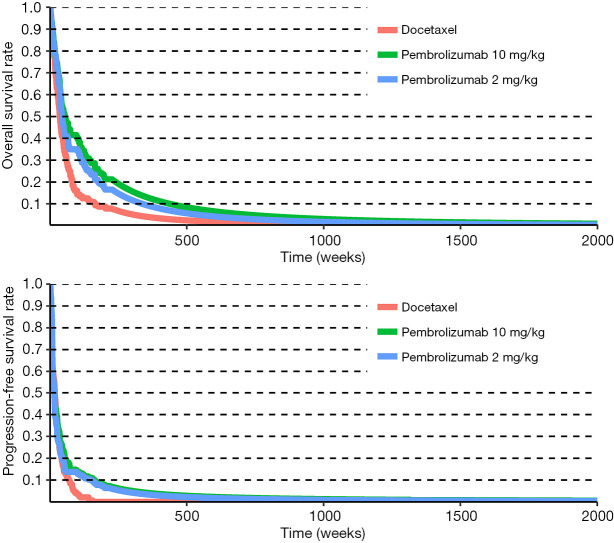
A partitioned survival model was developed to assess the cost-effectiveness of pembrolizumab versus docetaxel in the treatment of NSCLC patients. A phase III clinical trial (KEYNOTE-010) was used as the clinical data. Long-term survival data were extrapolated based on the clinical study data. Lifetime cost and utility were calculated with a discount set at 3%. One-way deterministic sensitivity analyses and probabilistic sensitivity analysis were used to test the robustness of incremental cost-effectiveness ratios (ICER).
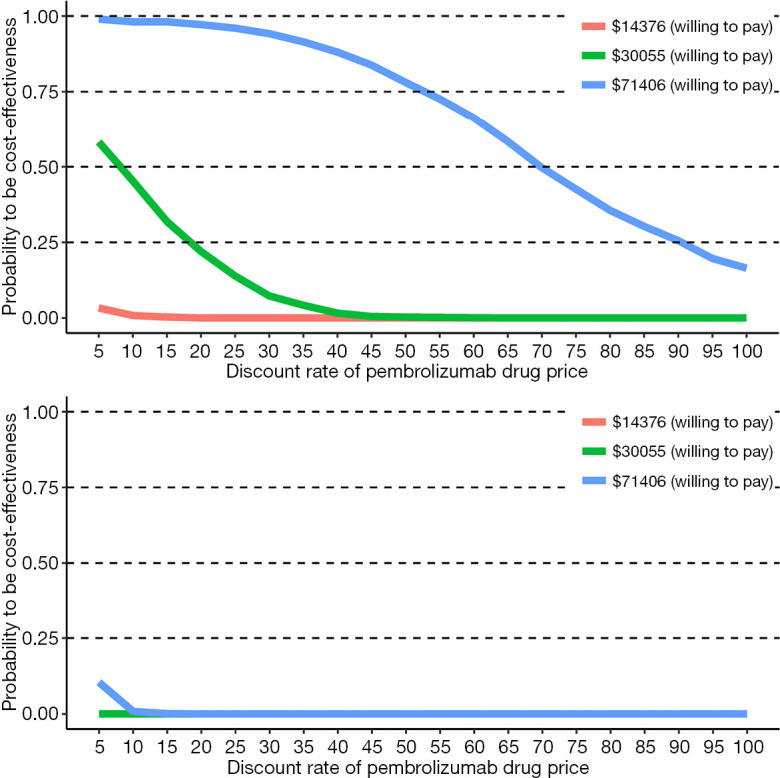
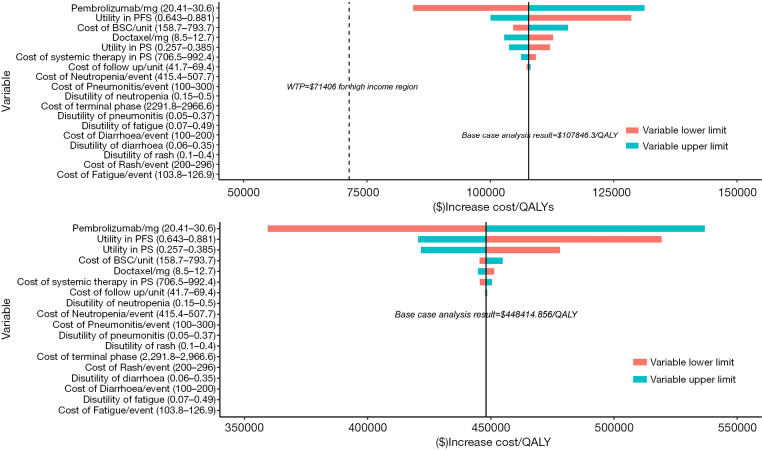
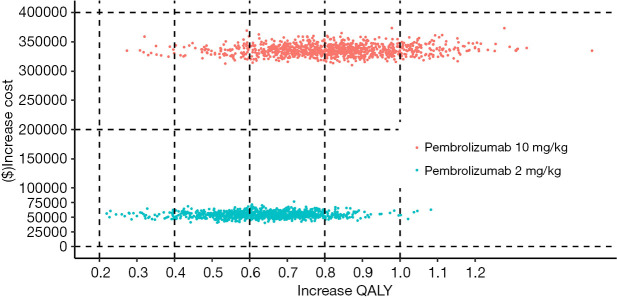
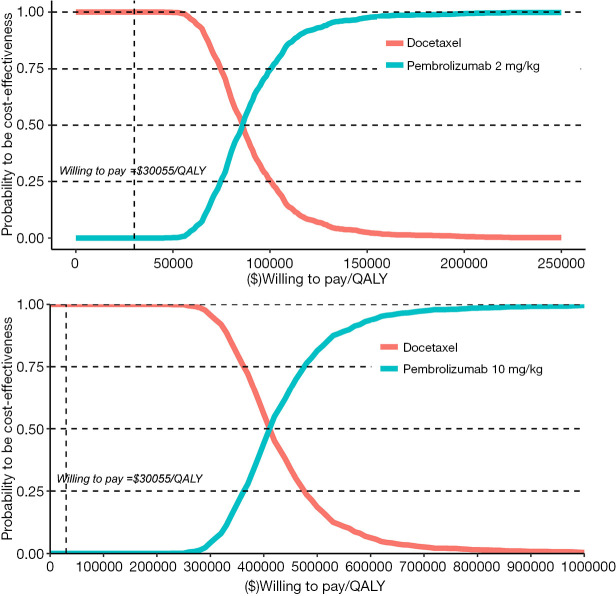
In the base-case scenario, the ICERs were $107,846/quality-adjusted life year (QALY) and $448,414/QALY for pembrolizumab (2 and 10 mg/kg) groups, respectively. Both ICER values were 3-fold higher than the threshold of China's per-capita GDP in 2019 ($30,055.01). One-way deterministic sensitivity analyses showed that the price of pembrolizumab is the main factor affecting the result of ICER. Median ICERs were $108,658/QALY ($107,005/QALY-$110,089/QALY) for the pembrolizumab 2 mg/kg group and $451,590/QALY ($443,685/QALY-$457,496/QALY) for the pembrolizumab 10 mg/kg group using the current price in China. For patients receiving regimens with 2 mg/kg pembrolizumab, the probabilities will be exceeding 95% when the price of pembrolizumab decreases by 25% in a high-income region (willing to pay setting as $71,406/QALY).
The results suggest that for it to become a second-line treatment of NSCLC in China, a reduction in the cost of pembrolizumab is needed.
在中国,帕博利珠单抗作为二线肺癌治疗的药物经济学信息不足,因此我们旨在评估其与多西他赛相比,作为中国非小细胞肺癌(NSCLC)患者二线治疗的成本效益。
建立一个分区生存模型来评估帕博利珠单抗与多西他赛治疗NSCLC患者的成本效益。一项III期临床试验(KEYNOTE-010)用作临床数据。基于临床研究数据外推长期生存数据。以3%的贴现率计算终身成本和效用。采用单向确定性敏感性分析和概率敏感性分析来检验增量成本效益比(ICER)的稳健性。
在基础情景下,帕博利珠单抗(2mg/kg和10mg/kg)组的ICER分别为107,846美元/质量调整生命年(QALY)和448,414美元/QALY。两个ICER值均比2019年中国国内人均生产总值阈值(30,055.01美元)高出3倍。单向确定性敏感性分析表明,帕博利珠单抗的价格是影响ICER结果的主要因素。在中国当前价格下,帕博利珠单抗2mg/kg组的ICER中位数为108,658美元/QALY(107,005美元/QALY - 110,089美元/QALY),帕博利珠单抗10mg/kg组为451,590美元/QALY(443,685美元/QALY - 457,496美元/QALY)。对于接受2mg/kg帕博利珠单抗治疗方案的患者,在高收入地区(支付意愿设定为71,406美元/QALY),当帕博利珠单抗价格降低25%时,概率将超过95%。
结果表明,要使其成为中国NSCLC的二线治疗药物,需要降低帕博利珠单抗的成本。