Science for Life Laboratory, Department of Cell and Molecular Biology, Uppsala University, Uppsala SE-751 24, Sweden.
Molecular Recognition Section, Laboratory of Bioorganic Chemistry, National Institute of Diabetes and Digestive and Kidney Diseases, National Institutes of Health, Bethesda, Maryland 20892, USA.
Chem Commun (Camb). 2021 Nov 19;57(92):12305-12308. doi: 10.1039/d1cc03202j.
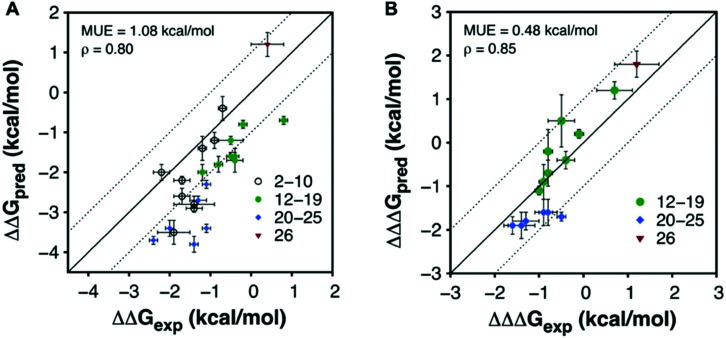
Fragment-based drug discovery relies on successful optimization of weakly binding ligands for affinity and selectivity. Herein, we explored strategies for structure-based evolution of fragments binding to a G protein-coupled receptor. Molecular dynamics simulations combined with rigorous free energy calculations guided synthesis of nanomolar ligands with up to >1000-fold improvements of binding affinity and close to 40-fold subtype selectivity.
基于片段的药物发现依赖于对亲和力和选择性较弱的配体的成功优化。在此,我们探索了基于结构的方法来进化与 G 蛋白偶联受体结合的片段。分子动力学模拟结合严格的自由能计算指导了纳米摩尔配体的合成,使结合亲和力提高了 1000 多倍,亚型选择性接近 40 倍。