Center for Vector Biology and Zoonotic Diseases, Department of Environmental Sciences, The Connecticut Agricultural Experiment Station, P.O. Box 1106. 123 Huntington Street, New Haven, CT 06504, USA.
J Med Entomol. 2022 Jan 12;59(1):1-13. doi: 10.1093/jme/tjab077.
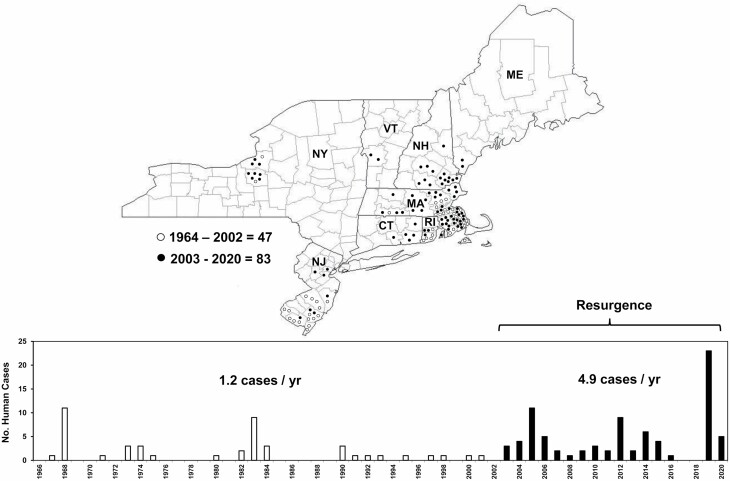
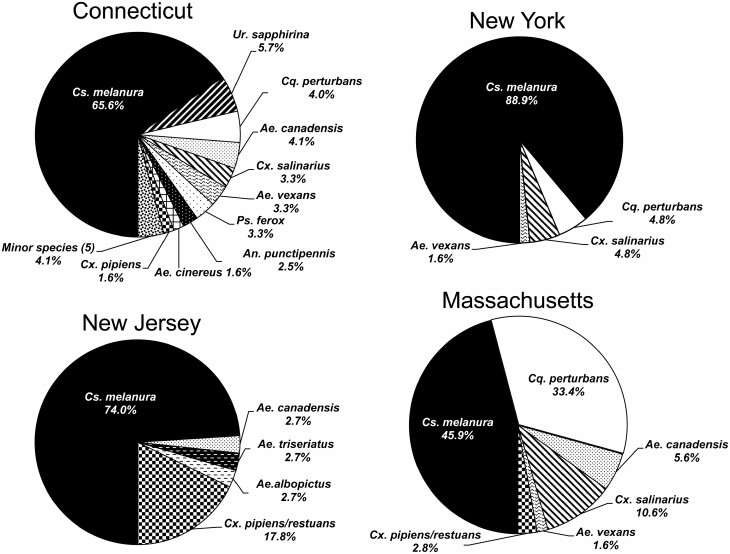
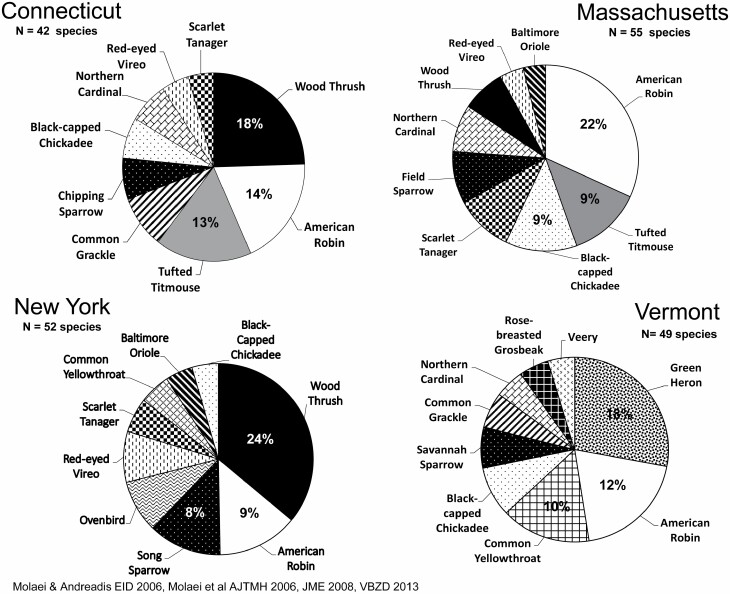
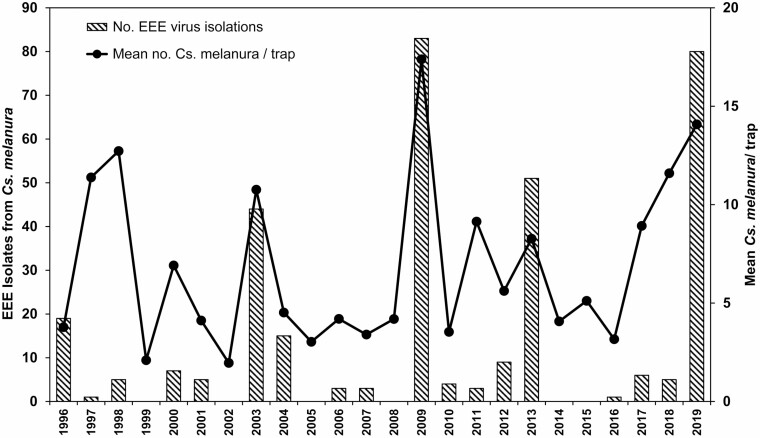
In the current review, we examine the regional history, ecology, and epidemiology of eastern equine encephalitis virus (EEEV) to investigate the major drivers of disease outbreaks in the northeastern United States. EEEV was first recognized as a public health threat during an outbreak in eastern Massachusetts in 1938, but historical evidence for equine epizootics date back to the 1800s. Since then, sporadic disease outbreaks have reoccurred in the Northeast with increasing frequency and northward expansion of human cases during the last 20 yr. Culiseta melanura (Coquillett) (Diptera: Culicidae) serves as the main enzootic vector that drives EEEV transmission among wild birds, but this mosquito species will occasionally feed on mammals. Several species have been implicated as bridge vectors to horses and humans, with Coquilletstidia perturbans (Walker) as a leading suspect based on its opportunistic feeding behavior, vector competence, and high infection rates during recent disease outbreaks. A diversity of bird species are reservoir competent, exposed to EEEV, and serve as hosts for Cs. melanura, with a few species, including the wood thrush (Hlocichia mustelina) and the American robin (Turdus migratorius), contributing disproportionately to virus transmission based on available evidence. The major factors responsible for the sustained resurgence of EEEV are considered and may be linked to regional landscape and climate changes that support higher mosquito densities and more intense virus transmission.
在本次综述中,我们研究了东部马脑炎病毒(EEEV)的区域历史、生态和流行病学,以调查美国东北部疾病爆发的主要驱动因素。EEEV 于 1938 年在马萨诸塞州东部的一次爆发中首次被认为是公共卫生威胁,但马脑炎的历史证据可以追溯到 19 世纪。从那时起,东北部分散的疾病爆发时有发生,而且在过去 20 年中,人类病例的频率和北移都有所增加。库蚊(Culiseta melanura)(双翅目:库蚊科)是驱动野生鸟类之间 EEEV 传播的主要媒介,但这种蚊子偶尔也会以哺乳动物为食。有几种蚊种被认为是向马和人类传播的桥梁媒介,其中 Coquilletstidia perturbans(Walker)是一个主要的嫌疑媒介,因为它具有机会性的摄食行为、媒介能力和在最近的疾病爆发中的高感染率。多种鸟类具有储主能力,接触到 EEEV,并作为 Cs. melanura 的宿主,少数几种鸟类,包括画眉(Hlocichia mustelina)和知更鸟(Turdus migratorius),根据现有证据,在病毒传播方面的贡献不成比例。导致 EEEV 持续复苏的主要因素被认为可能与支持更高的蚊子密度和更强烈的病毒传播的区域景观和气候变化有关。