Environmental Sciences, Center for Vector Biology & Zoonotic Diseases, The Connecticut Agricultural Experiment Station, New Haven, Connecticut, United States of America.
PLoS Negl Trop Dis. 2020 Feb 24;14(2):e0008066. doi: 10.1371/journal.pntd.0008066. eCollection 2020 Feb.
In the northeast United States (U.S.), mosquitoes transmit a number of arboviruses, including eastern equine encephalitis, Jamestown Canyon, and West Nile that pose an annual threat to human and animal health. Local transmission of each arbovirus may be driven by the involvement of multiple mosquito species; however, the specificity of these vector-virus associations has not been fully quantified.
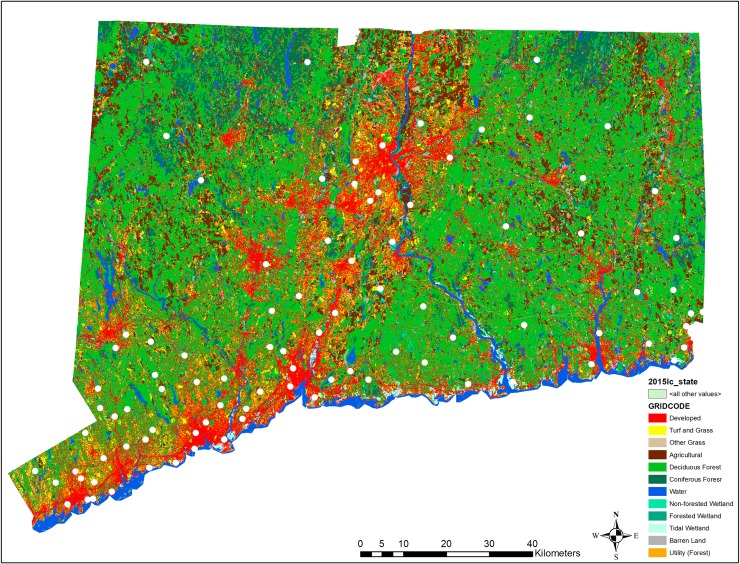
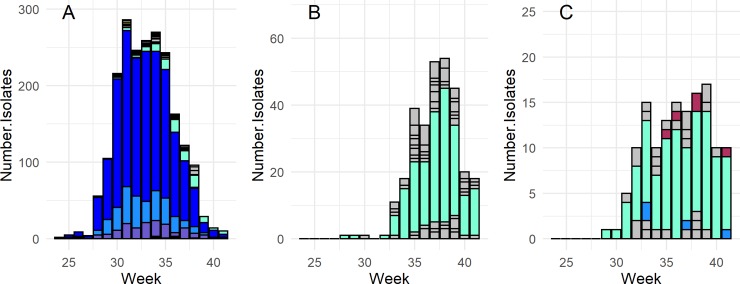
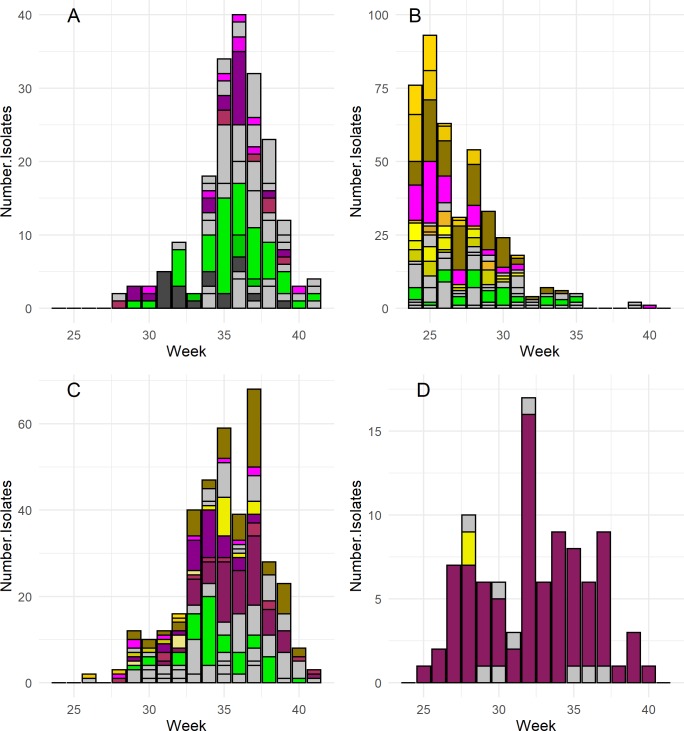
We used long-term surveillance data consistently collected over 18 years to evaluate mosquito and arbovirus community composition in the State of Connecticut (CT) based on land cover classifications and mosquito species-specific natural histories using community ecology approaches available in the R package VEGAN. We then used binomial-error generalized linear mixed effects models to quantify species-specific trends in arbovirus detections.
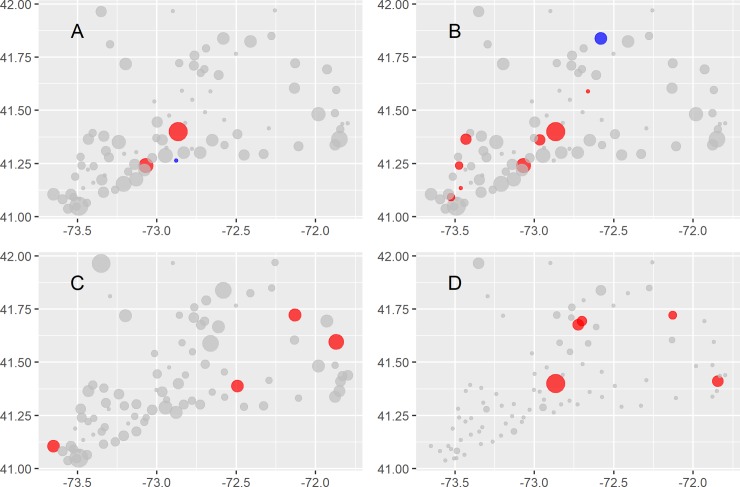
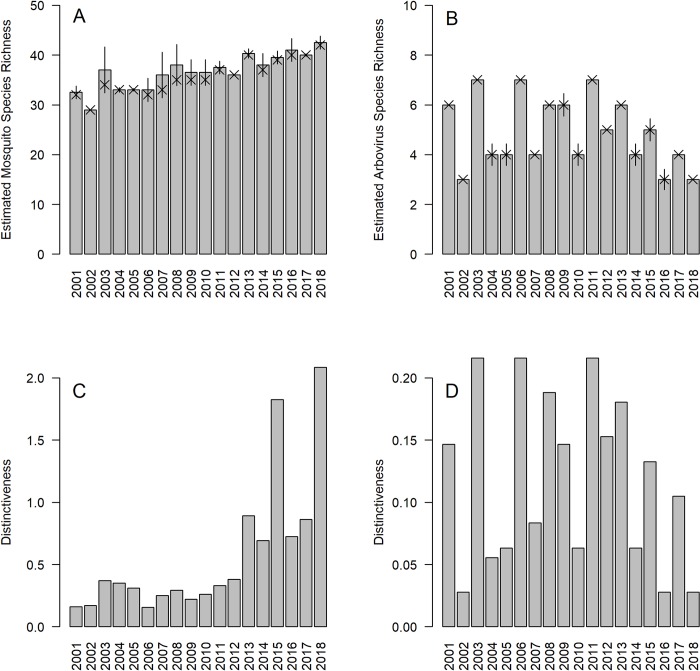
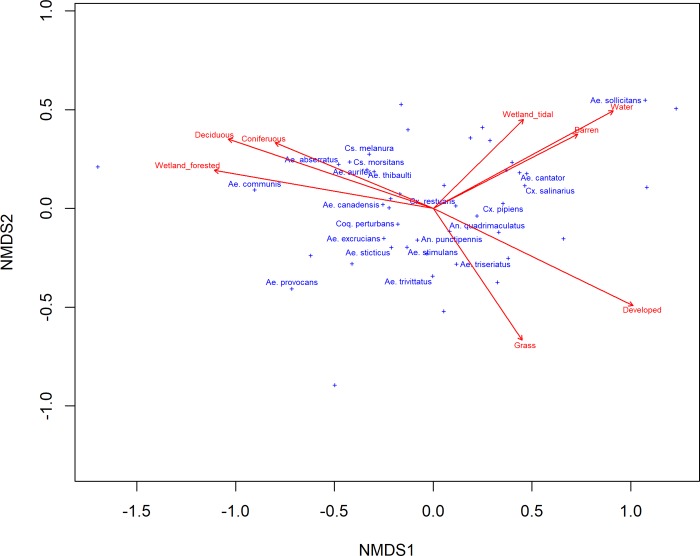
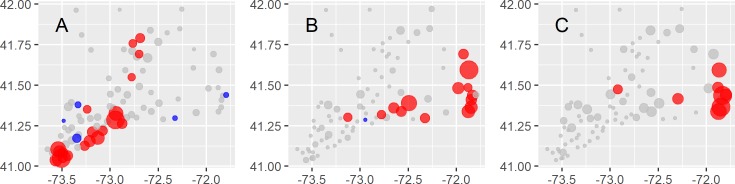
The composition of mosquito communities throughout CT varied more among sites than among years, with variation in mosquito community composition among sites explained mostly by a forested-to-developed-land-cover gradient. Arboviral communities varied equally among sites and years, and only developed and forested wetland land cover classifications were associated with the composition of arbovirus detections among sites. Overall, the avian host arboviruses, mainly West Nile and eastern equine encephalitis, displayed the most specific associations among mosquito species and sites, while in contrast, the mammalian host arboviruses (including Cache Valley, Jamestown Canyon, and Potosi) associated with a more diverse mix of mosquito species and were widely distributed throughout CT.
We find that avian arboviruses act as vector specialists infecting a few key mosquito species that associate with discrete habitats, while mammalian arboviruses are largely vector generalists infecting a wide diversity of mosquito species and habitats in the region. These distinctions have important implications for the design and implementation of mosquito and arbovirus surveillance programs as well as mosquito control efforts.
在美国东北部,蚊子传播多种虫媒病毒,包括东部马脑炎、詹姆斯敦峡谷病毒和西尼罗河病毒,这些病毒每年都会对人类和动物健康构成威胁。每种虫媒病毒的本地传播可能都涉及多种蚊子物种;然而,这些媒介-病毒关联的特异性尚未得到充分量化。
我们使用长期监测数据,这些数据是在过去 18 年中持续收集的,根据土地覆盖分类和使用 R 包 VEGAN 中提供的社区生态学方法的蚊子种特异性自然史,评估康涅狄格州(CT)的蚊子和虫媒病毒群落组成。然后,我们使用二项误差广义线性混合效应模型来量化虫媒病毒检测的种特异性趋势。
CT 各地的蚊子群落组成在不同地点之间的变化大于不同年份之间的变化,蚊子群落组成的变化主要是由森林到开发土地覆盖梯度解释的。虫媒病毒群落在不同地点和年份之间的变化相等,只有开发和森林湿地土地覆盖分类与不同地点之间的虫媒病毒检测组成有关。总体而言,主要是西尼罗河和东部马脑炎等鸟类宿主虫媒病毒,在蚊子种和地点之间表现出最特异的关联,而相反,哺乳动物宿主虫媒病毒(包括 Cache Valley、詹姆斯敦峡谷和 Potosi)与更多不同的蚊子种组合相关联,并且广泛分布于 CT 各地。
我们发现,鸟类虫媒病毒作为媒介专化种,感染少数与特定栖息地相关的关键蚊子种,而哺乳动物虫媒病毒则是媒介泛化种,感染该地区多种蚊子种和栖息地。这些区别对蚊子和虫媒病毒监测计划以及蚊子控制工作的设计和实施具有重要意义。